 |
|
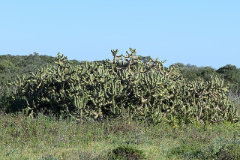
Krzysztof Ziarnek, Kenraiz. Creative Commons Attribution-Share Alike 4.0 |
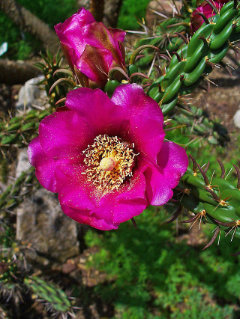 |
| H. Zell. Creative Commons Attribution-Share Alike 3.0 |
Translate this page:
Summary
Tree cholla is one of the most cold-tolerant and widely distributed chollas of the Chihuahuan Desert region. Its woody trunk and branching structure give it a small-tree appearance, making it both a striking landscape plant and an important ecological species. The fruits are edible, though texturally unappealing, while the seeds—despite their excellent flavor—lack reliable safety documentation and therefore should be approached cautiously. Like many chollas, this species represents a survival food rather than a preferred staple, yet it demonstrates how desert plants convert scarce moisture into usable calories.
Physical Characteristics

 Cylindropuntia imbricata is an evergreen Tree growing to 2 m (6ft) by 2 m (6ft) at a medium rate.
See above for USDA hardiness. It is hardy to UK zone 6. The flowers are pollinated by Bees, Insects.
It is noted for attracting wildlife.
Suitable for: light (sandy) and medium (loamy) soils, prefers well-drained soil and can grow in nutritionally poor soil. Suitable pH: neutral and basic (mildly alkaline) soils. It cannot grow in the shade. It prefers dry or moist soil and can tolerate drought.
UK Hardiness Map
US Hardiness Map
Synonyms
Cactus imbricatus (Haw.) Lem. Cereus imbricatus Haw. Echinocactus imbricatus (Haw.) Paxton. Grusonia imbricata (Haw.) G.D.Rowley. Opuntia imbricata (Haw.) DC.
Plant Habitats
Edible Uses
Edible but not highly desirable. Fruits are usable, seeds are flavorful yet uncertain in safety, and the plant overall functions best as a backup desert food rather than a primary resource [2-3]. Edible Uses & Rating: The fruits are edible, but they are generally considered to have low to moderate value due to their sticky, slimy pulp and abundance of hard seeds. Seeds themselves show strong culinary promise—especially after toasting—, but because safety data is lacking, consumption cannot be broadly recommended [2-3]. Overall rating: Useful in survival contexts; limited desirability for routine foraging. Taste, Processing & Kitchen Notes: Tree cholla pulp tastes reasonably good yet suffers from an unpleasant texture often compared to squash mixed with adhesive mucilage. The stickiness complicates preparation and reduces culinary appeal. Seeds are the standout feature from a flavor perspective. When toasted, they develop a distinct popcorn-like aroma and taste, making them one of the more intriguing cactus seeds encountered in field assessments. However, their coats remain extremely hard and require pounding or grinding before consumption. Because formal safety data is unavailable, experimentation should remain conservative [2-3]. Seasonality (Phenology): Tree cholla blooms from May through August. Fruits develop afterward, with seeds typically maturing between August and November. Timing varies with elevation and rainfall patterns. Safety & Cautions (Food Use): Dense spines and glochids present serious handling hazards. Protective gloves and tools are mandatory. Seeds, though flavorful, should not be consumed in large amounts until their safety is better documented. Harvest & Processing Workflow: Harvest fruits using tongs. Remove spines through brushing or controlled burning. Split fruits carefully to access pulp and seeds without embedding glochids. Pound seeds into meal or grind into flour before cooking. Toasting enhances flavor but does not soften seed coats sufficiently on its own [2-3]. Traditional / Indigenous Use Summary: Cholla species were broadly important foods across the Southwest, particularly for flower buds. Direct documentation for tree cholla is less prominent, suggesting it played a secondary role compared with more productive species. Cultivar/Selection Notes: No formal cultivars exist. Plants in cultivation are typically wild-type selections chosen for cold tolerance or ornamental flowering. Look-Alikes & Confusion Risks: Often confused with the cane cholla (Cylindropuntia spinosior), which shares similar fruit coloration and structure. Observing growth habit and branching form helps distinguish them, though from a foraging perspective, the handling precautions remain identical. Stem segments - cooked or raw[257 ]. Watery and very mucilaginous[85 ]. The prickles on the skin must be carefully removed before eating the pads. The young pads can be split lengthwise, then dried and stored for winter use[257 ]. Fruit - raw, cooked or dried for later use[257 ]. Sweet and gelatinous[85 ]. Lean and insipid[95 ]. Sour[1438 ] The unripe fruits can be added to soups etc, imparting an okra-like mucilaginous quality[183 ]. The fruit can hang on the plant all year round[160 ]. Be careful of the plant's irritant hairs; see the notes above on toxicity. The yellow, obovoid fruits are about 24 - 45mm long and 20 - 40mm in diameter and usually free of spines [200 , 227 , 270 ]. Seed - briefly roasted then ground into a powder[62 ]. It is also used as a thickener[62 ]. A gum obtained from the stem is used as a masticatory [64, 1987].
References More on Edible Uses
Medicinal Uses
Plants For A Future can not take any responsibility for any adverse effects from the use of plants. Always seek advice from a professional before using a plant medicinally.
Cylindropuntia imbricata has a long history of traditional medical uses and shows potential in modern research for therapeutic applications. It is particularly recognized for its anti-inflammatory, antidiabetic, and antioxidant properties. Traditional and Ethnobotanical Uses: Inflammation and Pain. Indigenous peoples have used plant parts to treat joint pain and inflammation. Wound Care: The plant has been used to treat skin infections and wounds.Specific Ailments: Various parts of the plant are used in traditional medicine for stomach pain, urinary tract infections, diarrhea, and kidney stones.Hair Care: New Mexicans have traditionally used a root infusion as a hair tonic to stimulate growth and reduce hair loss.Other Uses: The spines have been used for tattooing, and the dried stem pith for treating earaches. Scientific Research and Therapeutic Potential: Research has shown that extracts from C. imbricata seeds and cladodes (stem segments) can inhibit \(\alpha\)-glucosidase and DPPH, suggesting they may help manage diabetes and hyperglycemia.Antioxidant Activity: The fruit of the C. imbricata (xoconostle) is a rich source of polyphenols, flavonoids, and antioxidants, which can contribute to reducing oxidative stress.Veterinary Medicine: Studies indicate that extracts from C. imbricata have antiparasitic properties, showing 100% inhibition of egg hatching for certain gastrointestinal nematodes in cattle.Nutritional Value: The buds are high in calcium and fiber, making them useful for addressing nutritional deficiencies. Key Considerations Preparation: While edible, the plant is covered in sharp, barbed spines and glochids that must be carefully removed before consumption.Safety: While studies have shown that some extracts are not toxic in certain cell-based assays, it is generally advised to use them in moderation [3-1, 1987].
References More on Medicinal Uses
The Bookshop: Edible Plant Books
Our Latest books on Perennial Plants For Food Forests and Permaculture Gardens in paperback or digital formats.
Edible Tropical Plants
Food Forest Plants for Hotter Conditions: 250+ Plants For Tropical Food Forests & Permaculture Gardens.
More
Edible Temperate Plants
Plants for Your Food Forest: 500 Plants for Temperate Food Forests & Permaculture Gardens.
More
More Books
PFAF have eight books available in paperback and digital formats. Browse the shop for more information.
Shop Now
Other Uses
Tree cholla is valued in arid-landscape design for its structural form and exceptional hardiness. It requires little irrigation once established and performs best in soils that remain dry between rains. It is particularly suitable for cold-desert gardens where many cacti fail. Tree cholla supports desert biodiversity by offering nesting sites for birds and shelter for small mammals. Its elevated branching structure provides safer nesting locations than ground-level shrubs. Persistent fruits may serve as occasional wildlife food during lean seasons. The fruit is chopped into small pieces, boiled and then the fibre and seed is filtered out. The resulting liquid is used as a mordant for dyes [227 , 411 ]. The thorns have been used as a sewing material and for tattooing[257 ]. The soft outer tissue is removed from the stems, leaving a hard woody framework that is often made into canes and walking sticks[411 ]. The dried stems have been used as candles and torches[257 ]. Fodder for cattle when other options are not available. The following notes are for Opuntia ficus indica. They almost certainly also apply to this species[K ]. A gum is obtained from the stem. It is used as a masticatory or mixed with oil to make candles[64 ]. The juice of the boiled stem segments is very sticky. It is added to plaster, whitewash, etc., to improve adhesion to walls [92].
Special Uses
References More on Other Uses
Cultivation details
Tree cholla is a rugged desert species combining ornamental beauty with ecological value. While not among the finest edible cacti, it demonstrates impressive resilience and offers occasional food potential for prepared foragers. Growing Conditions: This cactus thrives in full sun, mineral soils, and sharply drained sites. It tolerates drought exceptionally well and is notably resistant to cold compared with many desert cacti, surviving winter freezes that would damage more tropical species. Habitat & Range: Tree cholla is primarily associated with the Chihuahuan Desert, extending across New Mexico, west Texas, southern Colorado, Oklahoma, and parts of Arizona and northern Mexico. It commonly inhabits desert grasslands, rocky slopes, open woodlands, and transitional shrublands. Size & Landscape Performance: Mature plants typically reach 1–3 meters tall, occasionally more under favorable conditions, with spreads up to 2.5 meters. Their upright structure provides strong vertical emphasis in xeriscapes. Because detached joints can root, placement away from paths is advisable. Cultivation (Horticulture): Tree cholla is valued in arid-landscape design for its structural form and exceptional hardiness. It requires little irrigation once established and performs best in soils that remain dry between rains. It is particularly suitable for cold-desert gardens where many cacti fail. Pollinators: The vivid purple flowers attract native solitary bees, especially cactus-specialist bees. Bumble bees, carpenter bees, and pollen-collecting beetles also visit blooms. In some areas, butterflies may contribute minor pollination activity. The plant’s late-spring to summer flowering window helps bridge nectar gaps in desert ecosystems. Pests & Problems: Generally resilient. Overwatering poses the greatest threat, often leading to root rot. Mechanical damage from frost is uncommon due to the plant’s cold tolerance. Identification & Habit: Tree cholla forms a stout trunk supporting ascending cylindrical branches composed of segmented joints. The joints are heavily armed with spines arising from prominent tubercles. With age, the plant develops a distinctly woody base that elevates the branching canopy above ground level. Flowers are typically purple to magenta, appearing near branch tips and providing one of the more colorful spring displays in desert landscapes. Fruits are yellow both inside and out and persist into late season. Although often compared to cane cholla, tree cholla tends to appear more tree-like and structured. Family: Cactus family (Cactaceae). Genus: Cylindropuntia. Common names: Tree cholla, cane cholla (sometimes confused), walkingstick cactus (regional overlap). USDA Hardiness Zones: Approx. Zones 5–10 (notably cold-hardy for a cactus). Typical Height: 1–3 m (occasionally taller). Typical Spread: 1–2.5 m. Native to: Arizona, Colorado, Kansas, Mexico Central, Mexico Gulf, Mexico Northeast, Mexico Northwest, Mexico Southwest, New Mexico, Oklahoma, Texas. Introduced into: Argentina Northeast, Canary Is., Cape Provinces, Free State, KwaZulu-Natal, Lesotho, Libya, Morocco, New South Wales, North Caucasus, Northern Provinces, Northern Territory, Peru, Queensland, South Australia, Spain, Transcaucasus, Tunisia, Victoria, Western Australia, Zimbabwe. Cylindropuntia species (commonly known as Cholla) generally exhibit a moderate growth rate compared to other cacti, typically growing between 6 to 12 inches (15–30 cm) per year under optimal conditions. While some specific species are categorized as slow-growing, the genus as a whole is recognized as one of the faster-growing types of cacti in desert landscapes.
References Carbon Farming Information and Carbon Sequestration Information
Temperature Converter
Type a value in the Celsius field to convert the value to Fahrenheit:
Fahrenheit:
The PFAF Bookshop
Plants For A Future have a number of books available in paperback and digital form. Book titles include Edible Plants, Edible Perennials, Edible Trees,Edible Shrubs, Woodland Gardening, and Temperate Food Forest Plants. Our new book is Food Forest Plants For Hotter Conditions (Tropical and Sub-Tropical).
Shop Now
Plant Propagation
Propagation is straightforward via detached stem segments that root after contact with soil. Seeds germinate as well but require more time to produce mature plants.
Other Names
If available other names are mentioned here
Tree cholla, cane cholla (sometimes confused), walkingstick cactus (regional overlap)
Native Range
US. USA. Arizona, Colorado, Kansas, Mexico Central, Mexico Gulf, Mexico Northeast, Mexico Northwest, Mexico Southwest, New Mexico, Oklahoma, Texas
Weed Potential
Right plant wrong place. We are currently updating this section.
Please note that a plant may be invasive in one area but may not in your area so it's worth checking.
Not invasive, but capable of gradual local expansion through fallen joints. In native habitats this contributes positively to structural diversity.
Conservation Status
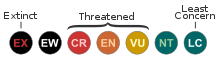
IUCN Red List of Threatened Plants Status : Least Concern.
Growth: S = slow M = medium F = fast. Soil: L = light (sandy) M = medium H = heavy (clay). pH: A = acid N = neutral B = basic (alkaline). Shade: F = full shade S = semi-shade N = no shade. Moisture: D = dry M = Moist We = wet Wa = water.
Now available:
Food Forest Plants for Mediterranean Conditions
350+ Perennial Plants For Mediterranean and Drier Food Forests and Permaculture Gardens.
[Paperback and eBook]
This is the third in Plants For A Future's series of plant guides for food forests tailored to
specific climate zones. Following volumes on temperate and tropical ecosystems, this book focuses
on species suited to Mediterranean conditions—regions with hot, dry summers and cool, wet winters,
often facing the added challenge of climate change.
Read More
Expert comment
Author
(Haw.) F.M.Knuth
Botanical References
Links / References
For a list of references used on this page please go here
Readers comment
| Add a comment |
|
If you have important information about this plant that may help other users please add a comment or link below. Only comments or links that are felt to be directly relevant to a plant will be included. If you think a comment/link or information contained on this page is inaccurate or misleading we would welcome your feedback at [email protected]. If you have questions about a plant please use the Forum on this website as we do not have the resources to answer questions ourselves.
* Please note: the comments by website users are not necessarily those held by PFAF and may give misleading or inaccurate information.
|
Subject : Cylindropuntia imbricata
|
|
|
|