 |
|
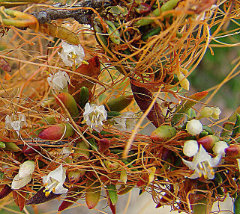
Dick Culbert from Gibsons, B.C., Canada. Creative Commons Attribution 2.0 |
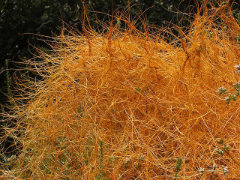 |
| Jason Hollinger. Creative Commons Attribution 2.0 |
Translate this page:
Summary
California dodder is a rootless, leafless, orange, twining parasite that looks exactly like “vegetable spaghetti” draped over shrubs and forbs. As a food plant it sits in the “interesting but risky” category: seeds are reported edible in scattered sources, but stems are widely regarded as inedible or potentially upsetting to digestion, and the host plant can strongly affect safety.
Physical Characteristics

 Cuscuta californica is a PERENNIAL growing to 0.5 m (1ft 8in) by 0.5 m (1ft 8in) at a fast rate.
See above for USDA hardiness. It is hardy to UK zone 8. The flowers are pollinated by Bees, Insects.
It is noted for attracting wildlife.
Suitable for: light (sandy), medium (loamy) and heavy (clay) soils and prefers well-drained soil. Suitable pH: mildly acid, neutral and basic (mildly alkaline) soils. It cannot grow in the shade. It prefers dry or moist soil and can tolerate drought.
UK Hardiness Map
US Hardiness Map
Synonyms
Grammica californica (Hook. & Arn.) Hadac & Chrtek
Plant Habitats
Edible Uses
Reported edible part is the seed, with food use generally minor and poorly documented compared with more reliable desert staples. Stems are sometimes promoted online as edible, but most field and ethnobotanical documentation you provided points away from routine food use, and some references warn the stems can cause digestive upset [2-3]. Edible Uses & Rating. Seeds (when reliably identified, mature, and cleanly separated) are the primary edible use and would be rated as a “conditional emergency food” rather than a regular wild staple because of (1) limited documentation, (2) strong host-related safety uncertainty, and (3) practical difficulty of harvesting enough seed at consistent quality. Stems are best rated “not recommended.” [2-3] Taste, Processing & Kitchen Notes. Field note experience with boiled stems found a surprisingly neutral flavor and crisp, sprout-like texture when the dodder was growing on yellow suncups, but that pleasant eating quality is not evidence of safety. Dodder can act like a pipeline tied into a host’s vascular system, so flavor can be mild even when chemistry is not. If anyone were to experiment despite cautions, the only rational culinary target would be mature seed (not stems), thoroughly cleaned of plant debris, and treated like tiny grains or spice-seeds; however, the safer recommendation remains to treat the plant as non-food unless a local, authoritative ethnobotanical tradition and host-specific knowledge supports use [2-3]. Seasonality (Phenology). In the Mojave/Sonoran region, actively growing stems tend to be most noticeable and harvestable when they are moist, vivid orange, and actively twining in spring; older infestations dry to brown tangles that are poor candidates for any handling. Flowering is commonly spring into early summer (March to June), with seed set following as capsules mature. Safety & Cautions (Food Use). The core hazard is host-mediated risk: dodder commonly parasitizes many unrelated plants, including species that are poisonous or resin-rich, and its haustorial connections can allow movement of compounds along with water and nutrients. A second hazard is the repeated warning in foraging literature that dodder stems may cause digestive upset, with some sources treating the group as inedible. A third practical hazard is contamination: dodder mats trap dust, insects, fungal growth, and fragments of the host, so “clean food-grade material” is difficult to guarantee. For safety-first guidance, dodder is best treated as a botanical curiosity, cordage/scouring material, or ethnobotanical study subject—not a dependable vegetable. Harvest & Processing Workflow. If seeds are being collected as a documentation exercise rather than a food recommendation, the workflow is: confirm the host is non-toxic and the dodder is correctly identified; wait until capsules are mature and dry; collect only clean clusters; separate capsules from host fragments; thresh gently; winnow repeatedly; and discard any lots that carry off-odors, visible mold, or persistent bitterness. For stems, the safest workflow is “do not harvest for eating,” and if handled at all, handle as you would any questionable wild plant: gloves, avoid eyes/mouth, and wash hands [2-3]. Cultivar/Selection Notes. None in a food sense. In horticulture and restoration contexts, dodders are generally not selected for cultivation because they are parasitic and can be destructive to valued plants. Look-Alikes & Confusion Risks. The main confusion risk is not botanical look-alikes (few plants mimic a leafless orange thread-mat), but host confusion: a harmless-looking dodder tangle can be growing on a highly toxic shrub or on a plant with latex/resins that you would not want in food. There is also within-genus confusion: many Cuscuta species look similar as tangles; species-level ID often depends on flower and fruit details. Traditional/Indigenous Use Summary. California dodder stems were used as a scouring pad by Cahuilla and medicinally (e.g., nosebleeds) by Kawaiisu, while seed-eating is reported for some California groups (e.g., Maidu) and seed use is mentioned more broadly for dodders in the Southwest, but the overall pattern is “minor food use, more non-food use.” [2-3]
References More on Edible Uses
Medicinal Uses
Plants For A Future can not take any responsibility for any adverse effects from the use of plants. Always seek advice from a professional before using a plant medicinally.
Cuscuta californica (California dodder) belongs to a genus of parasitic plants that are utilized in traditional medicine, particularly within Native American, Chinese, and other indigenous systems. While C. californica is specifically mentioned in studies for its potential in traditional herbal medicine, many pharmacological studies focus on more widely used species such as Cuscuta reflexa and Cuscuta chinensis. Traditional and Potential Medical Uses of Cuscuta Species: Liver and Kidney Health: Cuscuta species, including Cuscuta californica and others, are recognized for their traditional use in addressing liver and kidney ailments. Skin Conditions: The plant is used in traditional medicine to treat skin issues such as eczema, psoriasis, scabies, and sores. Anti-inflammatory and Analgesic: It has been used to alleviate pain, such as in cases of rheumatism or headaches. Hair Loss: Cuscuta species have been used to promote hair growth and treat hair loss. Other Uses: Traditionally used as a purgative, diuretic, diaphoretic, and anthelmintic (to expel parasitic worms). Scientific Findings on Cuscuta (General): Active Compounds: The genus is rich in phytochemicals like flavonoids (including quercetin, kaempferol), lignans, and phenolic acids. Pharmacological Activities: Studies on Cuscuta species have indicated potential anti-tumor, hepatoprotective (liver-protecting), antibacterial, antioxidant, and anti-inflammatory properties. Precautions and Safety: Cuscuta species can be toxic if consumed in high doses, with reported symptoms including digestive issues, and in severe cases, potential liver or kidney damage. It is advised to avoid using this plant during pregnancy or while breastfeeding. As a parasite, its chemical composition can vary based on the host plant it is growing on. Disclaimer: This information is for educational purposes only and does not constitute medical advice. Consult a healthcare professional before using any herbal remedies.
References More on Medicinal Uses
The Bookshop: Edible Plant Books
Our Latest books on Perennial Plants For Food Forests and Permaculture Gardens in paperback or digital formats.
Edible Tropical Plants
Food Forest Plants for Hotter Conditions: 250+ Plants For Tropical Food Forests & Permaculture Gardens.
More
Edible Temperate Plants
Plants for Your Food Forest: 500 Plants for Temperate Food Forests & Permaculture Gardens.
More
More Books
PFAF have eight books available in paperback and digital formats. Browse the shop for more information.
Shop Now
Other Uses
Dodder is part of native desert/chaparral ecology in many places and can influence plant community structure by selectively stressing certain hosts; the seed and plant tissues can be used by some insects, but it is not generally a wildlife “forage plant” in the way leafy greens or berries are. Intentional cultivation requires deliberate infection of host plants and is generally incompatible with gardens, orchards, or restoration plantings you want to protect.
Special Uses
References More on Other Uses
Cultivation details
California dodder is common, conspicuous, and ecologically fascinating, but it is not a reliable food source. Even where taste seems mild after cooking, the combination of host-linked chemistry and repeated digestive-upset warnings makes it a poor candidate for regular foraging. Growing Conditions. Dodder “grows” wherever suitable hosts are actively growing; it requires living host tissue, seasonal moisture that supports host growth, and warm temperatures that allow rapid stem expansion and flowering. Habitat & Range. Widespread in California and western Arizona, common in the Mojave and Sonoran deserts, and often seen as a noxious weed; Size & Landscape Performance. It forms conspicuous orange masses that can cover portions of shrubs, reducing host vigor and creating an “orange web” effect in the landscape. From a design standpoint, it is generally undesirable because it can suppress ornamental and native host plants. Cultivation (Horticulture). Not recommended. Intentional cultivation requires deliberate infection of host plants and is generally incompatible with gardens, orchards, or restoration plantings you want to protect. Pests & Problems. The “problem” is the plant itself: dodder can stress and sometimes kill host stems by siphoning resources and shading. It can also complicate host plant management by spreading across adjacent vegetation. Identification & Habit. A nongreen, rootless, thread-stemmed parasite forming tangled mats; leaves reduced to scales; small white flowers in spike-like clusters; capsules forming later. Your diagnostic character notes (orange stems; no infrastaminal scales; head-like stigmas) are the key within-genus signals you provided. Pollinators. Dodder flowers are small and open, and are typically visited by small generalist insects (especially small bees and flies) when nectar/pollen are accessible; self-pollination can also occur in some Cuscuta lineages, so pollinator presence may boost seed set but is not always strictly required. For field use, treat the flowers as “small-insect pollinated.”
References Carbon Farming Information and Carbon Sequestration Information
Temperature Converter
Type a value in the Celsius field to convert the value to Fahrenheit:
Fahrenheit:
The PFAF Bookshop
Plants For A Future have a number of books available in paperback and digital form. Book titles include Edible Plants, Edible Perennials, Edible Trees,Edible Shrubs, Woodland Gardening, and Temperate Food Forest Plants. Our new book is Food Forest Plants For Hotter Conditions (Tropical and Sub-Tropical).
Shop Now
Plant Propagation
By seed. Seeds persist in soil, germinate, briefly produce a seedling that must quickly contact a host, then form haustoria and abandon independent rooting.
Other Names
If available other names are mentioned here
California dodder, orange dodder, and chaparral dodder.
Native Range
US. USA. Arizona, California, Mexico Northwest, Nevada, Oregon, Utah, Washington.
Weed Potential
Right plant wrong place. We are currently updating this section.
Please note that a plant may be invasive in one area but may not in your area so it's worth checking.
High where hosts are abundant. Dodders are widely treated as noxious or problematic in agriculture and restoration because they can spread and weaken host stands.
Conservation Status
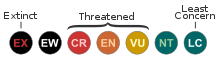
IUCN Red List of Threatened Plants Status : Not available
Growth: S = slow M = medium F = fast. Soil: L = light (sandy) M = medium H = heavy (clay). pH: A = acid N = neutral B = basic (alkaline). Shade: F = full shade S = semi-shade N = no shade. Moisture: D = dry M = Moist We = wet Wa = water.
Now available:
Food Forest Plants for Mediterranean Conditions
350+ Perennial Plants For Mediterranean and Drier Food Forests and Permaculture Gardens.
[Paperback and eBook]
This is the third in Plants For A Future's series of plant guides for food forests tailored to
specific climate zones. Following volumes on temperate and tropical ecosystems, this book focuses
on species suited to Mediterranean conditions—regions with hot, dry summers and cool, wet winters,
often facing the added challenge of climate change.
Read More
Expert comment
Author
Hook. & Arn.
Botanical References
Links / References
For a list of references used on this page please go here
Readers comment
| Add a comment |
|
If you have important information about this plant that may help other users please add a comment or link below. Only comments or links that are felt to be directly relevant to a plant will be included. If you think a comment/link or information contained on this page is inaccurate or misleading we would welcome your feedback at [email protected]. If you have questions about a plant please use the Forum on this website as we do not have the resources to answer questions ourselves.
* Please note: the comments by website users are not necessarily those held by PFAF and may give misleading or inaccurate information.
|
Subject : Cuscuta californica
|
|
|
|