 |
|
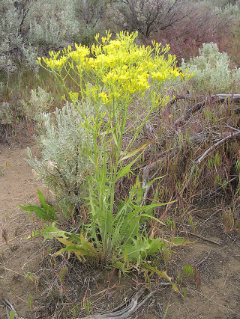
Thayne Tuason. Creative Commons Attribution-Share Alike 4.0 |
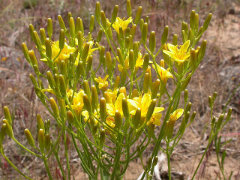 |
| Matt Lavin from Bozeman, Montana, USA. Creative Commons Attribution-Share Alike 2.0 |
Translate this page:
Summary
Tapertip hawksbeard is a milky-sapped, dandelion-tribe wildflower with yellow, dandelion-like heads on an upright stem, usually appearing in open woods, meadows, and montane settings. In foraging terms, it is a minor but sometimes useful green, with the best value coming from tender stems where traditional use has been documented (and where bitterness is usually easier to manage than in older foliage).
Physical Characteristics

 Crepis acuminata is an evergreen Perennial growing to 0.5 m (1ft 8in) by 0.2 m (0ft 8in) at a fast rate.
See above for USDA hardiness. It is hardy to UK zone 4. The flowers are pollinated by Bees, Insects.
It is noted for attracting wildlife.
Suitable for: light (sandy), medium (loamy) and heavy (clay) soils and prefers well-drained soil. Suitable pH: mildly acid, neutral and basic (mildly alkaline) soils. It can grow in semi-shade (light woodland) or no shade. It prefers moist soil.
UK Hardiness Map
US Hardiness Map
Synonyms
Berinia acuminata (Nutt.) Sch.Bip. Hieracioides acuminata (Nutt.) Kuntze. Psilochenia acuminata (Nutt.) W.A.Weber
Plant Habitats
Edible Uses
The edible part documented for this species is the stem (fresh or cooked), with leaf edibility likely but not reliably documented in the sources you’re working from. As with many chicory-tribe plants, the milky latex signals the potential for bitterness and digestive sensitivity in some people, so small trial servings matter [2-3]. Edible Uses & Rating. The primary edible use is as a seasonal stem vegetable (peeled if needed, raw in small amounts, or cooked). As a Southwest/Ground-truth foraging vegetable it rates as “fair” rather than standout, mostly because bitterness can be variable and because better greens often exist at the same time [2-3]. Taste, Processing & Kitchen Notes. Expect a dandelion-like profile: a green, slightly resinous bitterness from latex, usually stronger in older tissues. For stems, peeling and brief boiling are the most reliable upgrades; if bitterness persists, a change of water helps. In mixed soups or stews, small amounts can add “wild green” character without dominating the pot. If you trial leaves, treat them like dandelion—sample first, harvest young, and cook if the bite is strong [2-3]. Seasonality (Phenology). In the inland Northwest, C. acuminata flowers mainly from June to August, and it is insect-pollinated. ? Tender stems are generally best before or at the very start of flowering, while tissues are still crisp and less fibrous [2-3]. Safety & Cautions (Food Use). Latex-bearing greens can be rough on sensitive stomachs, and bitterness often increases with age. Treat first-time use as a “small serving” plant. Avoid plants from sprayed roadsides, contaminated soils, or heavy livestock-waste areas, and avoid any specimens with obvious mold, rot, or heavy insect damage [2-3]. Harvest & Processing Workflow. Harvest in clean habitat before full bloom, selecting vigorous plants with tender upper growth. Strip or peel any tougher outer tissues, rinse thoroughly, then blanch or simmer briefly; taste and decide whether to discard the first water. Combine with mild greens or starchy bases (rice, potatoes, beans) to buffer bitterness [2-3]. Cultivar/Selection Notes. This is a wild species rather than a cultivar crop; selection is mostly about choosing young, vigorous plants from better moisture regimes, since drought-stressed plants tend to be harsher. Look-Alikes & Confusion Risks. Many yellow-flowered chicory-tribe composites can resemble Crepis (and each other). The biggest practical risk is confusing “dandelion-like” composites with unrelated yellow composites that may be more resinous or poorly documented as food. Use the combination of milky sap, ligulate (strap) florets only, and overall Crepis habit, and avoid harvesting if you can’t confirm the chicory-tribe look with confidence. Traditional/Indigenous. The clearest documented edible focus for this species is on stems; broader Indigenous food documentation for Crepis in the Southwest appears limited and inconsistent, which is why a conservative, trial-based approach is appropriate.
References More on Edible Uses
Medicinal Uses
Plants For A Future can not take any responsibility for any adverse effects from the use of plants. Always seek advice from a professional before using a plant medicinally.
Crepis acuminata has a history of traditional medical use by indigenous North American tribes, particularly in the Great Basin region. Documented medicinal uses include: Eye Medicine: The Shoshoni people pulverized root pieces and sprinkled them into the eye to soothe eye inflammation and dislodge foreign objects. Gynecological Aid: A poultice made from the seeds or the entire plant was used to relieve breast pain and induce milk flow following childbirth. Analgesic: It has been used for general pain relief.
References More on Medicinal Uses
The Bookshop: Edible Plant Books
Our Latest books on Perennial Plants For Food Forests and Permaculture Gardens in paperback or digital formats.
Edible Tropical Plants
Food Forest Plants for Hotter Conditions: 250+ Plants For Tropical Food Forests & Permaculture Gardens.
More
Edible Temperate Plants
Plants for Your Food Forest: 500 Plants for Temperate Food Forests & Permaculture Gardens.
More
More Books
PFAF have eight books available in paperback and digital formats. Browse the shop for more information.
Shop Now
Other Uses
This is a wild species rather than a cultivar crop. Flowers support generalist insects; seed and foliage can be used opportunistically by small wildlife, while the bitter latex reduces heavy grazing pressure in many settings
Special Uses
References More on Other Uses
Cultivation details
Tapertip hawksbeard is a useful “backup green” and stem vegetable in the montane/intermountain seasonal mix: recognizable, generally safe when prepared like other bitter chicory-tribe greens, but rarely a first-choice staple unless other foods are scarce. Growing Conditions. It favors open to lightly shaded sites with seasonal moisture—meadows, open woods, and montane slopes—where spring moisture carries it into summer flowering. In cultivation-like handling, think “full sun to part shade” with moderate moisture and good drainage. Habitat & Range. Tapertip hawksbeard occurs widely in western North America; in Washington, it is treated as native and insect-pollinated, flowering in mid- to late-summer. Size & Landscape Performance. It behaves as an upright, small-footprint wildflower that can fill gaps in meadow plantings but is not typically used as an ornamental focal plant. Its performance is best in naturalistic, low-input landscapes. Cultivation (Horticulture). It is generally easiest to “cultivate” by allowing it to naturalize in suitable meadow/edge conditions rather than treating it as a garden vegetable. If grown deliberately, avoid over-fertility (which can encourage rank, bitter growth) and aim for even moisture early. Pests & Problems. Like many greens, it can be affected by leaf-chewers and general fungal spotting in damp years; in dry stress it can become tougher and more bitter. Discard any badly diseased foliage. Identification & Habit. Tapertip hawksbeard is an upright Crepis with milky sap and yellow ligulate heads, typically with basal leaves and a stem that becomes more obvious at flowering. Pollinators. The species is insect-pollinated, and in practice the yellow heads attract a broad mix of small native bees, flies, and other generalist flower visitors typical of chicory-tribe composites. Tapertip hawksbeard is in the sunflower family (Asteraceae), genus Crepis, and is commonly called tapertip hawksbeard. It is a cold-hardy, mountain West native best treated as hardy to roughly USDA Zones 3–8 (estimate based on broad interior-West distribution and montane tolerance). It typically reaches about 20–80 cm tall with a modest spread around 15–30 cm, depending on moisture and competition.
References Carbon Farming Information and Carbon Sequestration Information
Temperature Converter
Type a value in the Celsius field to convert the value to Fahrenheit:
Fahrenheit:
The PFAF Bookshop
Plants For A Future have a number of books available in paperback and digital form. Book titles include Edible Plants, Edible Perennials, Edible Trees,Edible Shrubs, Woodland Gardening, and Temperate Food Forest Plants. Our new book is Food Forest Plants For Hotter Conditions (Tropical and Sub-Tropical).
Shop Now
Plant Propagation
Propagation is primarily by seed; allow mature heads to set seed and disperse naturally, or collect and surface sow in fall/early spring in a well-drained medium.
Other Names
If available other names are mentioned here
Tapertip Hawksbeard (Crepis acuminata Nutt.). Tapertip.
Native Range
US. USA. Arizona, California, Colorado, Idaho, Iowa, Montana, Nebraska, Nevada, New Mexico, Oregon, Utah, Washington, Wyoming.
Weed Potential
Right plant wrong place. We are currently updating this section.
Please note that a plant may be invasive in one area but may not in your area so it's worth checking.
Generally low to moderate: it can self-seed in open ground but usually does not form aggressive monocultures in intact native communities.
Conservation Status
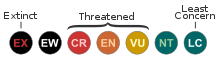
IUCN Red List of Threatened Plants Status : Not available
Growth: S = slow M = medium F = fast. Soil: L = light (sandy) M = medium H = heavy (clay). pH: A = acid N = neutral B = basic (alkaline). Shade: F = full shade S = semi-shade N = no shade. Moisture: D = dry M = Moist We = wet Wa = water.
Now available:
Food Forest Plants for Mediterranean Conditions
350+ Perennial Plants For Mediterranean and Drier Food Forests and Permaculture Gardens.
[Paperback and eBook]
This is the third in Plants For A Future's series of plant guides for food forests tailored to
specific climate zones. Following volumes on temperate and tropical ecosystems, this book focuses
on species suited to Mediterranean conditions—regions with hot, dry summers and cool, wet winters,
often facing the added challenge of climate change.
Read More
Expert comment
Author
Nutt.
Botanical References
Links / References
For a list of references used on this page please go here
Readers comment
| Add a comment |
|
If you have important information about this plant that may help other users please add a comment or link below. Only comments or links that are felt to be directly relevant to a plant will be included. If you think a comment/link or information contained on this page is inaccurate or misleading we would welcome your feedback at [email protected]. If you have questions about a plant please use the Forum on this website as we do not have the resources to answer questions ourselves.
* Please note: the comments by website users are not necessarily those held by PFAF and may give misleading or inaccurate information.
|
Subject : Crepis acuminata
|
|
|
|