 |
|
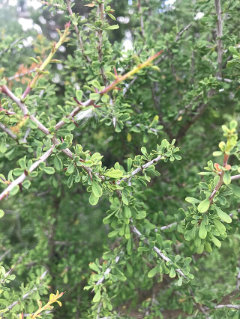
Cody Stricker. Creative Commons Attribution 4.0 |
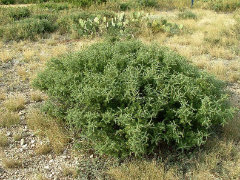 |
| © 2009 William R. Carr https://w3.biosci.utexas.edu/ |
Translate this page:
Summary
Knifeleaf condalia is one of the best edible-fruited species in the Condalia genus and stands out as a genuinely valuable desert food plant. Unlike bitter snakewood and some of its close relatives, knifeleaf condalia produces sweet, palatable, berry-like drupes that can be used fresh or cooked. Its fruits are reliable enough to justify targeted harvesting, and the plant represents one of the few truly worthwhile fruit resources in arid upland desert ecosystems. Among desert shrubs, knifeleaf condalia occupies a rare niche as a productive, native, drought-adapted edible fruit plant that thrives in extreme conditions and poor soils, making it ecologically and nutritionally important.
Physical Characteristics

 Condalia spathulata is a SHRUB growing to 3 m (9ft) by 3 m (9ft) at a slow rate.
See above for USDA hardiness. It is hardy to UK zone 9. The flowers are pollinated by Insects.
It is noted for attracting wildlife.
Suitable for: light (sandy) and medium (loamy) soils, prefers well-drained soil and can grow in nutritionally poor soil. Suitable pH: neutral and basic (mildly alkaline) soils and can grow in very alkaline and saline soils.
It cannot grow in the shade. It prefers dry or moist soil and can tolerate drought.
UK Hardiness Map
US Hardiness Map
Synonyms
None Known
Plant Habitats
Edible Uses
High-quality edible fruit. One of the best desert shrub fruits in the Southwest [2-3]. Edible Uses & Rating: The fruits are edible fresh or cooked and are among the highest-quality edible fruits produced by desert shrubs in the Southwest. Food value is high within desert ecosystems and excellent within the Condalia genus [2-3]. Taste, Processing & Kitchen Notes: Fresh fruits are black, sweet, mildly bitter, and slightly mucilaginous, with hard pits. The bitterness typical of the genus is minimal in this species. Raw fruits are edible, but cooking greatly improves their culinary value. Boiling the fruits breaks down the mucilage and produces a thick, sweet, reddish-black broth. This broth is especially well suited for rice dishes, vegetable soups, stews, and reductions. Cooking also allows the pulp to separate cleanly from the pits, making processing far easier [2-3]. The pulp has a rich, dark flavor profile well adapted to savory dishes rather than desserts. Seasonality (Phenology): Flowering occurs from midsummer into early autumn. Fruits ripen from late summer to early autumn. Ripening is staggered, and not all fruits mature simultaneously, making repeated harvest visits productive. Safety & Cautions (Food Use): No toxicity issues documented. Safe for consumption when properly identified [2-3]. Harvest & Processing Workflow: Harvesting is best done using ground tarps and branch agitation to avoid hand injuries. Fully ripe fruits detach more easily than unripe ones. Fruits can be boiled whole, then pulp separated from pits and reduced into broths or pastes. Cultivar / Selection Notes: No cultivars exist. Look-Alikes & Confusion Risks: Often confused with Warnock’s condalia (Condalia warnockii) and Mexican bluewood (Condalia mexicana). Taxonomic separation is unclear in older literature, and these species may represent a complex rather than distinct biological entities. Traditional / Indigenous Use Summary: Historically used as a food plant in desert regions, though documentation is limited. Its practical food value suggests it was likely used opportunistically rather than as a staple.
References More on Edible Uses
Medicinal Uses
Plants For A Future can not take any responsibility for any adverse effects from the use of plants. Always seek advice from a professional before using a plant medicinally.
None Known
References More on Medicinal Uses
The Bookshop: Edible Plant Books
Our Latest books on Perennial Plants For Food Forests and Permaculture Gardens in paperback or digital formats.
Edible Tropical Plants
Food Forest Plants for Hotter Conditions: 250+ Plants For Tropical Food Forests & Permaculture Gardens.
More
Edible Temperate Plants
Plants for Your Food Forest: 500 Plants for Temperate Food Forests & Permaculture Gardens.
More
More Books
PFAF have eight books available in paperback and digital formats. Browse the shop for more information.
Shop Now
Other Uses
Rarely cultivated, but ecologically valuable for native desert restoration, wildlife habitat, and edible native landscaping. Not suitable for residential gardens due to spines and harvesting difficulty. Provides shelter and nesting habitat for birds and small mammals. Fruits likely support wildlife during productive years.
Special Uses
References More on Other Uses
Cultivation details
Knifeleaf condalia is one of the most valuable edible-fruited desert shrubs in the Southwest. It produces genuinely palatable fruits, thrives in harsh environments, and offers a reliable wild food source in ecosystems where edible fruits are rare. Growing Conditions: Knifeleaf condalia thrives in extreme desert environments, tolerating heat, drought, rocky soils, alkaline substrates, and nutrient-poor conditions. It is highly drought-adapted and survives long dry periods without irrigation. Habitat & Range: This species occurs in desert upland communities from Arizona to Texas and southward into northern Mexico. It favors rocky slopes, arid scrublands, desert hillsides, and dry transitional zones rather than riparian corridors. Size & Landscape Performance: Plants typically reach 1–3 meters in height and form dense, thorny shrubs. Growth is slow but persistent, and plants are long-lived. Cultivation (Horticulture): Rarely cultivated, but ecologically valuable for native desert restoration, wildlife habitat, and edible native landscaping. Not suitable for residential gardens due to its spines and difficulty of harvesting. Pests & Problems: Fruits are frequently damaged by insects. Black skins make damage difficult to detect visually. Dense spines limit access and increase harvesting difficulty. Pollination: Likely insect-pollinated via small, inconspicuous flowers. Identification & Habit: Knifeleaf condalia grows as a rigid, spiny shrub with dense branching and short, thorn-tipped branchlets. Leaves are small, narrow, and spoon-shaped (spatulate), clustered along woody stems. The plant forms compact, defensive thickets that are difficult to penetrate, making harvesting physically challenging but ecologically protective. The plant’s structure reflects desert survival strategy: reduced leaf area, woody architecture, and heavy armoring with spines. FAMILY: Buckthorn family (Rhamnaceae) – Condalia genus. COMMON NAMES: Knifeleaf condalia. USDA HARDINESS ZONES: 8–10. HARDINESS / RANGE: Arizona, New Mexico, Texas, and northern Mexico. GROWTH FORM: Spiny desert shrub, 1–3 m tall.
References Carbon Farming Information and Carbon Sequestration Information
Temperature Converter
Type a value in the Celsius field to convert the value to Fahrenheit:
Fahrenheit:
The PFAF Bookshop
Plants For A Future have a number of books available in paperback and digital form. Book titles include Edible Plants, Edible Perennials, Edible Trees,Edible Shrubs, Woodland Gardening, and Temperate Food Forest Plants. Our new book is Food Forest Plants For Hotter Conditions (Tropical and Sub-Tropical).
Shop Now
Plant Propagation
Propagation occurs through seed. Germination is slow and variable. Natural recruitment depends on rainfall cycles and seed dispersal by animals.
Other Names
If available other names are mentioned here
Knifeleaf Condalia (Condalia spathulata A. Gray)
Native Range
US. USA. Mexico Northeast, Mexico Northwest, Texas.
Weed Potential
Right plant wrong place. We are currently updating this section.
Please note that a plant may be invasive in one area but may not in your area so it's worth checking.
Not invasive. Native desert species with stable ecological behavior.
Conservation Status
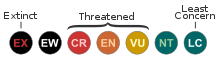
IUCN Red List of Threatened Plants Status : Not available
Growth: S = slow M = medium F = fast. Soil: L = light (sandy) M = medium H = heavy (clay). pH: A = acid N = neutral B = basic (alkaline). Shade: F = full shade S = semi-shade N = no shade. Moisture: D = dry M = Moist We = wet Wa = water.
Now available:
Food Forest Plants for Mediterranean Conditions
350+ Perennial Plants For Mediterranean and Drier Food Forests and Permaculture Gardens.
[Paperback and eBook]
This is the third in Plants For A Future's series of plant guides for food forests tailored to
specific climate zones. Following volumes on temperate and tropical ecosystems, this book focuses
on species suited to Mediterranean conditions—regions with hot, dry summers and cool, wet winters,
often facing the added challenge of climate change.
Read More
Expert comment
Author
A.Gray
Botanical References
Links / References
For a list of references used on this page please go here
Readers comment
| Add a comment |
|
If you have important information about this plant that may help other users please add a comment or link below. Only comments or links that are felt to be directly relevant to a plant will be included. If you think a comment/link or information contained on this page is inaccurate or misleading we would welcome your feedback at [email protected]. If you have questions about a plant please use the Forum on this website as we do not have the resources to answer questions ourselves.
* Please note: the comments by website users are not necessarily those held by PFAF and may give misleading or inaccurate information.
|
Subject : Condalia spathulata
|
|
|
|