 |
|
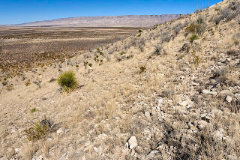
Patrick Alexander. Creative Commons Zero, Public Domain Dedication |
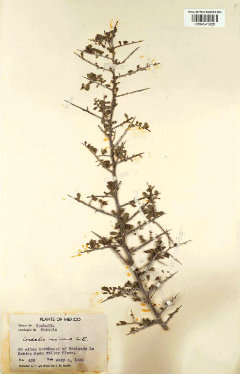 |
| A specimen from Kew's Herbarium |
Translate this page:
Summary
Mexican bluewood represents one of the most taxonomically confused plants in the Condalia genus. Older floras recognized Condalia mexicana as a widespread species extending into the southwestern United States. Modern floras often split U.S. populations into Correll’s bluewood (Condalia correllii), treating C. mexicana as strictly Mexican. From a practical, ecological, and foraging perspective, these distinctions are largely artificial. Historically, the edible-fruit references for Mexican bluewood apply to what modern floras now call Correll’s bluewood, meaning the food plant still exists in the U.S., even if the name has changed. For foragers, Mexican bluewood should be treated as a valid edible-fruited condalia type in the Southwest.
Physical Characteristics

 Condalia mexicana is a SHRUB growing to 4 m (13ft) by 4 m (13ft) at a slow rate.
See above for USDA hardiness. It is hardy to UK zone 9. The flowers are pollinated by Insects.
It is noted for attracting wildlife.
Suitable for: light (sandy) and medium (loamy) soils, prefers well-drained soil and can grow in nutritionally poor soil. Suitable pH: neutral and basic (mildly alkaline) soils and can grow in very alkaline and saline soils.
It cannot grow in the shade. It prefers dry or moist soil and can tolerate drought.
UK Hardiness Map
US Hardiness Map
Synonyms
Rhamnus microphylla
Plant Habitats
Edible Uses
Edible fruits. Moderate-to-good food value. Best used cooked [2-3]. Edible Uses & Rating: The fruits (drupes) are edible fresh or cooked. Food value is moderate to good, depending on fruit production year and insect pressure [2-3]. Taste, Processing & Kitchen Notes: Fruits are black, fleshy, and berry-like with hard pits. Flavor is reported as mildly sweet, with low bitterness compared to bitter snakewood and similar species. The flesh layer is thin but usable. Cooking improves palatability and allows pulp separation from pits. Boiling produces a dark broth that can be used as a base for soups and grain dishes. Fresh fruits are edible but limited by small size and pit volume [2-3]. Seasonality (Phenology): Flowering occurs in mid to late summer. Fruits ripen from late summer into early autumn, depending on rainfall and elevation. Safety & Cautions (Food Use): No toxicity issues reported. Safe for consumption when properly identified [2-3]. Harvest & Processing Workflow: Harvest by branch agitation over tarps or cloths. Fully ripe fruits detach more easily. Fruits can be boiled, pulp separated from pits, and broth reduced for cooking use. Cultivar / Selection Notes: No cultivars exist. Look-Alikes & Confusion Risks: Often confused with knifeleaf condalia (Condalia spathulata), Warnock’s condalia (Condalia warnockii), and Correll’s bluewood (Condalia correllii). Taxonomic distinctions are unresolved and inconsistent across floras. Traditional / Indigenous Use Summary: Historically documented as edible under the name Mexican bluewood in older ethnobotanical literature. Modern renaming has obscured continuity of use rather than reflecting real biological differences.
References More on Edible Uses
Medicinal Uses
Plants For A Future can not take any responsibility for any adverse effects from the use of plants. Always seek advice from a professional before using a plant medicinally.
None Known
References More on Medicinal Uses
The Bookshop: Edible Plant Books
Our Latest books on Perennial Plants For Food Forests and Permaculture Gardens in paperback or digital formats.

Edible Tropical Plants
Food Forest Plants for Hotter Conditions: 250+ Plants For Tropical Food Forests & Permaculture Gardens.
More

Edible Temperate Plants
Plants for Your Food Forest: 500 Plants for Temperate Food Forests & Permaculture Gardens.
More

More Books
PFAF have eight books available in paperback and digital formats. Browse the shop for more information.
Shop Now
Other Uses
Potential value in native desert food forests and restoration projects but impractical for residential planting due to spines and slow growth. Provides shelter for birds and small mammals. Fruits support wildlife during productive seasons. Condalia mexicana is used for firewood (Fernández-Nava et al. 2013).
Special Uses
References More on Other Uses
Cultivation details
Mexican bluewood represents a true desert-native edible fruit shrub whose value has been obscured by taxonomic revisions rather than ecological reality. From a functional perspective, it belongs to the edible-fruited Condalia complex and should be treated as such by foragers and ecological food system designers. Growing Conditions: Extremely drought-tolerant. Thrives in arid uplands, rocky soils, alkaline substrates, and desert scrub environments. Habitat & Range: Desert upland communities from southeastern Arizona to western Texas and southward into Mexico. Prefers dry slopes, rocky hillsides, and desert scrub rather than washes. Size & Landscape Performance: Grows 1–5 m tall. Dense, thorny architecture. Long-lived and slow-growing. Cultivation (Horticulture): Not cultivated. Potential value in native desert food forests and restoration projects but impractical for residential planting due to spines and slow growth. Pests & Problems: Heavy insect pressure on fruits. Irregular fruiting cycles. Dense spines complicate harvesting. Pollination: Likely insect-pollinated by small native insects. Identification & Habit: Mexican bluewood forms rigid, spiny shrubs with compact branching architecture. Leaves are small, spoon-shaped to obovate, and clustered along woody stems. The overall form is armored, thorny, and highly drought-adapted, typical of upland desert shrubs. The plant is structurally similar to knifeleaf condalia and Warnock’s condalia, differing mainly in leaf size and branching density. FAMILY: Buckthorn family (Rhamnaceae) – Condalia genus. COMMON NAMES: Mexican bluewood. USDA HARDINESS ZONES: 8–10. HARDINESS / RANGE: Southeastern Arizona, southwestern Texas, northern Mexico. GROWTH FORM: Spiny desert shrub, 1–5 m tall.
References Carbon Farming Information and Carbon Sequestration Information
Temperature Converter
Type a value in the Celsius field to convert the value to Fahrenheit:
Fahrenheit:
The PFAF Bookshop
Plants For A Future have a number of books available in paperback and digital form. Book titles include Edible Plants, Edible Perennials, Edible Trees,Edible Shrubs, Woodland Gardening, and Temperate Food Forest Plants. Our new book is Food Forest Plants For Hotter Conditions (Tropical and Sub-Tropical).
Shop Now
Plant Propagation
By seed. Germination is slow and erratic. Natural regeneration occurs through wildlife dispersal.
Other Names
If available other names are mentioned here
Mexican bluewood. Granjeno (San Luis Potosí).
Native Range
Mexico Central, Mexico Gulf, Mexico Northeast, Mexico Northwest, Mexico Southwest.
Weed Potential
Right plant wrong place. We are currently updating this section.
Please note that a plant may be invasive in one area but may not in your area so it's worth checking.
Not invasive. Native desert species with stable ecological behavior.
Conservation Status
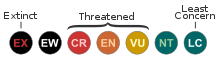
IUCN Red List of Threatened Plants Status : Least Concern.
Growth: S = slow M = medium F = fast. Soil: L = light (sandy) M = medium H = heavy (clay). pH: A = acid N = neutral B = basic (alkaline). Shade: F = full shade S = semi-shade N = no shade. Moisture: D = dry M = Moist We = wet Wa = water.
Now available:
Food Forest Plants for Mediterranean Conditions
350+ Perennial Plants For Mediterranean and Drier Food Forests and Permaculture Gardens.
[Paperback and eBook]
This is the third in Plants For A Future's series of plant guides for food forests tailored to
specific climate zones. Following volumes on temperate and tropical ecosystems, this book focuses
on species suited to Mediterranean conditions—regions with hot, dry summers and cool, wet winters,
often facing the added challenge of climate change.
Read More
Expert comment
Author
Schltdl.
Botanical References
Links / References
For a list of references used on this page please go here
Readers comment
| Add a comment |
|
If you have important information about this plant that may help other users please add a comment or link below. Only comments or links that are felt to be directly relevant to a plant will be included. If you think a comment/link or information contained on this page is inaccurate or misleading we would welcome your feedback at [email protected]. If you have questions about a plant please use the Forum on this website as we do not have the resources to answer questions ourselves.
* Please note: the comments by website users are not necessarily those held by PFAF and may give misleading or inaccurate information.
|
Subject : Condalia mexicana
|
|
|
|