 |
|
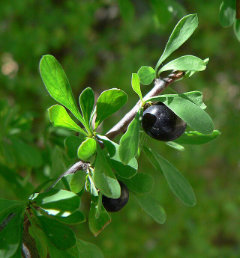
Stan Shebs. Creative Commons Attribution-Share Alike 3.0 |
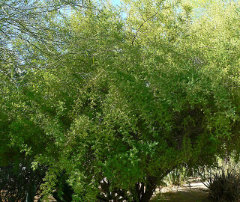 |
| Stan Shebs. Creative Commons Attribution-Share Alike 3.0 |
Translate this page:
Summary
Bitter snakewood is a spiny desert shrub or small tree native to the northern Sonoran Desert and southeastern California, producing small black drupes that are technically edible but extremely bitter and of very low food value. Although one tree may produce thousands of fruits in productive years, fruiting is highly unreliable and inconsistent across seasons. The plant flowers in winter or early spring, yet fruits may take many months to ripen, often appearing ripe long before they are actually palatable. Even when fully ripe, the fruits remain intensely bitter and barely qualify as edible. Ethnobotanical value is minimal, and the species is best understood as a marginal famine food rather than a meaningful foraging resource. Dense spines make harvesting physically hazardous, further reducing its practicality as a food plant.
Physical Characteristics

 Condalia globosa is a SHRUB growing to 3 m (9ft) by 3 m (9ft) at a medium rate.
See above for USDA hardiness. It is hardy to UK zone 8. The flowers are pollinated by Insects.
It is noted for attracting wildlife.
Suitable for: light (sandy) and medium (loamy) soils, prefers well-drained soil and can grow in nutritionally poor soil. Suitable pH: neutral and basic (mildly alkaline) soils and can grow in saline soils.
It cannot grow in the shade. It prefers dry or moist soil and can tolerate drought.
UK Hardiness Map
US Hardiness Map
Synonyms
C. globosa var. globosa
Plant Habitats
Edible Uses
Technically edible but extremely bitter and of negligible food value. Not recommended for foraging use [2-3]. Edible Uses & Rating: The fruits are technically edible but rank extremely low as a food resource. Even when fully ripe, the fruits are intensely bitter and unpleasant, offering little incentive for consumption. Cooking does not improve their palatability, and bitterness remains dominant. From a foraging perspective, bitter snakewood ranks as a very low-value wild food, suitable only as a survival fallback when no better resources are available. Taste, Processing & Kitchen Notes: Unripe fruits are extremely bitter and astringent. Fully ripe fruits remain strongly bitter, with no sweetness developing during maturation. Overripe fruits become wrinkled skins surrounding hard stones, offering no edible pulp. Cooking fails to reduce bitterness and does not improve flavor. No preparation method transforms these fruits into a palatable food. They produce no useful broth, no sweetness, and no aromatic qualities that would justify culinary use [2-3]. Seasonality (Phenology): Flowers appear from November through April. Fruits take an unusually long time to mature, often ripening between May and August. Fruits may appear dark and ripe for weeks before they are actually mature. Even at full maturity, they remain bitter. Because the northern Sonoran Desert does not freeze, the growing season is continuous, but fruit development is slow and inconsistent [2-3]. Safety & Cautions (Food Use): While not toxic, the extreme bitterness and low nutritional value make the fruits unsuitable for regular consumption. Physical injury risk from spines is significant during harvesting. Harvest & Processing Workflow: Harvesting requires placing a tarp beneath the shrub and striking branches with a stick to dislodge fully ripe fruits. Hand harvesting is dangerous due to dense spines. Fruits require no processing because they are not meaningfully usable as food [2-3]. Cultivar / Selection Notes: No cultivars exist. Look-Alikes & Confusion Risks: Other Condalia species closely resemble bitter snakewood. Accurate species-level identification requires leaf shape, fruit characteristics, and geographic range. Traditional / Indigenous Use Summary: Ethnobotanical documentation of bitter snakewood as a food source is minimal. It does not appear to have played a meaningful role in Indigenous food systems, likely due to poor fruit quality and difficulty in harvesting.
References More on Edible Uses
Medicinal Uses
Plants For A Future can not take any responsibility for any adverse effects from the use of plants. Always seek advice from a professional before using a plant medicinally.
None Known
References More on Medicinal Uses
The Bookshop: Edible Plant Books
Our Latest books on Perennial Plants For Food Forests and Permaculture Gardens in paperback or digital formats.
Edible Tropical Plants
Food Forest Plants for Hotter Conditions: 250+ Plants For Tropical Food Forests & Permaculture Gardens.
More
Edible Temperate Plants
Plants for Your Food Forest: 500 Plants for Temperate Food Forests & Permaculture Gardens.
More
More Books
PFAF have eight books available in paperback and digital formats. Browse the shop for more information.
Shop Now
Other Uses
The dense spiny structure provides shelter for desert wildlife, particularly birds and small mammals. Fruits may serve as occasional wildlife food, though bitterness limits widespread consumption.
Special Uses
References More on Other Uses
Cultivation details
Bitter snakewood is a desert shrub whose fruits are technically edible but practically useless as food. Extreme bitterness, low palatability, hazardous harvesting conditions, and unreliable fruiting make it a poor foraging resource. It is best regarded as a botanical curiosity rather than a meaningful food plant. Growing Conditions: Bitter snakewood grows primarily along desert washes in arid environments, thriving in sandy and rocky soils with low moisture availability. It is adapted to extreme heat, drought, and poor soil fertility, relying on deep root systems and defensive growth structures rather than productivity. Habitat & Range: This species occurs in the deserts of southwestern Arizona and southeastern California, particularly within the northern Sonoran Desert (Colorado Desert). It is primarily associated with desert washes and dry drainage systems. Size & Landscape Performance: Typically 2–5 meters tall, bitter snakewood forms dense, spiny thickets. It is structurally dominant in its microhabitats but contributes little ecological value as a food source for humans. Cultivation (Horticulture): Bitter snakewood is not cultivated for food purposes and has no horticultural value for edible landscaping. Its spiny structure and poor fruit quality make it unsuitable for human use beyond ecological landscaping or habitat restoration. Pests & Problems: Fruits are frequently damaged by insects, reducing their already limited food value. Dense spines make harvesting difficult and hazardous. Identification & Habit: Bitter snakewood grows as a rigid, heavily spined shrub or small tree, typically forming dense, tangled thickets along desert washes. The branches are intricately interwoven and strongly armed with sharp spines, creating nearly impenetrable growth. Leaves are small, spoon-shaped, and clustered or alternately arranged along short branchlets. The overall structure is compact, thorny, and defensive in form, reflecting adaptation to arid desert environments and herbivore pressure. The plant presents a harsh, woody silhouette against desert landscapes, often appearing more as a defensive structure than a food-bearing shrub. FAMILY: Buckthorn family (Rhamnaceae) – Condalia genus. COMMON NAMES: Bitter snakewood, snakewood. HARDINESS / RANGE: Sonoran Desert and Colorado Desert regions. GROWTH FORM: Spiny desert shrub or small tree, 2–5 m tall.
References Carbon Farming Information and Carbon Sequestration Information
Temperature Converter
Type a value in the Celsius field to convert the value to Fahrenheit:
Fahrenheit:
The PFAF Bookshop
Plants For A Future have a number of books available in paperback and digital form. Book titles include Edible Plants, Edible Perennials, Edible Trees,Edible Shrubs, Woodland Gardening, and Temperate Food Forest Plants. Our new book is Food Forest Plants For Hotter Conditions (Tropical and Sub-Tropical).
Shop Now
Plant Propagation
Propagation occurs naturally through seed. Germination is slow and establishment is limited by harsh desert conditions.
Other Names
If available other names are mentioned here
Bitter snakewood, snakewood.
Native Range
US. USA. Arizona, California, Mexico Northwest.
Weed Potential
Right plant wrong place. We are currently updating this section.
Please note that a plant may be invasive in one area but may not in your area so it's worth checking.
Not considered invasive. It is a native desert species with localized distribution.
Conservation Status
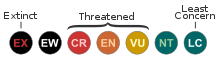
IUCN Red List of Threatened Plants Status : Least Concern.
Growth: S = slow M = medium F = fast. Soil: L = light (sandy) M = medium H = heavy (clay). pH: A = acid N = neutral B = basic (alkaline). Shade: F = full shade S = semi-shade N = no shade. Moisture: D = dry M = Moist We = wet Wa = water.
Now available:
Food Forest Plants for Mediterranean Conditions
350+ Perennial Plants For Mediterranean and Drier Food Forests and Permaculture Gardens.
[Paperback and eBook]
This is the third in Plants For A Future's series of plant guides for food forests tailored to
specific climate zones. Following volumes on temperate and tropical ecosystems, this book focuses
on species suited to Mediterranean conditions—regions with hot, dry summers and cool, wet winters,
often facing the added challenge of climate change.
Read More
Expert comment
Author
I.M.Johnst.
Botanical References
Links / References
For a list of references used on this page please go here
Readers comment
| Add a comment |
|
If you have important information about this plant that may help other users please add a comment or link below. Only comments or links that are felt to be directly relevant to a plant will be included. If you think a comment/link or information contained on this page is inaccurate or misleading we would welcome your feedback at [email protected]. If you have questions about a plant please use the Forum on this website as we do not have the resources to answer questions ourselves.
* Please note: the comments by website users are not necessarily those held by PFAF and may give misleading or inaccurate information.
|
Subject : Condalia globosa
|
|
|
|