 |
|
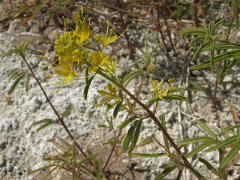
Jim Morefield from Nevada, USA. Creative Commons Attribution-Share Alike 2.0 |
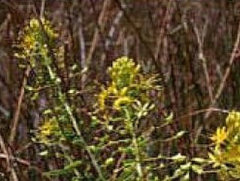 |
| Public domain |
Translate this page:
Summary
Twisted cleomella is a small, strongly scented annual of alkaline lowlands—especially dry lake margins and salt-meadow habitats across the Great Basin. It is edible, but only in the way many cleome-family plants are edible: the raw flavor is so pungent and disagreeable that it can ruin fresh dishes, while cooking turns it into a usable potherb and broth plant. For foragers, its value is tied to three things: it can occur in dense local colonies, it is distinctive once you learn the cleome-family scent signature, and it can be processed into a storable cooked-and-dried product similar to “leaf cakes.” It is not a first-choice green, but in the right habitat, at the right time, it can be a practical resource.
Physical Characteristics

 Cleomella plocasperma is a ANNUAL growing to 0.3 m (1ft) by 0.3 m (1ft in) at a fast rate.
See above for USDA hardiness. It is hardy to UK zone 5. The flowers are pollinated by Insects.
It is noted for attracting wildlife.
Suitable for: light (sandy), medium (loamy) and heavy (clay) soils and can grow in nutritionally poor soil. Suitable pH: neutral and basic (mildly alkaline) soils and can grow in very alkaline and saline soils.
It cannot grow in the shade. It prefers dry or moist soil and can tolerate drought.
UK Hardiness Map
US Hardiness Map
Synonyms
C. mojavensis Payson. C. oocarpa A.Gray. C. plocasperma var. mojavensis (Payson) Crum. C. plocasperma var. stricta Crum. C. stenosperma Coville ex Tidestr.
Plant Habitats
Edible Uses
Edible leaves are best cooked. Raw leaves are strongly pungent and can spoil fresh dishes [2-3]. Simmering produces a deep green broth and soft cooked greens suitable for soups, and cooked leaves can be dried and stored as cakes [2-3]. Edible Uses & Rating: The leaves are the main edible part and can be eaten cooked as a potherb. Raw use is technically possible but practically unwise because the pungency is strong enough to make salads unpleasant. As a food plant, twisted cleomella rates as a fair, situational green: worthwhile when you find it abundant in clean habitat, and you plan to cook it, but not attractive as a fresh snack or “everyday” wild vegetable. Taste, Processing & Kitchen Notes: Fresh leaves are pungent, spicy, and foul-smelling to many people, and even small quantities can dominate mixed greens. This intensity helps explain why many grazing animals avoid it even when other forage is scarce. Cooking is the reset button. Simmering effectively subdues the sharp flavor and reduces the offensive aroma, leaving a deep green broth and a softened cooked green. Texture is the trade-off: most aboveground parts (except tougher stem bases) become mushy when simmered, so the best culinary role is as a potherb, soup green, or a contributor to broth rather than a sautéed “leaf with bite.” Once cooked, the leaves can be dried and pressed into cakes, similar in concept to preserved beeplant preparations, creating a ready-to-store resource whose flavor is still assertive but far more tolerable than raw [2-3]. Seasonality (Phenology): Twisted cleomella can bloom from late spring through early autumn, commonly from May to September. Edible greens are most practical earlier in the growing season, before plants become coarse or stressed by heat and alkalinity. Seedpods develop through the warm season; while the leaves are the primary food source described here, the shift from green growth to fruiting often coincides with declining leaf quality in many annual desert plants, so timing matters. Safety & Cautions (Food Use): As with other Cleome-family edibles, the conservative approach is to cook and discard the water if the flavor is intense or if you are unsure of your tolerance. Avoid harvesting from the edges of roads, industrial basins, polluted playas, or places where salts concentrate alongside agricultural chemicals. The plant’s strong aroma is not itself a safety warning, but it is a reminder that you are dealing with a chemically assertive group of plants; moderation and proper cooking are sensible [2-3]. Harvest & Processing Workflow: Harvest young leaves and tender tops from clean, dust-free plants, avoiding the tougher stem bases if you plan to simmer. Wash thoroughly, as alkaline habitats often contain fine grit and salt residues. Simmer to tame pungency and to produce a usable green broth, then strain and use the greens as potherbs. If preserving, drain the cooked greens well, dry them thoroughly, and press or form them into cakes for storage, recognizing that the texture will be soft in rehydrated dishes and is best suited to soups and stews. Cultivar/Selection Notes: No cultivars are known in common use. Practical variation is more about habitat-driven differences—plants from harsher, saltier microsites may be smaller, stronger-smelling, and less pleasant than those from slightly milder alkaline meadows. Look-Alikes & Confusion Risks: Cleomellas are most reliably separated from other cleome-family plants by their distinctive diamond-shaped seedpods. Distribution and habitat are also useful: twisted cleomella is strongly tied to alkaline Great Basin lowlands. Within Cleomella, species can be tricky, so fruit shape, stipe length, and local range are key. The most common “confusion” risk is culinary rather than botanical: treating it like a mild salad green. Raw leaves can overpower a dish, so assume they need to be cooked. Traditional / Indigenous Use Summary: Documented food use appears minor compared with better-known Southwest greens, likely because palatability is poor and because the plant is locally abundant rather than broadly abundant. Even so, in alkaline basin regions where options can be limited, it is the kind of plant worth knowing: easy to identify by smell and fruit, and usable once you apply the right processing.
References More on Edible Uses
Medicinal Uses
Plants For A Future can not take any responsibility for any adverse effects from the use of plants. Always seek advice from a professional before using a plant medicinally.
None Known
References More on Medicinal Uses
The Bookshop: Edible Plant Books
Our Latest books on Perennial Plants For Food Forests and Permaculture Gardens in paperback or digital formats.
Edible Tropical Plants
Food Forest Plants for Hotter Conditions: 250+ Plants For Tropical Food Forests & Permaculture Gardens.
More
Edible Temperate Plants
Plants for Your Food Forest: 500 Plants for Temperate Food Forests & Permaculture Gardens.
More
More Books
PFAF have eight books available in paperback and digital formats. Browse the shop for more information.
Shop Now
Other Uses
Ecology & Wildlife: In its niche habitats, twisted cleomella contributes seasonal flowers for insects and green biomass during a limited window of the year. Its strong scent and chemistry appear to reduce grazing pressure from many animals. Colonies can provide small-scale structure and microhabitats in otherwise sparse basin flats. In principle, it could be grown in restoration-style or habitat-mimic plantings on alkaline sites, but for food production, it is mainly a foraged plant rather than a garden crop. Ecologically, it occupies a niche in harsh alkaline zones where few annuals perform reliably.
Special Uses
References More on Other Uses
Cultivation details
Twisted cleomella is a tough little alkaline-basin annual whose value is unlocked by cooking. Raw it is punishingly pungent; simmered it becomes a workable potherb and broth plant that can also be dried for storage. Its strongest advantages are habitat predictability, local abundance, and distinctive identification cues—especially the cleome-family smell and diamond-shaped pods. Growing Conditions: This species is closely tied to alkaline soils and basin environments. It thrives where many other edible greens struggle: salty, alkaline lowlands, seasonally wet flats that dry hard, and the margins of playas. It favors open sun and tolerates the extremes typical of Great Basin basins—high evaporation, wind, and episodic moisture. Habitat & Range: Twisted cleomella is primarily a Great Basin plant, often found around dry lakes, salt marshes, alkaline meadows, and similar lowland basins. It can be locally abundant, meaning it may dominate a patchy site while being absent from seemingly nearby areas with different soil chemistry or hydrology. Size & Landscape Performance: Plants are small to modest in height, but colonies can be visually noticeable in their habitat, especially when flowering and fruiting. In a landscape context, it is not usually grown ornamentally; rather, it is grown ecologically, occupying a niche in harsh, alkaline zones where few annuals perform reliably. Cultivation (Horticulture): Twisted cleomella is not commonly cultivated, largely because its preferred alkaline conditions are uncommon in garden soils and its odor discourages casual use. In principle, it could be grown in restoration-style or habitat-mimic plantings on alkaline sites, but for food production, it is mainly a foraged plant rather than a garden crop. Pests & Problems: The main “problem” for the human user is not pests but palatability and texture. Heat and drought stress can rapidly reduce leaf quality, and alkaline dust and soil splash can make washing essential. Because plants may grow near playa margins and low spots, it is also important to avoid sites with contamination or runoff concentration. Pollination: Flowers are insect-pollinated, and in open alkaline flats they can provide a seasonal nectar and pollen source when fewer plants are blooming nearby. The raceme structure elevates flowers above foliage, improving visibility to pollinators. Identification & Habit: Twisted cleomella is an upright to somewhat wiry annual with a well-defined central stem, strongly associated with alkaline flats. The leaves are usually palmately compound with three narrow leaflets, though upper leaves may become simple. Flowers are small, yellow, and arranged in terminal racemes that rise above the leaves, giving the plant a “little spiderflower” look. A key field clue is smell: crushed foliage releases the unmistakable, sharp odor typical of the cleome family. The most distinctive structural marker is the fruit: small, broadly diamond-shaped silicles on noticeable stalks, a feature that separates Cleomella from other cleome-family lookalikes in the same landscapes [2-3]. FAMILY: Cleome family (Cleomaceae) – Cleomella genus. COMMON NAMES: Twisted cleomella, alkali stinkweed, little spiderflower. USDA Hardiness Zones: Approx. Zones 4–9. Typical Size: About 10–60 cm tall; malodorous annual from a taproot, often locally abundant in alkaline basins.
References Carbon Farming Information and Carbon Sequestration Information
Temperature Converter
Type a value in the Celsius field to convert the value to Fahrenheit:
Fahrenheit:
The PFAF Bookshop
Plants For A Future have a number of books available in paperback and digital form. Book titles include Edible Plants, Edible Perennials, Edible Trees,Edible Shrubs, Woodland Gardening, and Temperate Food Forest Plants. Our new book is Food Forest Plants For Hotter Conditions (Tropical and Sub-Tropical).
Shop Now
Plant Propagation
Propagation is by seed. As an annual, it relies on seed set to persist year to year, and local abundance suggests it can reproduce strongly when conditions match its niche. In alkaline basins, establishment likely tracks seasonal moisture patterns and microsites that hold brief spring or early-summer water.
Other Names
If available other names are mentioned here
Twisted cleomella, alkali stinkweed, little spiderflower.
Native Range
US. USA. California, Idaho, Nevada, Oregon, Utah.
Weed Potential
Right plant wrong place. We are currently updating this section.
Please note that a plant may be invasive in one area but may not in your area so it's worth checking.
It is not a general-purpose weed across diverse environments; instead it behaves as a specialist that can be common where alkaline conditions suit it. In those habitats it may appear “weedy” simply because it succeeds where many plants cannot.
Conservation Status
IUCN Red List of Threatened Plants Status : Not available

Growth: S = slow M = medium F = fast. Soil: L = light (sandy) M = medium H = heavy (clay). pH: A = acid N = neutral B = basic (alkaline). Shade: F = full shade S = semi-shade N = no shade. Moisture: D = dry M = Moist We = wet Wa = water.
Now available:
Food Forest Plants for Mediterranean Conditions
350+ Perennial Plants For Mediterranean and Drier Food Forests and Permaculture Gardens.
[Paperback and eBook]
This is the third in Plants For A Future's series of plant guides for food forests tailored to
specific climate zones. Following volumes on temperate and tropical ecosystems, this book focuses
on species suited to Mediterranean conditions—regions with hot, dry summers and cool, wet winters,
often facing the added challenge of climate change.
Read More
Expert comment
Author
S.Watson
Botanical References
Links / References
For a list of references used on this page please go here
Readers comment
| Add a comment |
|
If you have important information about this plant that may help other users please add a comment or link below. Only comments or links that are felt to be directly relevant to a plant will be included. If you think a comment/link or information contained on this page is inaccurate or misleading we would welcome your feedback at [email protected]. If you have questions about a plant please use the Forum on this website as we do not have the resources to answer questions ourselves.
* Please note: the comments by website users are not necessarily those held by PFAF and may give misleading or inaccurate information.
|
Subject : Cleomella plocasperma
|
|
|
|