 |
|
Patrick Alexander. Creative Commons Zero, Public Domain Dedication |
 |
| Patrick Alexander. Creative Commons Zero, Public Domain Dedication |
Translate this page:
Summary
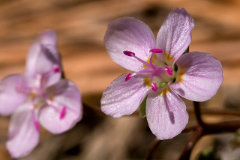
Rosy springbeauty is a tuber-bearing Claytonia of oak and pine communities in parts of the interior West. Although not always as widely encountered as western springbeauty, it follows the same edible logic: leaves are edible and pleasant but limited in bulk, while the tubers can be a substantial reward where populations are abundant and harvest is appropriate. Its showy pink to magenta flowers make it conspicuous during bloom and help foragers locate plants for identification. Where it occurs in good numbers, it has the potential to provide one of the better wild “small potato” foods of spring.
Physical Characteristics

 Claytonia rosea is a PERENNIAL growing to 0.2 m (0ft 6in) by 0.2 m (0ft 6in) at a fast rate.
See above for USDA hardiness. It is hardy to UK zone 4. The flowers are pollinated by Insects.
It is noted for attracting wildlife.
Suitable for: light (sandy), medium (loamy) and heavy (clay) soils and prefers well-drained soil. Suitable pH: mildly acid, neutral and basic (mildly alkaline) soils. It can grow in semi-shade (light woodland) or no shade. It prefers moist soil.
UK Hardiness Map
US Hardiness Map
Synonyms
C. lanceolata var. rosea (Rydb.) R.J.Davis
Plant Habitats
Edible Uses
Edible leaves and likely excellent edible tubers, with harvest best timed to bloom for visibility and safe identification [2-3]. Edible Uses & Rating: Leaves are edible and useful as a minor spring green. Tubers are the main edible resource and, by close relationship and structural similarity, are expected to be comparable in value to other edible springbeauty tubers. Overall food rating depends heavily on abundance, because yield per individual plant is limited even when tubers are larger [2-3]. Taste, Processing & Kitchen Notes: Leaves are typically mild and tender when young. Tubers are expected to be starchy and potato-like, with the same general culinary flexibility as other springbeauties. Boiling and roasting are the most practical methods, and whole-tuber cooking minimizes loss. If tubers are large enough, they can be sliced and dried to create a storable product or ground into a flour-like meal [2-3]. Seasonality (Phenology): Commonly blooms in spring, often March through May, depending on elevation and local climate. Edible leaves are best early. Tubers are present through the plant’s active season, but harvest is most practical during bloom when plants are easy to locate and confirm. Safety & Cautions (Food Use): As with any tuber harvest, the safety priority is correct identification and avoiding indiscriminate digging of unknown underground storage organs. Ethical harvest is also important: take tubers only where populations are clearly abundant and local rules allow it. Harvest & Processing Workflow: Locate plants during bloom, confirm identification, then excavate broadly to account for offset tubers. Rinse thoroughly and cook simply by boiling or roasting. If using leaves, take only small amounts from many plants to reduce stress on any one individual [2-3]. Cultivar/Selection Notes: No notable cultivars; natural color variation in flowers may occur. Look-Alikes & Confusion Risks: Genus-level confusion is low during bloom, but underground confusion risk rises if digging outside of the flowering season. Always tie tubers to a confirmed, intact plant. Traditional / Indigenous Use Summary: Tuber-bearing springbeauties fit a well-known pattern of Indigenous use across the West, where small geophytes could provide reliable starchy food during seasonal transitions. Documentation may vary by region, but the food logic is consistent with other Claytonia tubers.
References More on Edible Uses
Medicinal Uses
Plants For A Future can not take any responsibility for any adverse effects from the use of plants. Always seek advice from a professional before using a plant medicinally.
None Known
References More on Medicinal Uses
The Bookshop: Edible Plant Books
Our Latest books on Perennial Plants For Food Forests and Permaculture Gardens in paperback or digital formats.
Edible Tropical Plants
Food Forest Plants for Hotter Conditions: 250+ Plants For Tropical Food Forests & Permaculture Gardens.
More
Edible Temperate Plants
Plants for Your Food Forest: 500 Plants for Temperate Food Forests & Permaculture Gardens.
More
More Books
PFAF have eight books available in paperback and digital formats. Browse the shop for more information.
Shop Now
Other Uses
Provides early flowers for pollinators and participates in spring energy flow in woodland ecosystems. Tubers may be eaten by wildlife, contributing to its ecological role as a spring carbohydrate store. Cultivation is possible for native plant gardeners, but harvesting tubers conflicts with ornamental persistence. It is best grown for spring flowers and occasional leaf sampling rather than as a “dig-and-eat” crop.
Special Uses
References More on Other Uses
Cultivation details
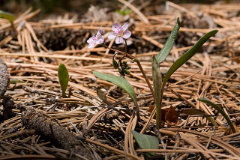
Rosy springbeauty is a small spring perennial with potentially high-value tubers and pleasant leaves, best considered a seasonal delicacy and carbohydrate opportunity where it is locally abundant. Growing Conditions: Rosy springbeauty is associated with oak and pine communities, generally in soils that provide spring moisture followed by seasonal drying. It occupies the same ecological niche as other spring ephemerals that “race” through growth before summer stress. Claytonia rosea (Western Springbeauty) generally prefers partial shade to full sun, particularly in areas with moist, well-drained, nutrient-rich soil. While it is a versatile, low-growing perennial native to mountainous, woody areas, it thrives best in conditions that mimic its natural habitat. Habitat & Range: Reported from Arizona, New Mexico, Utah, Colorado, and Wyoming, generally in upland woodland communities. Size & Landscape Performance: Small above ground, potentially more substantial below ground due to larger tuber size. In gardens, it would behave as a spring-emergent perennial that needs dormancy cycles respected. Cultivation (Horticulture): Cultivation is possible for native plant gardeners, but harvesting tubers conflicts with ornamental persistence. It is best grown for spring flowers and occasional leaf sampling rather than as a “dig-and-eat” crop. Pests & Problems: The main constraint is scarcity and the short season. As with other spring beauties, digging can easily miss tubers if done narrowly or carelessly. Pollination: Likely pollinated by spring-active insects attracted to showy petals and striping that function as nectar guides. Identification & Habit: This is a small perennial arising from a globe-shaped tuber that can be much larger than those of western springbeauty. It typically has two cauline leaves that are free and often stalked, and it produces showy, striped pinkish-purple flowers in racemes with multiple bracts. The combination of habitat, flower color, and the springbeauty form makes genus-level recognition straightforward. COMMON NAMES: Rosy springbeauty, Rocky Mountain springbeauty, western springbeauty (regional usage). USDA Hardiness Zones: Approx. Zones 3–8. Typical Size: About 2–15 cm tall; perennial arising from a larger globe-shaped tuber.
References Carbon Farming Information and Carbon Sequestration Information
Temperature Converter
Type a value in the Celsius field to convert the value to Fahrenheit:
Fahrenheit:
The PFAF Bookshop
Plants For A Future have a number of books available in paperback and digital form. Book titles include Edible Plants, Edible Perennials, Edible Trees,Edible Shrubs, Woodland Gardening, and Temperate Food Forest Plants. Our new book is Food Forest Plants For Hotter Conditions (Tropical and Sub-Tropical).
Shop Now
Plant Propagation
Propagation is by seed and tuber persistence. Establishment tends to be slow, typical of many small perennial geophytes.
Other Names
If available other names are mentioned here
Rosy springbeauty, Rocky Mountain springbeauty, western springbeauty (regional usage).
Native Range
US. USA. Arizona, Colorado, Mexico Northeast, New Mexico, Utah
Weed Potential
Right plant wrong place. We are currently updating this section.
Please note that a plant may be invasive in one area but may not in your area so it's worth checking.
Not weedy and unlikely to spread aggressively outside suitable native-style conditions.
Conservation Status
IUCN Red List of Threatened Plants Status : Not available

| Related Plants
|
| Latin Name | Common Name | Habit | Height | Hardiness | Growth | Soil | Shade | Moisture | Edible | Medicinal | Other |
| Claytonia acutifolia | Bering Sea Spring Beauty | Perennial | 0.2 |
-
| | LM | N | M | 3 | 0 | |
| Claytonia caroliniana | Broad-Leaved Spring Beauty, Carolina springbeauty | Perennial | 0.1 |
5-9
| | LM | N | M | 3 | 0 | 1 |
| Claytonia exigua | Pale Spring Beauty, Serpentine springbeauty | Annual | 0.1 |
0-0
| | LMH | FSN | DM | 2 | 0 | |
| Claytonia lanceolata | Lanceleaf Spring Beauty, Idaho springbeauty, Pacific springbeauty, Peirson's springbeauty | Perennial | 0.2 |
3-8
| | LM | N | M | 3 | 0 | 1 |
| Claytonia megarhiza | Alpine Spring Beauty | Perennial | 0.3 |
2-8
| | LM | N | M | 3 | 0 | 1 |
| Claytonia parviflora ssp. parviflora | Indian Lettuce | Annual | 0.3 |
4-9
| F | LMH | S | M | 4 | 0 | 1 |
| Claytonia perfoliata | Miner's Lettuce | Annual | 0.2 |
6-10
| | LMH | FSN | DM | 4 | 1 | 2 |
| Claytonia perfoliata ssp. perfoliata | Miner’s lettuce | Annual | 0.3 |
4-9
| F | LMH | FS | M | 4 | 2 | 2 |
| Claytonia rubra | Redstem Springbeauty | Annual | 0.1 |
4-9
| F | LMH | N | DM | 3 | 0 | 1 |
| Claytonia scammaniana | Scamman's Claytonia, Scamman's springbeauty | Perennial | 0.2 |
0-0
| | LM | N | M | 2 | 0 | |
| Claytonia sibirica | Pink Purslane, Siberian springbeauty | Annual/Perennial | 0.2 |
3-7
| | LMH | FSN | DM | 4 | 1 | 3 |
| Claytonia tuberosa | Tuberous Spring Beauty | Perennial | 0.2 |
4-8
| | LM | N | M | 3 | 0 | |
| Claytonia umbellata | Great Basin Spring Beauty | Perennial | 0.2 |
3-8
| | LM | N | M | 2 | 0 | 1 |
| Claytonia virginica | Spring Beauty, Virginia springbeauty, Hammond's claytonia, Yellow Virginia springbeauty | Perennial | 0.2 |
5-7
| M | LM | S | M | 3 | 1 | |
| Osmunda claytoniana | Interrupted Fern | Fern | 0.5 |
3-7
| | LMH | SN | MWe | 2 | 1 | |
|
Growth: S = slow M = medium F = fast. Soil: L = light (sandy) M = medium H = heavy (clay). pH: A = acid N = neutral B = basic (alkaline). Shade: F = full shade S = semi-shade N = no shade. Moisture: D = dry M = Moist We = wet Wa = water.
Now available:
Food Forest Plants for Mediterranean Conditions
350+ Perennial Plants For Mediterranean and Drier Food Forests and Permaculture Gardens.
[Paperback and eBook]
This is the third in Plants For A Future's series of plant guides for food forests tailored to
specific climate zones. Following volumes on temperate and tropical ecosystems, this book focuses
on species suited to Mediterranean conditions—regions with hot, dry summers and cool, wet winters,
often facing the added challenge of climate change.
Read More
Expert comment
Author
Rydb.
Botanical References
Links / References
For a list of references used on this page please go here
Readers comment
| Add a comment |
|
If you have important information about this plant that may help other users please add a comment or link below. Only comments or links that are felt to be directly relevant to a plant will be included. If you think a comment/link or information contained on this page is inaccurate or misleading we would welcome your feedback at [email protected]. If you have questions about a plant please use the Forum on this website as we do not have the resources to answer questions ourselves.
* Please note: the comments by website users are not necessarily those held by PFAF and may give misleading or inaccurate information.
|
Subject : Claytonia rosea
|
|
|
|