 |
|
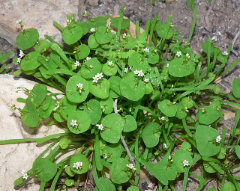
Stan Shebs. Creative Commons Attribution-Share Alike 3.0 |
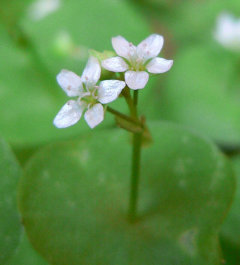 |
| Stan Shebs. Creative Commons Attribution-Share Alike 3.0 |
Translate this page:
Summary
Indian lettuce is a high-quality spring green closely allied to miner’s lettuce, often growing beside it in the same moist, shaded spring habitats. It offers mild, safe, thirst-quenching foliage and a gentle texture that suits salads and light cooking. Its main difference from miner’s lettuce is leaf shape and “feel” in the hand: Indian lettuce tends to have narrower basal leaves. From a foraging perspective it functions much the same as miner’s lettuce, providing dependable spring greens when moisture is available.
Physical Characteristics

 Claytonia parviflora ssp. parviflora is a ANNUAL growing to 0.3 m (1ft) by 0.3 m (1ft in) at a fast rate.
See above for USDA hardiness. It is hardy to UK zone 5. The flowers are pollinated by Insects.
It is noted for attracting wildlife.
Suitable for: light (sandy), medium (loamy) and heavy (clay) soils and prefers well-drained soil. Suitable pH: mildly acid, neutral and basic (mildly alkaline) soils. It can grow in semi-shade (light woodland). It prefers moist soil.
UK Hardiness Map
US Hardiness Map
Synonyms
Claytonia parviflora ssp. parviflora is subspecies of C. parviflora
Plant Habitats
Edible Uses
Edible leaves of high quality, best harvested young in spring from moist, shaded habitats, and used fresh or lightly cooked [2-3]. Edible Uses & Rating: Leaves are the primary edible portion and are safe to eat in quantity in typical culinary amounts. As a wild salad green it rates highly for flavor and tenderness, though not always as high-yield as miner’s lettuce in some habitats. It is an excellent spring vegetable wherever patches are abundant [2-3]. Taste, Processing & Kitchen Notes: Flavor is mild, fresh, and lettuce-like, with minimal bitterness and no aggressive aromatics. Texture is crisp and succulent when plants are well-watered, and softer when conditions dry. It performs well raw in salads, chopped into sandwiches, or lightly wilted into soups. Because stems can be delicate, gentle washing is best to avoid bruising. If plants are slightly older, a quick blanch can improve tenderness and reduce any emerging bitterness from drought stress [2-3]. Seasonality (Phenology): Most common from late winter through spring in many western settings, often blooming from roughly February to May, depending on elevation and rainfall. It declines as heat rises and soils dry. Safety & Cautions (Food Use): As with any low-growing spring green, avoid harvesting from contaminated soils, roadsides with heavy spray drift, or areas with pet traffic. Wash thoroughly to remove grit and small insects that shelter in the perfoliate leaf cup. Harvest & Processing Workflow: Harvest entire tender plants or selectively pick the freshest basal leaves and the perfoliate upper leaves. Rinse gently, drain well, and eat fresh soon after harvest for best texture. For cooked use, briefly wilt or blanch and add late to soups [2-3]. Cultivar/Selection Notes: No common cultivars exist; wild populations vary mainly by moisture and site conditions. Look-Alikes & Confusion Risks: Indian lettuce is easily confused with miner’s lettuce and red lettuce, which are also edible. Confusion among these three is not a safety concern. The distinctive fused upper leaves forming a “cup” greatly reduces confusion with unrelated plants. Traditional / Indigenous Use Summary: Claytonia greens were widely valued as spring vegetables by Indigenous peoples in many western regions. Indian lettuce fits this pattern as a safe, mild, early-season green in moist habitats.
References More on Edible Uses
Medicinal Uses
Plants For A Future can not take any responsibility for any adverse effects from the use of plants. Always seek advice from a professional before using a plant medicinally.
None Known
References More on Medicinal Uses
The Bookshop: Edible Plant Books
Our Latest books on Perennial Plants For Food Forests and Permaculture Gardens in paperback or digital formats.
Edible Tropical Plants
Food Forest Plants for Hotter Conditions: 250+ Plants For Tropical Food Forests & Permaculture Gardens.
More
Edible Temperate Plants
Plants for Your Food Forest: 500 Plants for Temperate Food Forests & Permaculture Gardens.
More
More Books
PFAF have eight books available in paperback and digital formats. Browse the shop for more information.
Shop Now
Other Uses
Its small flowers provide early resources for small insects. The plant’s succulent foliage also contributes moisture and soft plant tissue to spring food webs, including for invertebrates.
Special Uses
References More on Other Uses
Cultivation details
Indian lettuce is one of the best spring greens in the western forager’s toolkit: mild, moist, and easy to use raw or cooked, appearing predictably in the right habitats. Growing Conditions: It thrives in cool, moist, lightly shaded places with good soil moisture: streambanks, seep zones, canyon bottoms, shaded slopes, and beneath deciduous trees during the early season. It is strongly tied to seasonal moisture and disappears quickly in drought. Habitat & Range: Found across much of the western third of the United States, especially in canyons, riparian edges, and spring-moist hillsides where it can form scattered to abundant colonies. Size & Landscape Performance: Plants are small to moderate in height and often form pleasing green patches. In gardens it would behave as a spring annual green that self-seeds where moisture and partial shade are consistent. Cultivation (Horticulture): It can be cultivated similarly to miner’s lettuce, with fall or winter sowing in mild climates and consistent moisture through spring. Partial shade improves leaf quality in warmer regions. Pests & Problems: The most common issues are wilting and toughening as the season dries, and occasional leaf damage from insects. Quality is highest when harvested young and well-hydrated. Pollination: Pollinated by small generalist insects; reliable seed set often occurs in favorable spring conditions. Identification & Habit: Indian lettuce is an annual that produces clustered stems from a fibrous root system. It has both basal leaves and two opposite cauline leaves that are fused around the upper stem to form a perfoliate “cup.” The basal leaves are typically narrower than those of miner’s lettuce. Flowers are small, white to pink, with five petals and two sepals, arranged in racemes, and the plant commonly forms colonies in favorable sites.
References Carbon Farming Information and Carbon Sequestration Information
Temperature Converter
Type a value in the Celsius field to convert the value to Fahrenheit:
Fahrenheit:
The PFAF Bookshop
Plants For A Future have a number of books available in paperback and digital form. Book titles include Edible Plants, Edible Perennials, Edible Trees,Edible Shrubs, Woodland Gardening, and Temperate Food Forest Plants. Our new book is Food Forest Plants For Hotter Conditions (Tropical and Sub-Tropical).
Shop Now
Plant Propagation
Propagation is primarily by seed. Seeds mature quickly, and colonies often reappear annually where soils are disturbed lightly and moisture patterns persist.
Other Names
If available other names are mentioned here
Indian lettuce, streambank springbeauty
Native Range
US.USA. Aleutian Is., Arizona, British Columbia, California, Idaho, Mexico Northwest, Montana, Oregon, Washington.
Weed Potential
Right plant wrong place. We are currently updating this section.
Please note that a plant may be invasive in one area but may not in your area so it's worth checking.
It can self-seed readily in suitable garden beds but is rarely problematic because it is seasonal and shallow-rooted, and it pulls easily.
Conservation Status
IUCN Red List of Threatened Plants Status : Not available

| Related Plants
|
| Latin Name | Common Name | Habit | Height | Hardiness | Growth | Soil | Shade | Moisture | Edible | Medicinal | Other |
| Claytonia acutifolia | Bering Sea Spring Beauty | Perennial | 0.2 |
-
| | LM | N | M | 3 | 0 | |
| Claytonia caroliniana | Broad-Leaved Spring Beauty, Carolina springbeauty | Perennial | 0.1 |
5-9
| | LM | N | M | 3 | 0 | 1 |
| Claytonia exigua | Pale Spring Beauty, Serpentine springbeauty | Annual | 0.1 |
0-0
| | LMH | FSN | DM | 2 | 0 | |
| Claytonia lanceolata | Lanceleaf Spring Beauty, Idaho springbeauty, Pacific springbeauty, Peirson's springbeauty | Perennial | 0.2 |
3-8
| | LM | N | M | 3 | 0 | 1 |
| Claytonia megarhiza | Alpine Spring Beauty | Perennial | 0.3 |
2-8
| | LM | N | M | 3 | 0 | 1 |
| Claytonia perfoliata | Miner's Lettuce | Annual | 0.2 |
6-10
| | LMH | FSN | DM | 4 | 1 | 2 |
| Claytonia perfoliata ssp. perfoliata | Miner’s lettuce | Annual | 0.3 |
4-9
| F | LMH | FS | M | 4 | 2 | 2 |
| Claytonia rosea | Rosy Springbeauty | Perennial | 0.2 |
3-8
| F | LMH | SN | M | 3 | 0 | 1 |
| Claytonia rubra | Redstem Springbeauty | Annual | 0.1 |
4-9
| F | LMH | N | DM | 3 | 0 | 1 |
| Claytonia scammaniana | Scamman's Claytonia, Scamman's springbeauty | Perennial | 0.2 |
0-0
| | LM | N | M | 2 | 0 | |
| Claytonia sibirica | Pink Purslane, Siberian springbeauty | Annual/Perennial | 0.2 |
3-7
| | LMH | FSN | DM | 4 | 1 | 3 |
| Claytonia tuberosa | Tuberous Spring Beauty | Perennial | 0.2 |
4-8
| | LM | N | M | 3 | 0 | |
| Claytonia umbellata | Great Basin Spring Beauty | Perennial | 0.2 |
3-8
| | LM | N | M | 2 | 0 | 1 |
| Claytonia virginica | Spring Beauty, Virginia springbeauty, Hammond's claytonia, Yellow Virginia springbeauty | Perennial | 0.2 |
5-7
| M | LM | S | M | 3 | 1 | |
| Osmunda claytoniana | Interrupted Fern | Fern | 0.5 |
3-7
| | LMH | SN | MWe | 2 | 1 | |
|
Growth: S = slow M = medium F = fast. Soil: L = light (sandy) M = medium H = heavy (clay). pH: A = acid N = neutral B = basic (alkaline). Shade: F = full shade S = semi-shade N = no shade. Moisture: D = dry M = Moist We = wet Wa = water.
Now available:
Food Forest Plants for Mediterranean Conditions
350+ Perennial Plants For Mediterranean and Drier Food Forests and Permaculture Gardens.
[Paperback and eBook]
This is the third in Plants For A Future's series of plant guides for food forests tailored to
specific climate zones. Following volumes on temperate and tropical ecosystems, this book focuses
on species suited to Mediterranean conditions—regions with hot, dry summers and cool, wet winters,
often facing the added challenge of climate change.
Read More
Expert comment
Author
Douglas
Botanical References
Links / References
For a list of references used on this page please go here
Readers comment
| Add a comment |
|
If you have important information about this plant that may help other users please add a comment or link below. Only comments or links that are felt to be directly relevant to a plant will be included. If you think a comment/link or information contained on this page is inaccurate or misleading we would welcome your feedback at [email protected]. If you have questions about a plant please use the Forum on this website as we do not have the resources to answer questions ourselves.
* Please note: the comments by website users are not necessarily those held by PFAF and may give misleading or inaccurate information.
|
Subject : Claytonia parviflora ssp. parviflora
|
|
|
|