 |
|
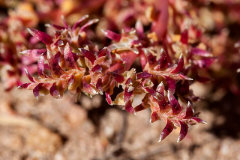
Patrick Alexander from Las Cruces, NM. Creative Commons Zero, Public Domain Dedication |
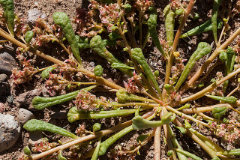 |
| Patrick Alexander from Las Cruces, NM. Creative Commons Zero, Public Domain Dedication |
Translate this page:
Summary
Common pussypaws is a small spring annual of deserts and open sandy places that can produce a surprisingly worthwhile seed harvest in good years. The succulent leaves can be eaten, but they are not a reliable or pleasant food because acrid, harsh flavors vary strongly between plants and even between leaves on the same plant. The seeds, however, are consistently the best edible part and are the reason this plant matters to foragers at all. When gathered at the right moment - after plants color-shift from green to red, orange, and then brown—the small black seeds cook into a mild, starchy, quinoa-like porridge that is free of bitterness and easy on the stomach. The main obstacle is scale: each capsule holds only a few seeds, so meaningful quantities require time, patience, and good patch selection.
Physical Characteristics

 Cistanthe monandra is a ANNUAL growing to 0.2 m (0ft 8in) by 0.2 m (0ft 8in) at a fast rate.
See above for USDA hardiness. It is hardy to UK zone 8. The flowers are pollinated by Insects.
It is noted for attracting wildlife.
Suitable for: light (sandy), medium (loamy) and heavy (clay) soils, prefers well-drained soil and can grow in nutritionally poor soil. Suitable pH: mildly acid, neutral and basic (mildly alkaline) soils. It cannot grow in the shade. It prefers dry or moist soil and can tolerate drought.
UK Hardiness Map
US Hardiness Map
Synonyms
C. monandra (Nutt.) Hershk.
Plant Habitats
Edible Uses
The seeds are edible and worthwhile in productive colonies, cooking into a mild, quinoa-like porridge [2-3]. Leaves are technically usable but frequently acrid and best treated as an occasional, cooked potherb rather than a dependable green. Edible Uses & Rating: The primary edible product is the seed. Leaves are not commonly recommended as food, and while they can be sampled, they are inconsistent and frequently harsh. As a seed plant, common pussypaws can rank as a good regional resource when abundant, because the seeds cook well and are free of unpleasant chaff problems once properly dried and cleaned. As a leaf vegetable, it rates low due to variable acridity and a mucilaginous texture that many people find unpleasant unless cooked [2-3]. Taste, Processing & Kitchen Notes: Leaves are crisp, moist, thick, and noticeably mucilaginous, with no fibrous stringiness. Their flavor ranges from mildly purslane-like with an earthy undertone to strongly acrid and harsh. This variability is the key problem: some leaves are tolerable, while others are intense enough that the best practice is simply to avoid them. Cooking improves the leaves substantially, but even boiled leaves can retain a hard-edged character. Seeds are much more dependable. They are small, black, shiny, and firm, and when boiled they become soft and mushy with a mild, earthy, grain-like flavor that often suggests quinoa or other goosefoot seeds. Toasting is possible but tricky because the seeds scorch quickly and do not develop a richly aromatic roasted character; the result is more “dry, dark, and plain” than nutty. Boiling is the most forgiving and usually the best-tasting preparation, especially for porridge or thickening soups [2-3]. Seasonality (Phenology): Common pussypaws is a spring plant that blooms early and sets seed from mid-spring into early summer, depending on rainfall and local conditions. Green rosettes dominate early in the season. As the seed crop matures, foliage often shifts to red and orange tones and then dries brown. The seeds do not persist long once fully mature, so the harvest window can be brief. In many desert systems, timing is tightly linked to moisture pulses and warming conditions, and good seed years may be patchy across the landscape. Safety & Cautions (Food Use): Seeds are the safest and most sensible edible part. Leaf use is limited by strong variability in acrid intensity and a mucilaginous character that some people find unpleasant. Because the plant grows in open washes and roadsides, site selection matters; avoid harvesting where contamination from road runoff, herbicides, or heavy animal traffic is likely. As with any small-seeded wild plant, start with small servings to confirm personal tolerance [2-3]. Harvest & Processing Workflow: For seed harvest, the most efficient strategy is to locate colonies early in the season, then return when plants have shifted toward red-orange tones and are drying brown, indicating peak seed maturity. Harvest is best done when the plants are dry enough that seeds loosen easily, but not so late that the capsules have already emptied. Because the plants can retain moisture and seeds can stick to tissue, drying the harvested material thoroughly before winnowing is essential. Once dry, gently crumble or rub capsules to release seeds, then winnow to remove lightweight debris. Boiling produces the best eating quality and the most forgiving texture, yielding a mild porridge or soup-thickener. Toasting is possible but requires low heat and constant attention because scorching happens quickly and the flavor payoff is modest [2-3]. Cultivar/Selection Notes: No cultivars are known. Populations vary naturally in vigor, bitterness levels in leaves, and seed productivity depending on rainfall, soils, and microhabitat. Look-Alikes & Confusion Risks: The desert Southwest hosts several small spring annuals with low rosettes and inconspicuous flowers, and the group has a complicated taxonomic history. Correct identification is helped by the combination of succulent rosette leaves, very small pale flowers in coiled clusters, and narrow capsules that split from top to bottom. Even when genus-level identification is secure, separating close relatives can be difficult in the field without careful examination of fruit and floral details. For foragers, the practical priority is ensuring that the harvested seeds truly come from the intended colony and that the plant matches the distinctive capsule behavior described above. Traditional / Indigenous Use Summary: Specific ethnobotanical documentation is limited in many areas, but the seeds fit the broader regional pattern of small-seeded desert annuals being gathered where abundant and where harvest could be timed efficiently. The labor cost is high because each capsule contains few seeds, yet in productive years the plant can act like a reliable “micro-grain” of open washes and flats. The leaves appear to have had little importance as a food due to their inconsistency and harshness.
References More on Edible Uses
Medicinal Uses
Plants For A Future can not take any responsibility for any adverse effects from the use of plants. Always seek advice from a professional before using a plant medicinally.
None Known
References More on Medicinal Uses
The Bookshop: Edible Plant Books
Our Latest books on Perennial Plants For Food Forests and Permaculture Gardens in paperback or digital formats.

Edible Tropical Plants
Food Forest Plants for Hotter Conditions: 250+ Plants For Tropical Food Forests & Permaculture Gardens.
More

Edible Temperate Plants
Plants for Your Food Forest: 500 Plants for Temperate Food Forests & Permaculture Gardens.
More

More Books
PFAF have eight books available in paperback and digital formats. Browse the shop for more information.
Shop Now
Other Uses
Common pussypaws is not commonly cultivated, but it is theoretically easy to encourage in arid gardens or restoration-style seed plots if conditions mimic its natural cycle: open ground, cool-season moisture, and a dry finish for seed set. As a spring annual, common pussypaws contributes to the short-lived burst of productivity that supports desert food webs after rain. Its flowers may support small insects, and the seeds can serve as food for seed-eating insects, birds, and small mammals. Because the seeds do not persist long on the plant, a portion of the crop often becomes rapidly redistributed through the activity of ants and other granivores once capsules open. As a spring annual, common pussypaws contributes to the short-lived burst of productivity that supports desert food webs after rain. Its flowers may support small insects, and the seeds can serve as food for seed-eating insects, birds, and small mammals. Because the seeds do not persist long on the plant, a portion of the crop often becomes rapidly redistributed through the activity of ants and other granivores once capsules open.
Special Uses
References More on Other Uses
Cultivation details
Common pussypaws is best understood as a seed plant rather than a green vegetable. The leaves can be tested, but they are unreliable and often harsh, making them a secondary option at best. The seeds are the real reward: mild, starchy, and satisfying once boiled, with a flavor that aligns with quinoa-like desert grains. Its main challenge is not quality but quantity and timing, because the seeds are small, dispersed across many capsules, and do not persist long once mature. Growing Conditions: This species favors open, sun-exposed sites with minimal competition, especially places where soil moisture is briefly available in spring and then drains or evaporates quickly. It tolerates sandy, gravelly, clay-rich, or mixed desert soils as long as the site stays relatively open. It commonly appears where disturbance, seasonal flooding, or sparse perennial cover creates space for winter–spring annuals to complete their life cycle. Habitat & Range: Common pussypaws occurs across much of the desert Southwest, from California eastward toward New Mexico and southward into Mexico. It is most often encountered in desert washes, sandy plains, flats near dry lakebeds, roadsides, mesas, and other open, sparsely vegetated ground. In favorable years it can appear in colonies that make the seed harvest feasible, but in poor years it may be scattered and not worth pursuing. Size & Landscape Performance: Plants are low and small, typically forming compact rosettes with short flowering stems that rarely exceed about 20 cm. Even dense patches remain low to the ground. From a land-management perspective, it behaves as a seasonal annual that comes and goes with rainfall, rather than a persistent groundcover. Its “performance” is therefore best understood as episodic: it can be locally abundant in the right year and nearly absent the next. Cultivation (Horticulture): Common pussypaws is not commonly cultivated, but it is theoretically easy to encourage in arid gardens or restoration-style seed plots if conditions mimic its natural cycle: open ground, cool-season moisture, and a dry finish for seed set. Because the seeds are the main value, cultivation only makes sense if one is deliberately producing small-grain desert annual seed crops, which is unusual but not impossible. Pests & Problems: The main “problem” for human use is not disease but timing and handling. Seeds can be lost quickly once capsules open, and wind, ants, and simple ground-drop losses can erase the harvest opportunity in a short period. Leaves also shift rapidly from green and crisp to colored and withering, so leaf harvest quality declines fast. When drying plant material for seed cleaning, insufficient drying causes seeds to cling to moist tissue, making winnowing frustrating and inefficient. Pollination: The small flowers are likely serviced by small generalist insects, but the plant’s success depends at least as much on completing its life cycle quickly under favorable spring moisture conditions as it does on specialized pollination relationships. Seed set can be heavy in good years, suggesting pollination is usually sufficient when flowering coincides with spring insect activity. Identification & Habit: Common pussypaws grows as a low, ground-hugging plant with a small rosette of thick, spoon- to lance-shaped leaves that are hairless and distinctly succulent. As it matures, it sends up short stems bearing coiled clusters of tiny pale flowers. The flowers are modest and easily overlooked, but the fruiting stage is more informative. Capsules are narrow and two-valved, splitting from top to bottom, and they sit among persistent sepals. A useful field clue is the plant’s seasonal color change. Early growth is vibrant green, then older leaves often shift into red, orange, and yellow tones before the plant dries brown as seed maturity peaks. In open washes and sandy flats, colonies can be recognized from a distance by this patchy, autumnal “withering palette” spread across the ground.
References Carbon Farming Information and Carbon Sequestration Information
Temperature Converter
Type a value in the Celsius field to convert the value to Fahrenheit:
Fahrenheit:
The PFAF Bookshop
Plants For A Future have a number of books available in paperback and digital form. Book titles include Edible Plants, Edible Perennials, Edible Trees,Edible Shrubs, Woodland Gardening, and Temperate Food Forest Plants. Our new book is Food Forest Plants For Hotter Conditions (Tropical and Sub-Tropical).
Shop Now
Plant Propagation
Propagation is by seed. Seeds are released from capsules that split open naturally, and dispersal is aided by the fact that plants dry quickly and fragment in wind or surface water movement. For intentional propagation, broadcasting seed onto open soil before cool-season rains would likely be the simplest approach, with minimal covering.
Other Names
If available other names are mentioned here
Common pussypaws, desert potherb
Native Range
US. USA. Arizona, California, Mexico Northwest, Nevada, New Mexico.
Weed Potential
Right plant wrong place. We are currently updating this section.
Please note that a plant may be invasive in one area but may not in your area so it's worth checking.
In its native range, common pussypaws behaves like a typical desert annual rather than an aggressive weed. It does not form persistent monocultures and is strongly limited by moisture timing and competition. In disturbed open ground, it can appear in large numbers, but this is usually temporary and season-dependent.
Conservation Status
IUCN Red List of Threatened Plants Status : Not available

Growth: S = slow M = medium F = fast. Soil: L = light (sandy) M = medium H = heavy (clay). pH: A = acid N = neutral B = basic (alkaline). Shade: F = full shade S = semi-shade N = no shade. Moisture: D = dry M = Moist We = wet Wa = water.
Now available:
Food Forest Plants for Mediterranean Conditions
350+ Perennial Plants For Mediterranean and Drier Food Forests and Permaculture Gardens.
[Paperback and eBook]
This is the third in Plants For A Future's series of plant guides for food forests tailored to
specific climate zones. Following volumes on temperate and tropical ecosystems, this book focuses
on species suited to Mediterranean conditions—regions with hot, dry summers and cool, wet winters,
often facing the added challenge of climate change.
Read More
Expert comment
Author
Nutt.
Botanical References
Links / References
For a list of references used on this page please go here
Readers comment
| Add a comment |
|
If you have important information about this plant that may help other users please add a comment or link below. Only comments or links that are felt to be directly relevant to a plant will be included. If you think a comment/link or information contained on this page is inaccurate or misleading we would welcome your feedback at [email protected]. If you have questions about a plant please use the Forum on this website as we do not have the resources to answer questions ourselves.
* Please note: the comments by website users are not necessarily those held by PFAF and may give misleading or inaccurate information.
|
Subject : Cistanthe monandra
|
|
|
|