 |
|
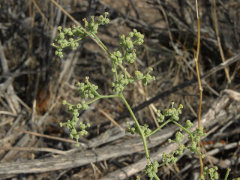
Jim Morefield from Nevada, USA. Creative Commons Attribution-Share Alike 2.0 |
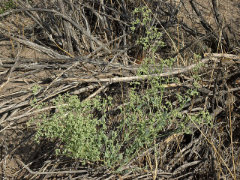 |
| Jim Morefield from Nevada, USA. Creative Commons Attribution-Share Alike 2.0 |
Translate this page:
Summary
Taxonomic Note: This genus was formerly classified in the family Chenopodiaceae. Modern classifications include it within the Amaranthaceae.
Nevada goosefoot is a weak-scented, seed-producing Chenopodium species native to the Great Basin and adjacent regions of the western United States. It thrives in dry, alkaline, or saline soils—particularly desert valleys, sagebrush flats, and open juniper communities. Historically, its seeds were an important staple of the Paiute and other Indigenous groups who valued the species for its abundance, reliability, and ease of harvest. Like many goosefoots, its leaves are less desirable due to acrid or bitter overtones, whereas the seeds provide a high-quality wild grain similar to quinoa and other domesticated relatives. Its tolerance for harsh soils makes it a dependable wild edible in some of the most nutrient-poor habitats of the West.
Physical Characteristics

 Chenopodium nevadense is a ANNUAL growing to 0.6 m (2ft) by 0.3 m (1ft in) at a fast rate.
See above for USDA hardiness. It is hardy to UK zone 5. The flowers are pollinated by Wind.
It is noted for attracting wildlife.
Suitable for: light (sandy) and medium (loamy) soils, prefers well-drained soil and can grow in nutritionally poor soil. Suitable pH: neutral and basic (mildly alkaline) soils and can grow in very alkaline and saline soils.
It cannot grow in the shade. It prefers dry or moist soil and can tolerate drought.
UK Hardiness Map
US Hardiness Map
Synonyms
None
Plant Habitats
Edible Uses
Leaves edible only when boiled and generally of low quality. Seeds are abundant, nutritious, and excellent when toasted or boiled, offering one of the most dependable wild grain resources of the Great Basin. Edible Uses & Rating: Nevada goosefoot is valued primarily for its seeds, which served as a significant food source for Native peoples of the Great Basin. The leaves, although technically edible when cooked, are generally of lower quality than those of species such as pitseed or slimleaf goosefoot and were rarely used as food historically. Seeds, however, are abundant, easy to gather, and rich in nutrients, offering a reliable wild grain even in extremely poor soils. As a traditional food and for modern foragers, Nevada goosefoot earns a high rating for seed edibility and a low rating for leaf edibility [2-3]. Taste, Processing & Kitchen Notes: Leaves tend to have an acrid, salty, or mineral-tinged flavour, often too harsh for raw consumption. Boiling can reduce bitterness but rarely produces a desirable cooked green. The seeds are the true asset. They resemble the small, dark-brown to black, thin-walled grains typical of the genus. Toasting brings out a nutty, quinoa-like aroma, while boiling creates a soft porridge. Seeds are enclosed in a papery pericarp that may adhere but is easily removed by light rubbing or by washing after toasting. Nevada goosefoot grain can be used alone or mixed with other wild seeds, flour, or ground meal. It excels in hot cereals, flatbreads, and savoury dishes [2-3]. Seasonality (Phenology): Plants germinate in spring or early summer as soil moisture allows. Flowering generally occurs in mid-summer, with seed production peaking from late summer into early autumn. Seeds often persist on dried stalks for weeks, allowing flexible harvest times. Leaf quality is best early in the season; seed quality remains high until plants begin to shatter. Safety & Cautions (Food Use): As with all Chenopodium species, leaves contain oxalates and saponins, requiring boiling to reduce harshness. Seeds are generally safe when cooked but should be rinsed if bitterness is detected. Plants grown in saline soils may accumulate minerals that influence flavour. Foraging should avoid contaminated sites due to the plant’s affinity for disturbed ground. Harvest & Processing Workflow: Seeds are harvested when clusters turn dry and pale brown. Rubbing the infructescence releases seeds easily. Winnowing removes most debris, and toasting improves both flavour and handling. Boiled seeds create a soft porridge; toasted seeds can be ground or added whole to other dishes. Leaves may be collected early in the season but rarely justify culinary effort. Cultivar / Selection Notes: No cultivars are recognised. Wild populations vary slightly in leaf shape, scent, and seed colour, but all share similar food qualities. Selective harvesting may encourage more robust local strains. Look-Alikes & Confusion Risks: Nevada goosefoot may resemble C. album, C. pratericola, or C. leptophyllum. Distinguishing features include its habitat preference for alkaline desert soils, its somewhat narrow yet thickened leaves, and its muted, weak scent. Because many goosefoots overlap in morphology, seed and leaf scent, branching habit, and location are often more diagnostic than leaf shape alone. Traditional / Indigenous Use Summary: The Paiute used the seeds as a staple food, collecting them in late summer and grinding them into flour or mixing them with water to make porridges. Their reliance reflects the species’ dependability in marginal desert soils. Documentation of leaf use is sparse, suggesting that seeds were overwhelmingly the primary resource.
References More on Edible Uses
Medicinal Uses
Plants For A Future can not take any responsibility for any adverse effects from the use of plants. Always seek advice from a professional before using a plant medicinally.
None Known
References More on Medicinal Uses
The Bookshop: Edible Plant Books
Our Latest books on Perennial Plants For Food Forests and Permaculture Gardens in paperback or digital formats.
Edible Tropical Plants
Food Forest Plants for Hotter Conditions: 250+ Plants For Tropical Food Forests & Permaculture Gardens.
More
Edible Temperate Plants
Plants for Your Food Forest: 500 Plants for Temperate Food Forests & Permaculture Gardens.
More
More Books
PFAF have eight books available in paperback and digital formats. Browse the shop for more information.
Shop Now
Other Uses
It requires minimal irrigation and tolerates nutrient-deficient substrates. Because it is highly drought-tolerant, it may be of interest in experimental food-forest or restoration projects where soil salinity and dryness limit plant options. Ecology & Wildlife: Seeds feed small birds, rodents, and other granivores. Plants contribute structurally to desert herbaceous layers, providing cover for insects and serving as early-season forage for some wildlife. Its drought tolerance makes it a stabilising species in erosion-prone soils.
Special Uses
References More on Other Uses
Cultivation details
Nevada goosefoot is a high-value wild grain species of the Great Basin, notable for its resilience, abundance, and cultural importance. Though its leaves are of limited culinary use, its seeds are excellent—nutritious, easy to process, and consistently available in arid environments. This makes it a key survival and traditional food plant across much of the desert West. Growing Conditions: Nevada goosefoot is adapted to arid and semi-arid environments, thriving in sandy, gravelly, alkaline, and even saline soils. It tolerates full sun, high temperatures, and low moisture. It appears most frequently in open, exposed habitats where competition from other plants is reduced. Disturbance—wind erosion, grazing, or soil exposure—may increase its abundance. Its ecological behaviour is characteristic of early-successional desert plants. Habitat & Range: This species is native to the western Great Basin, particularly Nevada, western Utah, and parts of eastern California. It also occurs in portions of Idaho and Oregon. Typical habitats include greasewood flats, saltbush communities, sagebrush steppe, juniper woodlands, and alkaline desert basins. Its presence is strongly tied to mineral-rich soils and arid landscapes, although it may appear in disturbed sites beyond its typical range. Size & Landscape Performance: Nevada goosefoot forms upright, moderately bushy plants that blend easily into desert vegetation. It is not ornamental in the traditional sense but contributes volumetric seed production in a compact footprint. Because it is highly drought-tolerant, it may be of interest in experimental food-forest or restoration projects where soil salinity and dryness limit plant options. Cultivation (Horticulture): This species is rarely cultivated but is easy to grow in poor, dry soils. It requires minimal irrigation and tolerates nutrient-deficient substrates. Gardeners experimenting with wild grains may find it productive with little effort. Excess fertility reduces seed quality by producing lush leaf growth at the expense of grain. Direct sowing is preferred, as seeds germinate readily in warm, dry conditions. Pests & Problems: The species is resistant to most pests and diseases common in arid climates. Overwatering can produce weak, elongated growth susceptible to mildew, though this is rarely a concern in natural settings. Seed predation by wildlife may reduce harvest in some areas. Pollination: Flowers are wind-pollinated, lacking showy petals and producing abundant pollen. Seed set is typically high even in harsh desert climates with limited pollinator activity. Identification & Habit: Nevada goosefoot grows as a moderately tall, upright annual, typically 20–60 cm in height but capable of greater size in favourable years. The stems are green to reddish and often somewhat striated. Leaves are simple, alternate, stalked or subsessile, and usually triangular to lanceolate with entire or slightly toothed margins. Leaf surfaces may appear mealy or dusty due to the characteristic scurfy coating found in many goosefoot species. Plants bear numerous small green flowers in dense or loosely arranged clusters at the branch tips and in the leaf axils. As seeds mature, plants often transition to yellowish-brown or pale green, becoming brittle in late summer or autumn. The habit is upright rather than sprawling, and individuals often occur in scattered yet noticeable patches across desert basins.
References Carbon Farming Information and Carbon Sequestration Information
Temperature Converter
Type a value in the Celsius field to convert the value to Fahrenheit:
Fahrenheit:
The PFAF Bookshop
Plants For A Future have a number of books available in paperback and digital form. Book titles include Edible Plants, Edible Perennials, Edible Trees,Edible Shrubs, Woodland Gardening, and Temperate Food Forest Plants. Our new book is Food Forest Plants For Hotter Conditions (Tropical and Sub-Tropical).
Shop Now
Plant Propagation
Propagation is exclusively by seed. Seeds germinate reliably without cold stratification. In cultivated or disturbed areas, plants may reseed freely if not harvested thoroughly. Seedlings establish rapidly and require little care.
Other Names
If available other names are mentioned here
Nevada Goosefoot (Chenopodium nevadense)
Native Range
US. USA. California, Nevada, Oregon.
Weed Potential
Right plant wrong place. We are currently updating this section.
Please note that a plant may be invasive in one area but may not in your area so it's worth checking.
Nevada goosefoot has low to moderate weed potential. It can colonise disturbed soils but seldom spreads aggressively in managed landscapes. It is not known to displace native vegetation outside its natural habitats. Its association with saline and alkaline soils limits its competitiveness in richer environments.
Conservation Status
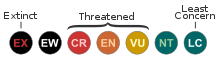
IUCN Red List of Threatened Plants Status : Not available
Growth: S = slow M = medium F = fast. Soil: L = light (sandy) M = medium H = heavy (clay). pH: A = acid N = neutral B = basic (alkaline). Shade: F = full shade S = semi-shade N = no shade. Moisture: D = dry M = Moist We = wet Wa = water.
Now available:
Food Forest Plants for Mediterranean Conditions
350+ Perennial Plants For Mediterranean and Drier Food Forests and Permaculture Gardens.
[Paperback and eBook]
This is the third in Plants For A Future's series of plant guides for food forests tailored to
specific climate zones. Following volumes on temperate and tropical ecosystems, this book focuses
on species suited to Mediterranean conditions—regions with hot, dry summers and cool, wet winters,
often facing the added challenge of climate change.
Read More
Expert comment
Author
Standl.
Botanical References
Links / References
For a list of references used on this page please go here
Readers comment
| Add a comment |
|
If you have important information about this plant that may help other users please add a comment or link below. Only comments or links that are felt to be directly relevant to a plant will be included. If you think a comment/link or information contained on this page is inaccurate or misleading we would welcome your feedback at [email protected]. If you have questions about a plant please use the Forum on this website as we do not have the resources to answer questions ourselves.
* Please note: the comments by website users are not necessarily those held by PFAF and may give misleading or inaccurate information.
|
Subject : Chenopodium nevadense
|
|
|
|