 |
|
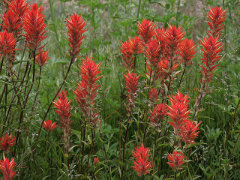
Jim Morefield from Nevada, USA. Creative Commons Attribution-Share Alike 2.0 |
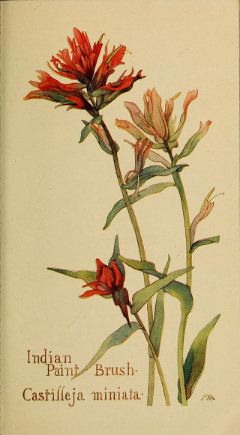 |
| Margaret Neilson Armstrong |
Translate this page:
Summary
Scarlet paintbrush is one of the most widespread and visually striking paintbrushes in western North America, known for its tall stature and vivid scarlet bracts. Although its corollas are edible, this species frequently grows in montane soils that may contain selenium, making consumption minimal and cautious.
Physical Characteristics

 Castilleja miniata is a PERENNIAL growing to 0.8 m (2ft 7in) by 0.5 m (1ft 8in) at a medium rate.
See above for USDA hardiness. It is hardy to UK zone 4. The flowers are pollinated by Hummingbirds, bees, .
It is noted for attracting wildlife.
Suitable for: light (sandy), medium (loamy) and heavy (clay) soils and prefers well-drained soil. Suitable pH: mildly acid, neutral and basic (mildly alkaline) soils. It cannot grow in the shade. It prefers moist soil.
UK Hardiness Map
US Hardiness Map
Synonyms
C. pallida var. miniata (Douglas ex Hook.) A.Gray
Plant Habitats
Edible Uses
Edible Uses & Rating: Edible corollas may contain sweet nectar. Best rating among the four species, but still low-to-moderate due to selenium risk [2-3]. Taste, Processing & Kitchen Notes: Corollas have pleasant sweetness; bracts are resinous and bitter. Corollas can be used fresh as garnish. Nectar is best extracted by immersing corollas in water and reducing into a sweet infusion [2-3]. Seasonality (Phenology):Blooms June–August (earlier at low elevations, later at high). Harvest during open bloom.
References More on Edible Uses
Medicinal Uses
Plants For A Future can not take any responsibility for any adverse effects from the use of plants. Always seek advice from a professional before using a plant medicinally.
None Known
References More on Medicinal Uses
Other Uses
Ornamental - In gardens, thrives when paired with compatible hosts (e.g., penstemon, grasses, asters). Ecology & Wildlife: Highly attractive to hummingbirds, especially due to bright scarlet bracts. Also visited by bumblebees and long-tongued bees.
Special Uses
References More on Other Uses
Cultivation details
Growing Conditions: Found in moist mountain meadows, forest edges, riparian areas, and subalpine slopes. USDA Zone 3–8. Habitat & Range: Widespread across western North America: Alaska to New Mexico, especially the Cascades, Rockies, Sierra Nevada, and coastal mountains. Size & Landscape Performance: Generally 30–80 cm tall, spreading 20–40 cm. In gardens, thrives when paired with compatible hosts (e.g., penstemon, grasses, asters). Cultivation (Horticulture): More easily grown than many paintbrushes but still host-dependent. Requires well-drained soils with consistent moisture. Identification & Habit: A perennial herb 30–80 cm tall, with broad, lanceolate leaves that may be slightly lobed and a dense spike of bright red to orange-red bracts. Stems are upright and often numerous. Flowers bloom from early to mid-summer.
References Carbon Farming Information and Carbon Sequestration Information
Temperature Converter
Type a value in the Celsius field to convert the value to Fahrenheit:
Fahrenheit:
Plant Propagation
Seed propagation with cold stratification. Germinates best in contact with roots of host plants.
Other Names
If available other names are mentioned here
Scarlet Paintbrush, Giant Red Paintbrush, Giant Paintbrush (Castilleja miniata)
Native Range
US. USA. Alaska, Alberta, Arizona, British Columbia, California, Colorado, Idaho, Manitoba, Mexico Northwest, Montana, Nevada, New Mexico, Ontario, Oregon, Saskatchewan, Utah, Washington, Wyoming, Yukon
Weed Potential
Right plant wrong place. We are currently updating this section.
Please note that a plant may be invasive in one area but may not
in your area so it's worth checking.
Moderate only in native meadows; not an invasive species.
Conservation Status
IUCN Red List of Threatened Plants Status : Not available
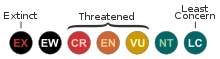
IUCN Red List
Growth: S = slow M = medium F = fast. Soil: L = light (sandy) M = medium H = heavy (clay). pH: A = acid N = neutral B = basic (alkaline). Shade: F = full shade S = semi-shade N = no shade. Moisture: D = dry M = Moist We = wet Wa = water.
Support Plants For A Future
Plants For A Future relies on regular donations to keep our free database and search facilities going, to pay for ongoing research, improvements and enhancements, and to develop and publish new books.
Read more
Choose Currency
Donate in £ GBP
Donate in $ USD
Donate in € EUR
Securely pay via PayPal or Credit/Debit Card without an account.
Expert comment
Author
Douglas ex Benth.
Botanical References
Links / References
For a list of references used on this page please go here
Readers comment
| Add a comment |
|
If you have important information about this plant that may help other users please add a comment or link below. Only comments or links that are felt to be directly relevant to a plant will be included. If you think a comment/link or information contained on this page is inaccurate or misleading we would welcome your feedback at [email protected]. If you have questions about a plant please use the Forum on this website as we do not have the resources to answer questions ourselves.
* Please note: the comments by website users are not necessarily those held by PFAF and may give misleading or inaccurate information.
|
Subject : Castilleja miniata
|
|
|
|