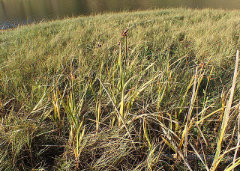
 |
|
Krzysztof Ziarnek, Kenraiz Creative Commons Attribution-Share Alike 4.0 |
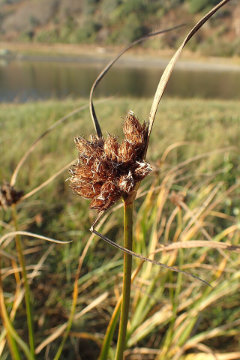 |
| Krzysztof Ziarnek, Kenraiz Creative Commons Attribution-Share Alike 4.0 |
Translate this page:
Summary
Sturdy Bulrush or Saltmarsh bulrush is the coastal, brackish-tolerant counterpart to cosmopolitan bulrush, prized for its edible corms and serviceable seeds in tidal marshes and lagoon edges. It anchors saline substrates, feeds waterfowl, and offers one of the few starchy roots obtainable near the ocean’s edge. USDA Zones 6–10. Clumps reach 0.6–1.5 m tall, spreading 0.6–2 m by rhizomes and corm offsets.
Physical Characteristics

 Bolboschoenus robustus is an evergreen Perennial growing to 1 m (3ft 3in) by 1 m (3ft 3in) at a fast rate.
See above for USDA hardiness. It is hardy to UK zone 7 and is not frost tender. The flowers are pollinated by Wind.
It is noted for attracting wildlife.
Suitable for: light (sandy), medium (loamy) and heavy (clay) soils. Suitable pH: neutral and basic (mildly alkaline) soils and can grow in very alkaline and saline soils.
It cannot grow in the shade. It prefers wet soil and can grow in water.
UK Hardiness Map
US Hardiness Map
Synonyms
Homotypic Synonyms: Schoenoplectus robustus (Pursh) M.T.Strong. Scirpus maritimus var. macrostachyus Michx. Scirpus maritimus var. robustus (Pursh) Kük. Scirpus robustus Pursh
Plant Habitats
Edible Uses
Edible Uses & Rating: Corms are the principal food part: starchy, mild, and satisfying when roasted, boiled, or dried and milled. Seeds contribute a nutty flour after winnowing and roasting. In coastal foraging contexts it is among the best carbohydrate sources available [2-3]. Edibility rating: 4.5/5 for corms; overall 4/5 given habitat limits. Taste, Processing & Kitchen Notes: Fresh corms are firm to hard. Roasting softens and coaxes a chestnut-potato profile with faint sweetness. Boiling followed by mashing yields a coarse puree; drying and milling yield a pleasantly nutty, pale flour good for dumplings or as a thickener. Seeds benefit from roasting before milling to remove any brackish note [2-3]. Seasonality (Phenology): Vegetative growth begins in spring as marsh temperatures rise. Flowering and seed set occur from summer to early autumn. Corms are fullest in late autumn into winter, after aerial parts senesce, mirroring carbohydrate allocation cycles [2-3]. Safety & Cautions (Food Use): Harvest only from clean saltmarshes away from storm drains and legacy contamination. Rinse corms to remove surface salts; parboiling in fresh water reduces residual salinity. Harvest & Processing Workflow: For corms, probe at the base of senesced culms in late autumn, levering up with a narrow spade. Trim, wash, and either roast whole or slice and boil. For flour, slice, dehydrate to brittleness, and mill. For seeds, clip mature heads, dry, rub free, winnow, roast, and grind. Look-Alikes & Confusion Risks: Easily confused with Bolboschoenus maritimus. Both have corms. Local floras separate them by subtle achene morphology and bract metrics; for foraging, the distinction is less critical than correct genus. Distinguish from non-corm-forming Schoenoplectus by digging and checking for true corms. Traditional/Indigenous Use Summary: Coastal peoples have long used corms as starchy food and stems/leaves for matting and thatch. Waterfowl hunting cultures valued dense stands as feeding grounds that concentrated birds seasonally.
References More on Edible Uses
Medicinal Uses
Plants For A Future can not take any responsibility for any adverse effects from the use of plants. Always seek advice from a professional before using a plant medicinally.
None Known
References More on Medicinal Uses
The Bookshop: Edible Plant Books
Our Latest books on Perennial Plants For Food Forests and Permaculture Gardens in paperback or digital formats.
Edible Tropical Plants
Food Forest Plants for Hotter Conditions: 250+ Plants For Tropical Food Forests & Permaculture Gardens.
More
Edible Temperate Plants
Plants for Your Food Forest: 500 Plants for Temperate Food Forests & Permaculture Gardens.
More
More Books
PFAF have eight books available in paperback and digital formats. Browse the shop for more information.
Shop Now
Other Uses
Stems/leaves for matting and thatch. Waterfowl hunting cultures valued dense stands as feeding grounds that concentrated birds seasonally. Ecology & Wildlife: Corms and achenes are eaten by dabbling ducks and geese; stands create nursery habitat for fish and invertebrates in shallow pannes and creeks; root systems improve water clarity by binding fines. Practical chiefly in coastal restoration.
Special Uses
References More on Other Uses
Cultivation details
Identification & Habit: A perennial sedge with triangular stems and a compact, many-spikelet inflorescence near the stem tip, subtended by leaf-like bracts. The key field character is the presence of basal corms—swollen, starchy storage organs that form on short rhizomes at the stem bases. Leaves are reduced and sheathing; plants form tight clumps in intertidal or supratidal zones. Growing Conditions: Thrives in brackish to saline marshes, tidal flats, and lagoon margins with full sun. Tolerates fluctuating salinity and periodic inundation. Best in silty clays and organic mucks with neutral to alkaline reaction. Habitat & Range: Native to Atlantic and Gulf coasts and parts of the Pacific coast of North America; also reported in coastal South America. In the Southwest it is largely restricted to coastal California and estuarine complexes. Size & Landscape Performance: Forms dense clumps that stabilize tidal margins and trap sediments. In living shorelines it supports wave attenuation and accretion, pairing well with Spartina/Distichlis in zonation schemes. Cultivation (Horticulture): Practical chiefly in coastal restoration. Plant corm divisions or rhizome chunks into soft intertidal soils at low tide. Maintain hydrologic regime allowing occasional exposure and flushing. Pests & Problems: Storm events can uproot immature plantings. Prolonged hypersalinity with no freshwater pulses may stunt growth. Grazing by geese can clip young shoots. Cultivar/Selection Notes: No named cultivars; select local ecotypes adapted to specific tidal ranges and salinity bands. Very similar to B. maritimus in floral biology. Primarily wind-pollinated in coastal marshes; animals are not central to pollen movement.
References Carbon Farming Information and Carbon Sequestration Information
Temperature Converter
Type a value in the Celsius field to convert the value to Fahrenheit:
Fahrenheit:
The PFAF Bookshop
Plants For A Future have a number of books available in paperback and digital form. Book titles include Edible Plants, Edible Perennials, Edible Trees,Edible Shrubs, Woodland Gardening, and Temperate Food Forest Plants. Our new book is Food Forest Plants For Hotter Conditions (Tropical and Sub-Tropical).
Shop Now
Plant Propagation
Divide corms in late winter or plant freshly dug corm-rhizome pieces in early spring. Seed can be used with cold-moist stratification; broadcast onto saturated mudflats and protect from scouring.
Other Names
If available other names are mentioned here
Bolboschoenus robustus (Saltmarsh Bulrush / Sturdy Bulrush)
Native Range
US. USA. Alabama, Argentina Northeast, Arkansas, Bahamas, Bermuda, California, Connecticut, Delaware, Florida, Georgia, Guyana, Louisiana, Maine, Maryland, Massachusetts, Mexico Northwest, Mexico Southeast, Mississippi, New Hampshire, New Jersey, New York, North Carolina, Paraguay, Pennsylvania, Rhode I., South Carolina, Suriname, Texas, Uruguay, Venezuela, Virginia
Weed Potential
Right plant wrong place. We are currently updating this section.
Please note that a plant may be invasive in one area but may not in your area so it's worth checking.
Low inland; moderate on suitable tidal flats where it can form dominant stands (a desired trait in restoration). It does not leap into uplands.
Conservation Status
IUCN Red List of Threatened Plants Status : Bolboschoenus robustus is listed as Least Concern.

Growth: S = slow M = medium F = fast. Soil: L = light (sandy) M = medium H = heavy (clay). pH: A = acid N = neutral B = basic (alkaline). Shade: F = full shade S = semi-shade N = no shade. Moisture: D = dry M = Moist We = wet Wa = water.
Now available:
Food Forest Plants for Mediterranean Conditions
350+ Perennial Plants For Mediterranean and Drier Food Forests and Permaculture Gardens.
[Paperback and eBook]
This is the third in Plants For A Future's series of plant guides for food forests tailored to
specific climate zones. Following volumes on temperate and tropical ecosystems, this book focuses
on species suited to Mediterranean conditions—regions with hot, dry summers and cool, wet winters,
often facing the added challenge of climate change.
Read More
Expert comment
Author
(Pursh) Soják
Botanical References
Links / References
For a list of references used on this page please go here
Readers comment
| Add a comment |
|
If you have important information about this plant that may help other users please add a comment or link below. Only comments or links that are felt to be directly relevant to a plant will be included. If you think a comment/link or information contained on this page is inaccurate or misleading we would welcome your feedback at [email protected]. If you have questions about a plant please use the Forum on this website as we do not have the resources to answer questions ourselves.
* Please note: the comments by website users are not necessarily those held by PFAF and may give misleading or inaccurate information.
|
Subject : Bolboschoenus robustus
|
|
|
|