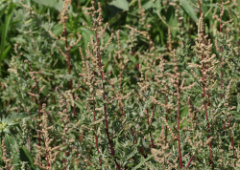
 |
|
(c) James Bailey, some rights reserved (CC BY-NC) |
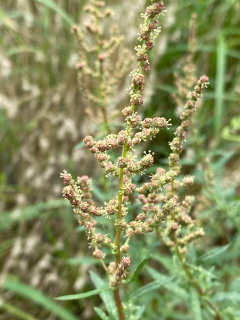 |
| (c) Daniel McNair, some rights reserved (CC BY) |
Translate this page:
Summary
Taxonomic Note: This genus was formerly classified in the family Chenopodiaceae. Modern classifications include it within the Amaranthaceae.
A reliable desert “salt green” for spring pots—simple, boiled, and best when young. Herbaceous native of southern Arizona, New Mexico, Texas; often blooms in spring (earlier than many congeners). Locally known as “salt greens.”
Physical Characteristics

 Atriplex wrightii is an evergreen Shrub growing to 1 m (3ft 3in) by 1 m (3ft 3in) at a medium rate.
See above for USDA hardiness. It is hardy to UK zone 8 and is not frost tender. The flowers are pollinated by Wind.
Suitable for: light (sandy) and medium (loamy) soils, prefers well-drained soil and can grow in nutritionally poor soil. Suitable pH: neutral and basic (mildly alkaline) soils and can grow in very alkaline and saline soils.
It cannot grow in the shade. It prefers dry or moist soil and can tolerate drought.
UK Hardiness Map
US Hardiness Map
Synonyms
Homotypic Synonyms: Obione wrightii (S.Watson) Ulbr. Heterotypic Synonyms: A. radiata J.M.Coult.
Plant Habitats
Edible Uses
Edibility (summary & rating). Leaves esteemed as potherbs by the Pima; boil to temper salts/irritants. Seeds are likely usable as in other Atriplex, though not highlighted here. Edibility rating: 3/5 (good boiled green when young). Parts used & preparation: Leaves - Harvest tender spring growth, boil (change water if needed), and use as a side vegetable. Seeds: If attempted, process as for orache—thresh/winnow/grind; cook [2-3]. Harvest tips. Take only young, tender shoots; if very briny/irritating, blanch, refresh, then finish cooking [2-3]. Traditional uses. Pima potherb (“salt greens”).
References More on Edible Uses
Medicinal Uses
Plants For A Future can not take any responsibility for any adverse effects from the use of plants. Always seek advice from a professional before using a plant medicinally.
None Known
References More on Medicinal Uses
The Bookshop: Edible Plant Books
Our Latest books on Perennial Plants For Food Forests and Permaculture Gardens in paperback or digital formats.
Edible Tropical Plants
Food Forest Plants for Hotter Conditions: 250+ Plants For Tropical Food Forests & Permaculture Gardens.
More
Edible Temperate Plants
Plants for Your Food Forest: 500 Plants for Temperate Food Forests & Permaculture Gardens.
More
More Books
PFAF have eight books available in paperback and digital formats. Browse the shop for more information.
Shop Now
Other Uses
Good for desert swales, ephemeral washes, saline flats
Special Uses
References More on Other Uses
Cultivation details
It is an annual and grows primarily in the desert or dry shrubland biome. The native range of this species is Arizona to W. Texas and Mexico (Sonora, Chihuahua). Season & phenology: Often flowers in spring; leafy flush early with moisture pulses. Identification notes: Scurfy herb, bright gray-green; typical Atriplex bractlets on female flowers; recognized locally as “salt greens.” Habitat & distribution: Desert swales, ephemeral washes, saline flats of s. AZ/NM/TX. Growing conditions & cultivation: Full sun; drought/alkali tolerant; responds to summer rains. Hardiness: Warm-season annual/biennial; reseeds reliably in USDA 7–10. Size & habit: 30–100 cm, branching clumps. Weed potential: Low–moderate. Abundant after disturbance/rains but not typically invasive outside niche. Lookalikes & cautions: Other desert oraches; same oxalate/nitrate precautions—boil and moderate use.
References Carbon Farming Information and Carbon Sequestration Information
Temperature Converter
Type a value in the Celsius field to convert the value to Fahrenheit:
Fahrenheit:
The PFAF Bookshop
Plants For A Future have a number of books available in paperback and digital form. Book titles include Edible Plants, Edible Perennials, Edible Trees,Edible Shrubs, Woodland Gardening, and Temperate Food Forest Plants. Our new book is Food Forest Plants For Hotter Conditions (Tropical and Sub-Tropical).
Shop Now
Plant Propagation
By seed; shallow sow after winter or with summer monsoon moisture.
Other Names
If available other names are mentioned here
Atriplex wrightii — Wright’s Saltweed, Obione wrightii, Atriplex radiata
Native Range
US. Arizona, Mexico Northeast, Mexico Northwest, New Mexico, Texas
Weed Potential
Right plant wrong place. We are currently updating this section.
Please note that a plant may be invasive in one area but may not in your area so it's worth checking.
Low–moderate. Abundant after disturbance/rains but not typically invasive outside niche.
Conservation Status
IUCN Red List of Threatened Plants Status : Not available

| Related Plants
|
| Latin Name | Common Name | Habit | Height | Hardiness | Growth | Soil | Shade | Moisture | Edible | Medicinal | Other |
| Atriplex argentea | Silvery Orach, Silverscale saltbush, Stalked saltbush | Annual | 0.5 |
4-9
| | LM | N | M | 3 | 2 | 2 |
| Atriplex argentea expansa | Silverscale Saltbush | Annual | 0.6 |
-
| | LM | N | M | 2 | 0 | |
| Atriplex californica | California Orach, California saltbush | Perennial | 0.1 |
7-10
| M | LM | N | DM | 3 | 0 | 3 |
| Atriplex canescens | Grey Sage Brush, Fourwing saltbush | Shrub | 1.8 |
3-9
| M | LM | N | DM | 3 | 1 | 3 |
| Atriplex carnosa | Thickleaf Orach | Annual | 0.9 |
-
| | LM | N | DM | 2 | 0 | |
| Atriplex cinerea | Grey Saltbush | Shrub | 2.0 |
9-11
| M | LM | N | DM | 3 | 0 | 3 |
| Atriplex confertifolia | Shadscale, Shadscale saltbush | Shrub | 1.5 |
4-9
| M | LM | N | DM | 3 | 1 | 2 |
| Atriplex coronata | Crownscale | Annual | 0.4 |
-
| | LM | N | DM | 2 | 0 | |
| Atriplex dimorphostegia | | Annual | 0.2 |
-
| | LM | N | DM | 2 | 0 | |
| Atriplex elegans | Wheelscale Saltbush | Annual | 0.2 |
0-0
| | LM | N | DM | 3 | 0 | 1 |
| Atriplex glabriuscula | Scotland orache, Maritime saltbush, Frankton's saltbush, Northeastern saltbush | Annual | 0.3 |
0-0
| | LM | N | DM | 2 | 0 | |
| Atriplex gmelinii | Gmelin's saltbush | Annual | 0.5 |
0-0
| | LM | N | DM | 2 | 0 | |
| Atriplex halimus | Sea Orach, Saltbush | Shrub | 2.0 |
7-10
| M | LM | N | DM | 5 | 1 | 3 |
| Atriplex hastata | Hastate Orach | Annual | 0.8 |
0-0
| | LM | N | DM | 3 | 0 | 2 |
| Atriplex hortensis | Orach, Garden orache | Annual | 1.8 |
5-9
| F | LM | N | M | 4 | 2 | 3 |
| Atriplex lapathifolia | | Annual | 0.9 |
-
| | LM | N | DM | 3 | 0 | |
| Atriplex lentiformis | Quail Bush, Big saltbush, Quailbush, | Shrub | 3.0 |
8-11
| M | LM | N | DM | 2 | 1 | 3 |
| Atriplex littoralis | Grassleaf orache | Biennial | 0.7 |
4-11
| F | LMH | N | DM | 2 | 0 | 0 |
| Atriplex maximowicziana | Maximowicz's saltbush | Perennial | 0.8 |
0-0
| | LM | N | DM | 2 | 0 | |
| Atriplex mucronata | | Annual | 0.4 |
-
| | LMH | N | DM | 2 | 0 | |
| Atriplex nummularia | Giant Saltbush, Bluegreen saltbush | Shrub | 3.5 |
7-10
| M | LM | N | DM | 3 | 2 | 3 |
| Atriplex nuttallii | Nuttall's Saltbush | Shrub | 0.9 |
5-9
| M | LM | N | DM | 4 | 0 | 2 |
| Atriplex obovata | Mound Saltbrush | Shrub | 1.0 |
5-9
| M | LMH | N | DM | 3 | 0 | 3 |
| Atriplex patula | Spreading Orach, Spear saltbush | Annual | 0.8 |
0-0
| | LM | N | M | 3 | 1 | 0 |
| Atriplex polycarpa | Cattle spinach | Shrub | 1.0 |
8-10
| M | LM | N | DM | 1 | 0 | 4 |
| Atriplex powellii | Powell's Saltweed | Annual | 0.7 |
4-9
| | LM | N | DM | 3 | 0 | 2 |
| Atriplex rosea | Tumbling or redscale saltweed | Annual | 0.6 |
3-10
| F | LM | N | DM | 2 | 2 | 2 |
| Atriplex saccaria | Sack Saltbush | Annual | 0.3 |
5-9
| | LM | N | DM | 3 | 0 | 0 |
| Atriplex semibaccata | Australian Saltbush. Australian saltbush, Creeping saltbush | Shrub | 0.5 |
8-11
| F | LMH | N | DM | 3 | 0 | 3 |
| Atriplex serenana | Bractscale, Davidson's bractscale | Annual | 3.0 |
8-11
| | LM | N | DM | 3 | 0 | 0 |
|
|
Growth: S = slow M = medium F = fast. Soil: L = light (sandy) M = medium H = heavy (clay). pH: A = acid N = neutral B = basic (alkaline). Shade: F = full shade S = semi-shade N = no shade. Moisture: D = dry M = Moist We = wet Wa = water.
Now available:
Food Forest Plants for Mediterranean Conditions
350+ Perennial Plants For Mediterranean and Drier Food Forests and Permaculture Gardens.
[Paperback and eBook]
This is the third in Plants For A Future's series of plant guides for food forests tailored to
specific climate zones. Following volumes on temperate and tropical ecosystems, this book focuses
on species suited to Mediterranean conditions—regions with hot, dry summers and cool, wet winters,
often facing the added challenge of climate change.
Read More
Expert comment
Author
S.Watson
Botanical References
Links / References
For a list of references used on this page please go here
Readers comment
| Add a comment |
|
If you have important information about this plant that may help other users please add a comment or link below. Only comments or links that are felt to be directly relevant to a plant will be included. If you think a comment/link or information contained on this page is inaccurate or misleading we would welcome your feedback at [email protected]. If you have questions about a plant please use the Forum on this website as we do not have the resources to answer questions ourselves.
* Please note: the comments by website users are not necessarily those held by PFAF and may give misleading or inaccurate information.
|
Subject : Atriplex wrightii
|
|
|
|