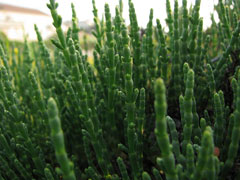
 |
|
http://flickr.com/photos/stonebird/3423682491 |
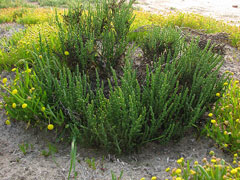 |
| http://flickr.com/photos/73431753@N00/3423682501 |
Translate this page:
Summary
Taxonomic Note: This genus was formerly classified in the family Chenopodiaceae. Modern classifications include it within the Amaranthaceae.
Parish’s glasswort is a perennial halophyte of California and Baja saltmarshes. It plays an important ecological role in stabilizing coastal sediments and providing habitat for wildlife. While edible, with young stems and seeds occasionally used as food, its heavy salt load limits it as a dietary resource. Traditionally valued for its salty ashes in glass- and soap-making, it remains more important ecologically than as a human food plant. Parish’s glasswort is edible mainly for its young stems, which are salty, juicy, and sometimes bitter, making them suitable for pickling, sautéing, or use as a salty garnish. Its seeds are edible but too small and tedious to collect in large amounts. Overall, it is a minor wild vegetable, best used sparingly due to its high salt content.
Physical Characteristics

 Arthrocnemum subterminale is a PERENNIAL growing to 0.3 m (1ft) by 0.3 m (1ft in).
See above for USDA hardiness. It is hardy to UK zone 9. It is in flower from June to September. The species is hermaphrodite (has both male and female organs).
Suitable for: light (sandy), medium (loamy) and heavy (clay) soils. Suitable pH: mildly acid, neutral and basic (mildly alkaline) soils and can grow in very alkaline soils.
It cannot grow in the shade. It prefers moist soil.
UK Hardiness Map
US Hardiness Map
Synonyms
Plant Habitats
Cultivated Beds;
Edible Uses
Edible Parts: Leaves Seed
Edible Uses:
Young stems of Parish’s glasswort are edible fresh or cooked, though they contain very high levels of salt and should be eaten only in moderation. Flavor is crisp, juicy, and saline—somewhat like sea asparagus or samphire—though often with a slight bitterness. Cooking or parboiling helps reduce the harshness and salt content. The seeds are also edible and were historically used as food by coastal Native Americans, though their small size makes them labor-intensive to harvest and process. Seeds can be dried and ground into a coarse flour, or boiled into a porridge, but availability is highly seasonal. As with related glassworts, fruits and seeds are tiny, enclosed in papery utricles, and difficult to separate from chaff. Overconsumption of either seeds or stems can contribute to excessive salt intake [2-3]. Edibility Rating: 3/5 – useful as a wild vegetable or emergency grain, but not a staple. Leaves - raw or cooked[172]. Seed - ground into a meal[257].
References More on Edible Uses
Medicinal Uses
Plants For A Future can not take any responsibility for any adverse effects from the use of plants. Always seek advice from a professional before using a plant medicinally.
Stems and ashes also had minor medicinal and preservative applications.
References More on Medicinal Uses
The Bookshop: Edible Plant Books
Our Latest books on Perennial Plants For Food Forests and Permaculture Gardens in paperback or digital formats.
Edible Tropical Plants
Food Forest Plants for Hotter Conditions: 250+ Plants For Tropical Food Forests & Permaculture Gardens.
More
Edible Temperate Plants
Plants for Your Food Forest: 500 Plants for Temperate Food Forests & Permaculture Gardens.
More
More Books
PFAF have eight books available in paperback and digital formats. Browse the shop for more information.
Shop Now
Other Uses
Traditionally, dried glasswort stems were burned for their ash, which is rich in soda and potash, and used in soap- and glass-making (“glasswort” comes from this use). Dense mats of Parish’s glasswort help trap sediments and stabilize coastal saltmarshes, improving habitat for birds and invertebrates.
Special Uses
References More on Other Uses
Cultivation details
Habitat & Distribution: Parish’s glasswort is a halophyte (salt-loving plant) native to coastal southern California and northern Baja California, Mexico. It grows in salt marshes, estuaries, tidal flats, and other saline habitats where few plants can survive. Growth & Ecology: This species is a perennial subshrub, spreading into mats. Like other saltworts, it tolerates extreme salinity and periodic inundation. In coastal ecosystems, it plays a key role in soil stabilization, salt cycling, and wildlife habitat. Cultivation: Rarely cultivated, but potentially useful for saline soil rehabilitation. It prefers saline or brackish soils in full sun and tolerates periodic flooding. Best growth occurs in coastal wetlands. Typically 20–80 cm tall, forming low shrubby clumps. Likely hardy in USDA zones 8–11, restricted to mild coastal climates. Not frost-tolerant. We have very little information on this species and do not know if it will be hardy in Britain, though judging by its native range it is unlikely succeed outdoors in any but the mildest parts of the country. The plants native habitat will give some idea of its cultivation needs.
References Carbon Farming Information and Carbon Sequestration Information
Temperature Converter
Type a value in the Celsius field to convert the value to Fahrenheit:
Fahrenheit:
The PFAF Bookshop
Plants For A Future have a number of books available in paperback and digital form. Book titles include Edible Plants, Edible Perennials, Edible Trees,Edible Shrubs, Woodland Gardening, and Temperate Food Forest Plants. Our new book is Food Forest Plants For Hotter Conditions (Tropical and Sub-Tropical).
Shop Now
Plant Propagation
Seed - we have no information for this species but suggest sowing the seed as soon as it is ripe if this is possible, otherwise in spring, in a greenhouse in a light sandy compost. When they are large enough to handle, prick the seedlings out into individual pots and plant them out in the summer. Division might be possible in the spring.
Other Names
If available other names are mentioned here
Arthrocnemum subterminale (Parish) Standl. (= Salicornia subterminalis Parish)
Common name: Parish’s glasswort
Native Range
California, Mexico Northwest
Weed Potential
Right plant wrong place. We are currently updating this section.
Please note that a plant may be invasive in one area but may not in your area so it's worth checking.
Low – highly specialized for saline environments and unlikely to spread beyond them.
Conservation Status
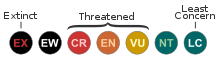
IUCN Red List of Threatened Plants Status :
Growth: S = slow M = medium F = fast. Soil: L = light (sandy) M = medium H = heavy (clay). pH: A = acid N = neutral B = basic (alkaline). Shade: F = full shade S = semi-shade N = no shade. Moisture: D = dry M = Moist We = wet Wa = water.
Now available:
Food Forest Plants for Mediterranean Conditions
350+ Perennial Plants For Mediterranean and Drier Food Forests and Permaculture Gardens.
[Paperback and eBook]
This is the third in Plants For A Future's series of plant guides for food forests tailored to
specific climate zones. Following volumes on temperate and tropical ecosystems, this book focuses
on species suited to Mediterranean conditions—regions with hot, dry summers and cool, wet winters,
often facing the added challenge of climate change.
Read More
Expert comment
Author
Parish.
Botanical References
270
Links / References
For a list of references used on this page please go here
Readers comment
| Add a comment |
|
If you have important information about this plant that may help other users please add a comment or link below. Only comments or links that are felt to be directly relevant to a plant will be included. If you think a comment/link or information contained on this page is inaccurate or misleading we would welcome your feedback at [email protected]. If you have questions about a plant please use the Forum on this website as we do not have the resources to answer questions ourselves.
* Please note: the comments by website users are not necessarily those held by PFAF and may give misleading or inaccurate information.
|
Subject : Arthrocnemum subterminale
|
|
|
|