 |
|
http://commons.wikimedia.org/wiki/User:Stan_Shebs |
 |
| http://commons.wikimedia.org/wiki/User:Stan_Shebs |
Translate this page:
Summary
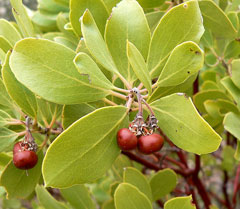
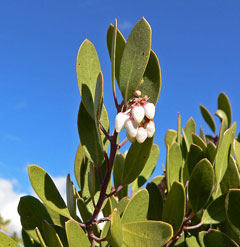
Grayleaf manzanita is one of the best food manzanitas, producing abundant, relatively palatable fruits and edible seeds. A key resource in Southwestern food traditions.
Physical Characteristics

 Arctostaphylos pungens is an evergreen Shrub growing to 2 m (6ft) by 2 m (6ft).
See above for USDA hardiness. It is hardy to UK zone 8. The species is hermaphrodite (has both male and female organs) and is pollinated by Insects.
Suitable for: light (sandy) and medium (loamy) soils and prefers well-drained soil. Suitable pH: mildly acid soils and can grow in very acid soils.
It can grow in semi-shade (light woodland) or no shade. It prefers dry or moist soil.
UK Hardiness Map
US Hardiness Map
Synonyms
Homotypic Synonyms: Daphnidostaphylis pungens (Kunth) Klotzsch. Uva-ursi pungens (Kunth) Abrams
Plant Habitats
Woodland Garden Sunny Edge;
Edible Uses
Edible Parts: Fruit
Edible Uses:
Fruits are edible and among the best-tasting manzanitas, less astringent than A. patula. The red to reddish-brown drupes contain 4–8 nutlets, which are also edible. Unripe fruits can be tart, but they are often palatable. Mature fruits are sweet-tart with powdery flesh. Flowers can be steeped into tea [2-3]. Fruit - raw or cooked[257]. An agreeable acid flavour, but the fruit is dry and mealy[95]. Hard to digest, the fruit should be eaten in moderation[95]. It can be dried and ground into a powder and then used as mush or as a flavouring in soups, etc[257]. A cooling drink can be made from the fruit[161, 257]. Fruits ground into meal for mush, cakes, or cider-like drinks. Historically important to Native American diets [2-3].
References More on Edible Uses
Medicinal Uses
Plants For A Future can not take any responsibility for any adverse effects from the use of plants. Always seek advice from a professional before using a plant medicinally.
Astringent Skin
An infusion of the leaves is used in the treatment of diarrhoea[257]. An infusion is also used in the treatment of the rash caused by poison oak, Toxicodendron diversiloba[257]. Leaves are sometimes used as mild astringents.
References More on Medicinal Uses
The Bookshop: Edible Plant Books
Our Latest books on Perennial Plants For Food Forests and Permaculture Gardens in paperback or digital formats.
Edible Tropical Plants
Food Forest Plants for Hotter Conditions: 250+ Plants For Tropical Food Forests & Permaculture Gardens.
More
Edible Temperate Plants
Plants for Your Food Forest: 500 Plants for Temperate Food Forests & Permaculture Gardens.
More
More Books
PFAF have eight books available in paperback and digital formats. Browse the shop for more information.
Shop Now
Other Uses
Dye Fuel Wood
A yellowish-brown dye is obtained from the leaves, it does not require a mordant[168]. The wood makes a good fuel, producing a long-lasting hot fire[257]. The hard wood has been used for making small tools, awl handles etc[257].
Special Uses
References More on Other Uses
Cultivation details
Evergreen shrub, 1–3 m tall, with gray-green leaves and smooth reddish bark. Forms dense thickets that stabilize soils on slopes.. Requires a deep moist well-drained light or medium lime-free loam in sun or semi-shade[3, 11, 166, 200], but plants produce less fruit when they are grown in the shade[200]. This species is closely related to A. manzanita[11]. Plants resent root disturbance and should be placed in their final positions as soon as possible[11, 134]. Habitat & Growing Conditions: Grows in chaparral, shrub oak, juniper, and pinyon pine communities from California to Texas and into Mexico. Blooms February–June. Prefers well-drained, dry soils in sunny exposures.
References Carbon Farming Information and Carbon Sequestration Information
Temperature Converter
Type a value in the Celsius field to convert the value to Fahrenheit:
Fahrenheit:
The PFAF Bookshop
Plants For A Future have a number of books available in paperback and digital form. Book titles include Edible Plants, Edible Perennials, Edible Trees,Edible Shrubs, Woodland Gardening, and Temperate Food Forest Plants. Our new book is Food Forest Plants For Hotter Conditions (Tropical and Sub-Tropical).
Shop Now
Plant Propagation
Seed - best sown in a greenhouse as soon as it is ripe. Pre-soak dried seed in boiling water for 10 - 20 seconds or burn some straw on top of them and then stratify at 2 - 5°c for 2 months[11, 200]. The seed usually germinates in 2 - 3 months at 15°c[134]. When large enough to handle, prick the seedlings out into individual pots and grow them on in a cold frame or greenhouse for at least their first winter. Plant out in late spring or early summer. Cuttings of side shoots of the current season's growth, 5 - 8cm with a heel, August to December in a frame. The cuttings are very slow and can take a year to root[1, 78]. Division in early spring. Take care because the plant resents root disturbance. Pot the divisions up and keep them in a lightly shaded position in a cold frame or greenhouse until they are growing away actively. Layering in spring[200].
Other Names
If available other names are mentioned here
Mexican, Pointleaf, or Grayleaf Manzanita (Arctostaphylos pungens Kunth)
Native Range
NORTHERN AMERICA: United States (New Mexico, Texas, Arizona, California (south), Utah (south)), Mexico (Chihuahua, Coahuila de Zaragoza, Durango, Nuevo León, San Luis Potosí, Sinaloa, Sonora, Tamaulipas, Zacatecas, Baja California (Norte), Aguascalientes, Chiapas, Colima, Guanajuato, Hidalgo, Jalisco, México, Michoacán de Ocampo, Morelos, Nayarit, Oaxaca, Puebla, Querétaro, Tlaxcala, Veracruz de Ignacio de la Llave, Ciudad de México)
Weed Potential
Right plant wrong place. We are currently updating this section.
Please note that a plant may be invasive in one area but may not
in your area so it's worth checking.
Low in its native range; can dominate chaparral landscapes but not invasive beyond.
Conservation Status
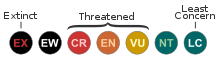
IUCN Red List of Threatened Plants Status :
IUCN Red List
| Related Plants
|
| Latin Name | Common Name | Habit | Height | Hardiness | Growth | Soil | Shade | Moisture | Edible | Medicinal | Other |
| Arctostaphylos alpina | Alpine Bearberry | Shrub | 0.1 |
-
| | LM | SN | M | 2 | 1 | |
| Arctostaphylos columbiana | Hairy Manzanita | Shrub | 1.5 |
6-9
| | LM | SN | M | 2 | 1 | 2 |
| Arctostaphylos glauca | Bigberry Manzanita | Shrub | 4.0 |
7-10
| | LM | SN | DM | 2 | 2 | 3 |
| Arctostaphylos manzanita | Manzanita, Whiteleaf manzanita, Konocti manzanita, Contra Costa manzanita, Roof's manzanita, Wieslan | Shrub | 2.0 |
7-10
| M | LM | SN | DM | 3 | 1 | 3 |
| Arctostaphylos nevadensis | Pine-Mat Manzanita | Shrub | 0.1 |
5-9
| M | LM | SN | M | 2 | 1 | 3 |
| Arctostaphylos parryana | Parry Manzanita | Shrub | 1.8 |
-
| | LM | SN | DM | 1 | 0 | 1 |
| Arctostaphylos patula | Greenleaf Manzanita | Shrub | 2.0 |
5-9
| | LM | SN | M | 3 | 1 | 1 |
| Arctostaphylos pringlei | Stickleaf Manzanita | Shrub | 2.0 |
7-9
| M | LM | N | DM | 3 | 0 | 1 |
| Arctostaphylos stanfordiana | Stanford's manzanita, Rincon manzanita | Shrub | 1.5 |
5-9
| | LM | SN | DM | 3 | 0 | 1 |
| Arctostaphylos tomentosa | Downy Manzanita, Woollyleaf manzanita, Brittleleaf manzanita, Dacite manzanita, Rosy manzanita, San | Shrub | 1.5 |
7-10
| | LM | SN | M | 3 | 3 | 3 |
| Arctostaphylos uva-ursi | Bearberry, Kinnikinnick | Shrub | 0.1 |
2-8
| M | LM | FSN | M | 3 | 4 | 4 |
| Vaccinium arctostaphylos | Caucasian Whortleberry | Shrub | 3.0 |
5-9
| | LM | SN | M | 3 | 0 | 0 |
|
Growth: S = slow M = medium F = fast. Soil: L = light (sandy) M = medium H = heavy (clay). pH: A = acid N = neutral B = basic (alkaline). Shade: F = full shade S = semi-shade N = no shade. Moisture: D = dry M = Moist We = wet Wa = water.
Now available:
Food Forest Plants for Mediterranean Conditions
350+ Perennial Plants For Mediterranean and Drier Food Forests and Permaculture Gardens.
[Paperback and eBook]
This is the third in Plants For A Future's series of plant guides for food forests tailored to
specific climate zones. Following volumes on temperate and tropical ecosystems, this book focuses
on species suited to Mediterranean conditions—regions with hot, dry summers and cool, wet winters,
often facing the added challenge of climate change.
Read More
Expert comment
Author
Kunth.
Botanical References
11
Links / References
For a list of references used on this page please go here
Readers comment
© 2010, Plants For A Future. Plants For A Future is a charitable company limited by guarantee, registered in England and Wales. Charity No. 1057719, Company No. 3204567.