 |
|
|
 |
| http://flickr.com/photos/nofolete/2943660314 |
Translate this page:
Summary
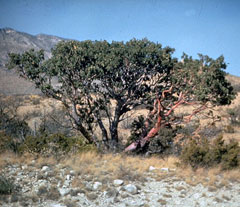
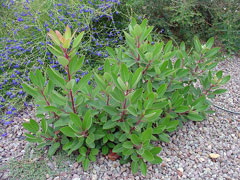
Texas madrone is a smaller evergreen tree or shrub, found in the southwestern U.S. and Mexico, including Texas, New Mexico, and the Guadalupe Mountains. It differs from Arizona madrone by having more rounded leaves with U-shaped bases.
Physical Characteristics

 Arbutus xalapensis is an evergreen Tree growing to 12 m (39ft 4in) at a slow rate.
See above for USDA hardiness. It is hardy to UK zone 8. It is in leaf all year, in flower from July to August. The species is hermaphrodite (has both male and female organs) and is pollinated by Bees. The plant is self-fertile.
Suitable for: light (sandy) and medium (loamy) soils and prefers well-drained soil. Suitable pH: mildly acid soils. It can grow in semi-shade (light woodland) or no shade. It prefers dry or moist soil.
UK Hardiness Map
US Hardiness Map
Synonyms
Plant Habitats
Woodland Garden Canopy; Secondary;
Edible Uses
Edible Parts: Fruit
Edible Uses:
Its red, bumpy fruits are edible when ripe, though they can cause nausea if eaten in excess. The berries are sweet but mild, similar in character to Arizona madrone. Unfortunately, they are highly susceptible to fungal spoilage if not harvested promptly. Fruits were eaten fresh or dried and could be ground for flour or used in beverages [2-3]. Fruit - raw[161, 177]. Edibility rating: 3/5 – Pleasant fruits, but less reliable in storage than Arizona madrone.
References More on Edible Uses
Medicinal Uses
Plants For A Future can not take any responsibility for any adverse effects from the use of plants. Always seek advice from a professional before using a plant medicinally.
None known
References More on Medicinal Uses
The Bookshop: Edible Plant Books
Our Latest books on Perennial Plants For Food Forests and Permaculture Gardens in paperback or digital formats.
Edible Tropical Plants
Food Forest Plants for Hotter Conditions: 250+ Plants For Tropical Food Forests & Permaculture Gardens.
More
Edible Temperate Plants
Plants for Your Food Forest: 500 Plants for Temperate Food Forests & Permaculture Gardens.
More
More Books
PFAF have eight books available in paperback and digital formats. Browse the shop for more information.
Shop Now
Other Uses
Wood
The berries were sometimes fermented into drinks. The tree’s ornamental qualities—smooth red bark, white flowers, and red berries—make it valued in landscaping. Wildlife such as birds and mammals also feed on the fruits.
Special Uses
References More on Other Uses
Cultivation details
Requires a lime-free nutrient-rich well-drained moisture-retentive soil in sun or semi-shade and shelter from cold drying winds, especially when young[200]. This species thrives on limestone soils and in dry conditions[260]. Plants are not very hardy in the colder areas of the country, tolerating temperatures down to about -10°c[200].
References Carbon Farming Information and Carbon Sequestration Information
Temperature Converter
Type a value in the Celsius field to convert the value to Fahrenheit:
Fahrenheit:
The PFAF Bookshop
Plants For A Future have a number of books available in paperback and digital form. Book titles include Edible Plants, Edible Perennials, Edible Trees,Edible Shrubs, Woodland Gardening, and Temperate Food Forest Plants. Our new book is Food Forest Plants For Hotter Conditions (Tropical and Sub-Tropical).
Shop Now
Plant Propagation
Seed - best surface sown in a cold frame as soon as it is ripe. Stored seed should be soaked for 5 - 6 days in warm water and then surface sown in a shady position in a greenhouse[78]. Do not allow the compost to become dry. 6 weeks cold stratification helps[134]. The seed usually germinates well in 2 - 3 months at 20°c[134]. Seedlings are prone to damp off[184], they are best transplanted to individual pots as soon as they are large enough to handle and should be kept well ventilated. Grow them on in a greenhouse for their first winter and then plant out in late spring after the last expected frosts[K]. Basal cuttings in late winter[200]. Cuttings of mature wood of the current season's growth, November/December in a frame. Poor percentage[78]. Layering of young wood - can take 2 years[1, 200].
Other Names
If available other names are mentioned here
Texas Madrone (Arbutus xalapensis Kunth = A. texana Buckley)
Native Range
NORTHERN AMERICA: United States (New Mexico (south), Texas), Mexico (Durango, Nuevo León, San Luis Potosí, Sinaloa, Sonora, Tamaulipas, Zacatecas, Chiapas, Guanajuato, Guerrero, Hidalgo, Jalisco, México, Michoacán de Ocampo, Morelos, Nayarit, Oaxaca, Puebla, Querétaro, Tlaxcala, Veracruz de Ignacio de la Llave, Ciudad de México) SOUTHERN AMERICA: Guatemala, Honduras, Nicaragua, El Salvador
Weed Potential
Right plant wrong place. We are currently updating this section.
Please note that a plant may be invasive in one area but may not in your area so it's worth checking.
None. A regional specialty species with no invasive tendencies.
Conservation Status
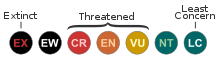
IUCN Red List of Threatened Plants Status :
Growth: S = slow M = medium F = fast. Soil: L = light (sandy) M = medium H = heavy (clay). pH: A = acid N = neutral B = basic (alkaline). Shade: F = full shade S = semi-shade N = no shade. Moisture: D = dry M = Moist We = wet Wa = water.
Now available:
Food Forest Plants for Mediterranean Conditions
350+ Perennial Plants For Mediterranean and Drier Food Forests and Permaculture Gardens.
[Paperback and eBook]
This is the third in Plants For A Future's series of plant guides for food forests tailored to
specific climate zones. Following volumes on temperate and tropical ecosystems, this book focuses
on species suited to Mediterranean conditions—regions with hot, dry summers and cool, wet winters,
often facing the added challenge of climate change.
Read More
Expert comment
Author
Kunth.
Botanical References
200274
Links / References
For a list of references used on this page please go here
Readers comment