 |
|
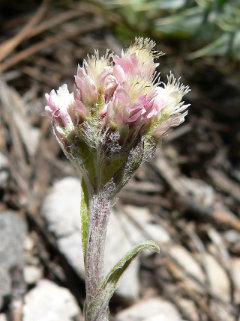
Stan Shebs Creative Commons Attribution-Share Alike 3.0 |
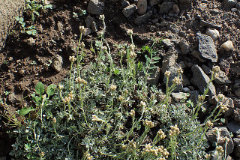 |
| Krzysztof Ziarnek, Kenraiz Creative Commons Attribution-Share Alike 4.0 |
Translate this page:
Summary
Rosy pussytoes (Antennaria rosea) is a low, perennial, mat-forming species of the sunflower family (Asteraceae). It is native to mountain meadows, grasslands, and alpine slopes across western North America. Plants are typically 5–20 cm tall, spreading by rhizomes and stolons to form persistent groundcover. Leaves are small, spoon- to lance-shaped, and densely woolly, while the flower heads occur in clusters and are usually pink-tinted, giving the species its common name. Male and female flowers are produced on separate plants.
Physical Characteristics

 Antennaria rosea is a PERENNIAL growing to 0.2 m (0ft 8in) by 0.2 m (0ft 8in) at a fast rate.
See above for USDA hardiness. It is hardy to UK zone 4 and is not frost tender. The flowers are pollinated by Bees, Insects.
It is noted for attracting wildlife.
Suitable for: light (sandy) and medium (loamy) soils and prefers well-drained soil. Suitable pH: mildly acid, neutral and basic (mildly alkaline) soils. It cannot grow in the shade. It prefers dry or moist soil.
UK Hardiness Map
US Hardiness Map
Synonyms
Accepted Infraspecifics: A. rosea subsp. arida (E.E.Nelson) R.J.Bayer. A. rosea subsp. confinis (Greene) R.J.Bayer. A.a subsp. pulvinata (Greene) R.J.Bayer. A. rosea subsp. rosea.
Plant Habitats
Edible Uses
The leaves can be chewed like gum, though they provide no real nutritional value. Their main appeal is as a mild-tasting, slightly fibrous chew rather than as a food source. Unlike littleleaf pussytoes (A. parvifolia), where the dense hairs make leaves unpleasant to eat, A. rosea has been noted in ethnobotanical records as being casually chewed by Native Americans. Beyond this, the species has little food use and is not considered an important edible plant [2-3].
References More on Edible Uses
Medicinal Uses
Plants For A Future can not take any responsibility for any adverse effects from the use of plants. Always seek advice from a professional before using a plant medicinally.
None Known
References More on Medicinal Uses
The Bookshop: Edible Plant Books
Our Latest books on Perennial Plants For Food Forests and Permaculture Gardens in paperback or digital formats.

Edible Tropical Plants
Food Forest Plants for Hotter Conditions: 250+ Plants For Tropical Food Forests & Permaculture Gardens.
More

Edible Temperate Plants
Plants for Your Food Forest: 500 Plants for Temperate Food Forests & Permaculture Gardens.
More
More Books
PFAF have eight books available in paperback and digital formats. Browse the shop for more information.
Shop Now
Other Uses
While there are no significant records of medicinal applications, rosy pussytoes plays a role in soil stabilization and erosion control, as its stoloniferous mats bind loose soil in alpine and subalpine habitats. Its nectar supports native pollinators, and its pink-tinged flowers make it an attractive component of wildflower and rock gardens.
Special Uses
References More on Other Uses
Cultivation details
Habitat & Growing Conditions: Rosy pussytoes thrives in open meadows, dry slopes, alpine tundra, and prairies, usually in well-drained sandy or rocky soils. It is adapted to full sun and low to moderate soil moisture. Its tolerance for drought and cold makes it well suited to upland conditions. Growth & Ecology: This species spreads steadily by rhizomes and stolons, forming low mats that persist for many years. It competes successfully in dry, nutrient-poor soils but is not aggressive outside of its natural habitats. The hairy leaves conserve moisture and deter herbivory. Hardy in USDA zones 3–8, capable of surviving cold alpine winters and short growing seasons.
References Carbon Farming Information and Carbon Sequestration Information
Temperature Converter
Type a value in the Celsius field to convert the value to Fahrenheit:
Fahrenheit:
The PFAF Bookshop
Plants For A Future have a number of books available in paperback and digital form. Book titles include Edible Plants, Edible Perennials, Edible Trees,Edible Shrubs, Woodland Gardening, and Temperate Food Forest Plants. Our new book is Food Forest Plants For Hotter Conditions (Tropical and Sub-Tropical).
Shop Now
Plant Propagation
Seed. Division of stolons.
Other Names
If available other names are mentioned here
Rosy Pussy Toes (Antennaria rosea Greene).
Native Range
Alaska, Alberta, Arizona, British Columbia, California, Colorado, Greenland, Idaho, Labrador, Maine, Manitoba, Michigan, Minnesota, Montana, Nevada, New Mexico, Newfoundland, North Dakota, Northwest Territories, Nunavut, Ontario, Oregon, Québec, Saskatchewan, South Dakota, Utah, Washington, Wyoming, Yukon
Weed Potential
Right plant wrong place. We are currently updating this section.
Please note that a plant may be invasive in one area but may not in your area so it's worth checking.
Not considered invasive. It spreads locally in mountain meadows and dry prairies but does not aggressively colonize disturbed ground outside its native range.
Conservation Status
IUCN Red List of Threatened Plants Status : Not available
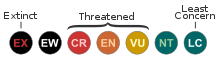
Growth: S = slow M = medium F = fast. Soil: L = light (sandy) M = medium H = heavy (clay). pH: A = acid N = neutral B = basic (alkaline). Shade: F = full shade S = semi-shade N = no shade. Moisture: D = dry M = Moist We = wet Wa = water.
Now available:
Food Forest Plants for Mediterranean Conditions
350+ Perennial Plants For Mediterranean and Drier Food Forests and Permaculture Gardens.
[Paperback and eBook]
This is the third in Plants For A Future's series of plant guides for food forests tailored to
specific climate zones. Following volumes on temperate and tropical ecosystems, this book focuses
on species suited to Mediterranean conditions—regions with hot, dry summers and cool, wet winters,
often facing the added challenge of climate change.
Read More
Expert comment
Author
Greene
Botanical References
Links / References
For a list of references used on this page please go here
Readers comment
| Add a comment |
|
If you have important information about this plant that may help other users please add a comment or link below. Only comments or links that are felt to be directly relevant to a plant will be included. If you think a comment/link or information contained on this page is inaccurate or misleading we would welcome your feedback at [email protected]. If you have questions about a plant please use the Forum on this website as we do not have the resources to answer questions ourselves.
* Please note: the comments by website users are not necessarily those held by PFAF and may give misleading or inaccurate information.
|
Subject : Antennaria rosea
|
|
|
|