 |
|
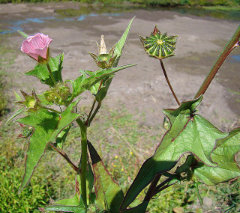
Dick Culbert from Gibsons, B.C., Canada Creative Commons Attribution 2.0 |
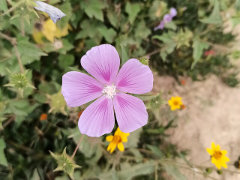 |
| Juan Carlos Fonseca Mata Creative Commons Attribution 4.0 |
Translate this page:
Summary
Taxonomic Note: This genus was formerly classified in the family Tiliaceae. Modern classifications include it within the Malvaceae.
Crested anoda (Anoda cristata) is an annual mallow of disturbed soils that provides edible leaves and flowers, though both are minor resources. The leaves are mild but hairy and mucilaginous, and the flowers are sweet but tedious to collect, making the plant of limited food value. In Mexico, it is more significant as a gathered leafy vegetable, while in the southwestern United States it remains a secondary wild food, found after summer rains in fields and riparian areas. Not invasive beyond disturbed soils, crested anoda is a modest, opportunistic species. Edibility rating: 2/5 – minor food value, mostly as a supplemental green.
Physical Characteristics

 Anoda cristata is a ANNUAL growing to 0.8 m (2ft 7in) by 0.3 m (1ft) at a fast rate.
See above for USDA hardiness. It is hardy to UK zone 9 and is not frost tender. The flowers are pollinated by Bees, Insects.
Suitable for: light (sandy), medium (loamy) and heavy (clay) soils and prefers well-drained soil. Suitable pH: mildly acid, neutral and basic (mildly alkaline) soils. It cannot grow in the shade. It prefers dry or moist soil.
UK Hardiness Map
US Hardiness Map
Synonyms
Homotypic Synonyms: A. lavateroides Medik. Sida cristata L.
Plant Habitats
Edible Uses
Crested anoda provides edible leaves and flowers, though both are minor resources compared to other mallows. The leaves can be eaten raw or cooked, with a mild, agreeable flavor similar to mallows, but their hairy and mucilaginous texture limits appeal. Boiling softens the hairs but does not eliminate them, leaving the leaves only marginally useful as potherbs. The flowers, particularly the petals, stamens, and pistils, are mild, sweet, and mucilaginous, in line with other members of the mallow family. However, the flower stalks and sepals are covered in irritating hairs and must be removed, and collecting sufficient petals is tedious. Immature fruits resemble small, hairy green wheels, but are not considered a practical food. In regions where it grows abundantly, especially in Mexico, the plant is sometimes gathered as a green leafy vegetable, but in the southwestern United States it remains a resource of minor importance [2-3]. Edibility rating: 2/5 – edible but minor; leaves and petals are palatable, though textural issues and difficulty of harvesting reduce their value [2-3].
References More on Edible Uses
Medicinal Uses
Plants For A Future can not take any responsibility for any adverse effects from the use of plants. Always seek advice from a professional before using a plant medicinally.
None Known
References More on Medicinal Uses
The Bookshop: Edible Plant Books
Our Latest books on Perennial Plants For Food Forests and Permaculture Gardens in paperback or digital formats.
Edible Tropical Plants
Food Forest Plants for Hotter Conditions: 250+ Plants For Tropical Food Forests & Permaculture Gardens.
More
Edible Temperate Plants
Plants for Your Food Forest: 500 Plants for Temperate Food Forests & Permaculture Gardens.
More
More Books
PFAF have eight books available in paperback and digital formats. Browse the shop for more information.
Shop Now
Other Uses
Crested anoda has no strong record of medicinal or non-food uses, unlike some other mallows. Its main value lies as a supplementary wild food where abundant, and it has occasionally been encouraged to grow near cultivated fields in Mexico as a leafy vegetable source.
Special Uses
References More on Other Uses
Cultivation details
An annual or subshrub that grows primarily in the seasonally dry tropical biome. This species thrives in disturbed sites such as agricultural fields, rangelands, roadsides, and riparian areas. It appears in response to summer rainfall, grows quickly, and wilts soon after blooming. It prefers warm climates, open sun, and soils with adequate moisture following rains. Crested anoda is an annual that grows rapidly after summer rains, producing purple flowers in modest numbers. It is more common in Mexico than in the southwestern United States, where it is relatively localized. While technically considered a weed, it is a “well-behaved” one—restricted to disturbed or agricultural areas and not aggressively invasive outside those habitats. Likely suitable to USDA zones 8–11, where summer rains support its short life cycle. It cannot withstand frost and completes its life cycle quickly in hot weather.
References Carbon Farming Information and Carbon Sequestration Information
Temperature Converter
Type a value in the Celsius field to convert the value to Fahrenheit:
Fahrenheit:
The PFAF Bookshop
Plants For A Future have a number of books available in paperback and digital form. Book titles include Edible Plants, Edible Perennials, Edible Trees,Edible Shrubs, Woodland Gardening, and Temperate Food Forest Plants. Our new book is Food Forest Plants For Hotter Conditions (Tropical and Sub-Tropical).
Shop Now
Plant Propagation
Seed
Other Names
If available other names are mentioned here
Crested or spurred anoda (Anoda cristata (L.) Schltdl. = Anoda hastata Cav. = Sida cristata L.).
Native Range
Argentina Northeast, Argentina Northwest, Arizona, Belize, Bolivia, Brazil South, Chile Central, Chile North, Chile South, Colombia, Costa Rica, Cuba, Dominican Republic, Ecuador, El Salvador, Guatemala, Honduras, Jamaica, Mexico Central, Mexico Gulf, Mexico Northeast, Mexico Northwest, Mexico Southeast, Mexico Southwest, New Mexico, Nicaragua, Panamá, Peru, Puerto Rico, Texas, Uruguay, Venezuela
Weed Potential
Right plant wrong place. We are currently updating this section.
Please note that a plant may be invasive in one area but may not in your area so it's worth checking.
Although often labeled a weed, crested anoda does not behave aggressively in natural ecosystems. It persists mainly in disturbed or cultivated habitats, where it can appear in quantity after rains. It is better described as a localized agricultural weed than as an invasive threat.
Conservation Status
IUCN Red List of Threatened Plants Status : Not available
Growth: S = slow M = medium F = fast. Soil: L = light (sandy) M = medium H = heavy (clay). pH: A = acid N = neutral B = basic (alkaline). Shade: F = full shade S = semi-shade N = no shade. Moisture: D = dry M = Moist We = wet Wa = water.
Now available:
Food Forest Plants for Mediterranean Conditions
350+ Perennial Plants For Mediterranean and Drier Food Forests and Permaculture Gardens.
[Paperback and eBook]
This is the third in Plants For A Future's series of plant guides for food forests tailored to
specific climate zones. Following volumes on temperate and tropical ecosystems, this book focuses
on species suited to Mediterranean conditions—regions with hot, dry summers and cool, wet winters,
often facing the added challenge of climate change.
Read More
Expert comment
Author
(L.) Schltdl.
Botanical References
Links / References
For a list of references used on this page please go here
Readers comment
| Add a comment |
|
If you have important information about this plant that may help other users please add a comment or link below. Only comments or links that are felt to be directly relevant to a plant will be included. If you think a comment/link or information contained on this page is inaccurate or misleading we would welcome your feedback at [email protected]. If you have questions about a plant please use the Forum on this website as we do not have the resources to answer questions ourselves.
* Please note: the comments by website users are not necessarily those held by PFAF and may give misleading or inaccurate information.
|
|