 |
|
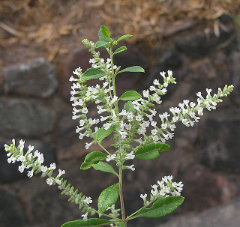
Dick Culbert from Gibsons, B.C., Canada Creative Commons Attribution 2.0 |
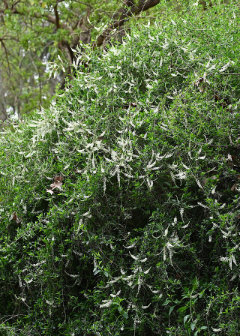 |
| Krzysztof Ziarnek, Kenraiz Creative Commons Attribution-Share Alike 4.0 |
Translate this page:
Summary
Whitebrush is not a food plant in the traditional sense but provides a pleasant, herbal-flavored tea from its leaves and flowers. Its role is more as a flavoring herb than a source of calories.
Physical Characteristics

 Aloysia gratissima is an evergreen Shrub growing to 3 m (9ft) by 3 m (9ft) at a fast rate.
See above for USDA hardiness. It is hardy to UK zone 8 and is not frost tender. The flowers are pollinated by Bees, Insects.
It is noted for attracting wildlife.
Suitable for: light (sandy) and medium (loamy) soils, prefers well-drained soil and can grow in nutritionally poor soil. Suitable pH: mildly acid, neutral and basic (mildly alkaline) soils and can grow in very alkaline and saline soils.
It cannot grow in the shade. It prefers dry or moist soil and can tolerate drought. The plant can tolerate maritime exposure.
UK Hardiness Map
US Hardiness Map
Synonyms
A. chacoensis Moldenke, A. floribunda M.Martens & Galeotti, A. lycioides Cham., A. meyeri Moldenke, A. schulziana Moldenke, A. sellowii (Briq.) Moldenke, Lantana virgata Larrañaga, Lippia affinis Briq., Lippia gratissima (Gillies & Hook.) L.D.Benson, Lippia lycioides (Cham.) Steud., Lippia sellowii Briq., Verbena gratissima Gillies & Hook., Verbena integerrima Larrañaga.
Plant Habitats
Edible Uses
The leaves and flowers can be steeped to make a tea. The flavor is herbal, lightly fruity, and somewhat similar to its close relative oreganillo (Aloysia wrightii), though usually less pronounced. The tea can be enjoyed hot or cold and was traditionally used as a refreshing beverage in the desert Southwest. Beyond tea, the shrub is not considered edible. Gathering leaves is straightforward, but collecting flowers in useful amounts can be time-consuming since they are small and delicate. Plants often bloom in response to summer rains, providing a seasonal opportunity for foragers [2-3].
References More on Edible Uses
Medicinal Uses
Plants For A Future can not take any responsibility for any adverse effects from the use of plants. Always seek advice from a professional before using a plant medicinally.
An infusion of the flowers is used to treat catarrh and colds[46].
References More on Medicinal Uses
The Bookshop: Edible Plant Books
Our Latest books on Perennial Plants For Food Forests and Permaculture Gardens in paperback or digital formats.
Edible Tropical Plants
Food Forest Plants for Hotter Conditions: 250+ Plants For Tropical Food Forests & Permaculture Gardens.
More
Edible Temperate Plants
Plants for Your Food Forest: 500 Plants for Temperate Food Forests & Permaculture Gardens.
More
More Books
PFAF have eight books available in paperback and digital formats. Browse the shop for more information.
Shop Now
Other Uses
The plant is grown to stabilize sand dunes[317]. It is a bee and butterfly plant, valued as a nectar source. It is often used in xeriscaping (low-water gardens) and for erosion control in arid regions.
Special Uses
References More on Other Uses
Cultivation details
A plant of the warm temperate zone to the tropics, usually ascending to higher elevations above 1,400 metres in the tropics. The plant can tolerate some frost, though is more likely to be deciduous in such circumstances. Requires a sunny position and a well-drained soil. Aloysia gratissima (whitebrush / Chihuahuan beebrush) is adapted to hot, dry regions and thrives under tough conditions where many other shrubs struggle. Here are its main preferences: Growing Conditions. Sunlight: Requires full sun for best flowering and dense growth. It will not do well in heavy shade.. Soil: Prefers well-drained soils — sandy, rocky, or gravelly soils are best suited for it. It is tolerant of alkaline and calcareous soils and can grow in poor, dry soils with low fertility. Water: Very drought-tolerant once established. Occasional deep watering during extended dry periods will encourage flowering, but it does not like soggy ground. Temperature: Thrives in warm climates and tolerates summer heat extremely well. Hardy to about USDA zones 7–9; in colder areas, it may be killed back by frost. Habitat: Naturally found in desert grasslands, scrub, and rocky slopes, often blooming after summer rains. Aloysia gratissima (whitebrush / Chihuahuan beebrush) is considered a moderate- to fast-growing shrub under the right conditions. In warm, sunny climates with well-drained soil, it can establish quickly and often puts on 30–60 cm (1–2 ft) of new growth per year once established. In harsher, drier soils, growth may be slower, but it is still reliable due to its drought tolerance. Plants often respond with a flush of new growth and flowers after summer rains, even if growth was slow beforehand. It can reach 2–3 m (6–10 ft) in height and spread within several years in ideal conditions. Not as fast as some desert willows or acacias, but still a reasonably quick grower for a xeric shrub, especially once roots are established.
References Carbon Farming Information and Carbon Sequestration Information
Temperature Converter
Type a value in the Celsius field to convert the value to Fahrenheit:
Fahrenheit:
The PFAF Bookshop
Plants For A Future have a number of books available in paperback and digital form. Book titles include Edible Plants, Edible Perennials, Edible Trees,Edible Shrubs, Woodland Gardening, and Temperate Food Forest Plants. Our new book is Food Forest Plants For Hotter Conditions (Tropical and Sub-Tropical).
Shop Now
Plant Propagation
Seed.
Other Names
If available other names are mentioned here
Aloysia gratissima (Whitebrush, Chihuahuan Beebrush)
Native Range
Argentina Northeast, Argentina Northwest, Arizona, Bolivia, Brazil South, Brazil Southeast, Chile Central, Mexico Central, Mexico Gulf, Mexico Northeast, Mexico Northwest, Mexico Southwest, New Mexico, Paraguay, Texas, Uruguay
Weed Potential
Right plant wrong place. We are currently updating this section.
Please note that a plant may be invasive in one area but may not in your area so it's worth checking.
Not invasive in its native range (southern U.S., Mexico, South America). It tends to stay in arid, rocky, and disturbed habitats where it naturally belongs. Limited spread: It can seed itself and spread locally, especially after summer rains, but it does not usually form aggressive monocultures like some invasive shrubs. Cultivation: In gardens or restoration projects, it remains well-behaved if given dry, sunny conditions. It is not known to invade farmland or displace native vegetation aggressively. Global reports: Unlike some related species (like Aloysia citrodora, lemon verbena, which is cultivated worldwide), A. gratissima is not listed as a noxious or invasive weed in major invasive plant databases.
Conservation Status
IUCN Red List of Threatened Plants Status : Not available

Growth: S = slow M = medium F = fast. Soil: L = light (sandy) M = medium H = heavy (clay). pH: A = acid N = neutral B = basic (alkaline). Shade: F = full shade S = semi-shade N = no shade. Moisture: D = dry M = Moist We = wet Wa = water.
Now available:
Food Forest Plants for Mediterranean Conditions
350+ Perennial Plants For Mediterranean and Drier Food Forests and Permaculture Gardens.
[Paperback and eBook]
This is the third in Plants For A Future's series of plant guides for food forests tailored to
specific climate zones. Following volumes on temperate and tropical ecosystems, this book focuses
on species suited to Mediterranean conditions—regions with hot, dry summers and cool, wet winters,
often facing the added challenge of climate change.
Read More
Expert comment
Author
(Gillies & Hook.) Troncoso
Botanical References
Links / References
For a list of references used on this page please go here
A special thanks to Ken Fern for some of the information used on this page.
Readers comment
| Add a comment |
|
If you have important information about this plant that may help other users please add a comment or link below. Only comments or links that are felt to be directly relevant to a plant will be included. If you think a comment/link or information contained on this page is inaccurate or misleading we would welcome your feedback at [email protected]. If you have questions about a plant please use the Forum on this website as we do not have the resources to answer questions ourselves.
* Please note: the comments by website users are not necessarily those held by PFAF and may give misleading or inaccurate information.
|
Subject : Aloysia gratissima
|
|
|
|