Plant Portrait - Allium ursinum, Wild Garlic
Español 
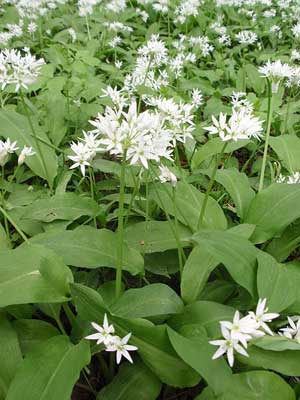
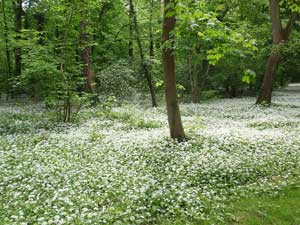
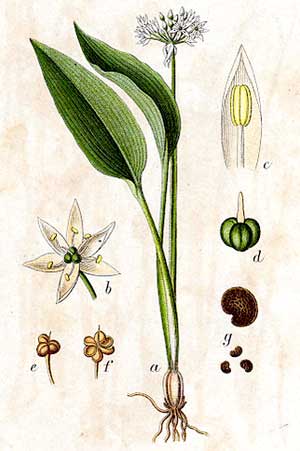 Wild garlic grows abundantly in Cornwall and many other temperate areas of Britain. It is a plant that seldom needs to be cultivated, just give it a position in semi-shade, preferably under trees, and leave it to its own devices. It will succeed in most soils and prefers moist conditions, though it will also succeed where the soil is very wet in the winter. When given suitable conditions, it will form a dense carpet of growth and can be very invasive. The plant comes into growth in the middle to late winter, flowers in the spring and then dies down completely by the middle of summer. This allows many other plants that come into growth in spring to grow in the same space.
This is an excellent companion plant in the garden, it grows well with most plants and seems to positively affect their health and their ability to resist pests and diseases. It does not seem to grow so well with plants in the pea and bean family, however, with many gardeners noticing reduced growth and vigour in both species. It is also said to repel moles from the garden, though this is debatable.
All parts of this plant are edible. The leaves are delicious raw or cooked and may be harvested early in late winter when it is mild. They have a distinct garlic flavour, though are milder than garlic cloves, and really add something special to a winter salad. When cooked, they are normally used as a flavouring in soups, stews etc, or they can be used like spinach.
As the flowers begin to open in the middle of spring, the leaves start to lose their vitality, but then the flowers can be used in exactly the same way as the leaves. They have a somewhat stronger flavour and make a decorative and very tasty addition to salads.
The flowering heads can still be eaten as the seed pods are forming, though the flavour gets even stronger as the seeds ripen. The bulb can also be eaten raw or cooked, and can be harvested all year round, though is best used when the plant is dormant. It has a fairly strong garlic flavour, though it is quite small and fiddly to harvest.
From the health perspective, wild garlic has most of the benefits of the cultivated garlic, A. sativum. It is therefore a very beneficial addition to the diet, promoting the general health of the body when used regularly. It is particularly effective in reducing high blood pressure and blood cholesterol levels. The juice of the plant has been used as a general household disinfectant.
Once you have this plant growing, you are unlikely to be without it, or to need to propagate it. However, should you want to introduce it to a new site, this is a simple thing to do. You can either harvest the seed in early summer or sow it immediately either in situ (if you have masses of the seed) or in trays in a cold frame. It usually germinates well and should produce plants large enough for harvesting in the third year of growth.
Alternatively, dig up some bulbs in the summer once the plants have died down and plant them immediately into their new site. They will be ready for harvesting from their second year of growth.
 Alternatively, dig up some bulbs in the summer once the plants have died down and plant them immediately into their new site. They will be ready for harvesting from their second year of growth.
 You can look at our leaflet on Perennial Onions for other interesting members of the onion family.
Database
The database has more details on these plants: Allium sativum ophioscorodon, Allium ursinum.