 |
|
http://www.hear.org/starr/ |
 |
|
Translate this page:
Summary
Physical Characteristics

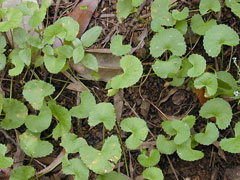
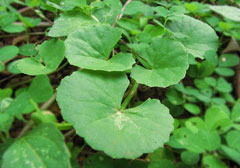
 Centella asiatica is an evergreen Perennial growing to 0.2 m (0ft 8in) by 1 m (3ft 3in).
See above for USDA hardiness. It is hardy to UK zone 8 and is frost tender. It is in leaf all year, in flower from July to August, and the seeds ripen from August to September. The species is hermaphrodite (has both male and female organs) and is pollinated by Insects. The plant is self-fertile.
Suitable for: light (sandy), medium (loamy) and heavy (clay) soils. Suitable pH: mildly acid, neutral and basic (mildly alkaline) soils. It can grow in semi-shade (light woodland) or no shade. It prefers moist or wet soil.
UK Hardiness Map
US Hardiness Map
Synonyms
Hydrocotyle asiatica. L. H. cordifolia. H. repanda.
Plant Habitats
Bog Garden; Cultivated Beds; East Wall. In. South Wall. In. West Wall. In.
Edible Uses
Edible Parts: Leaves
Edible Uses:
Leaves - raw or cooked. Used in salads and in curries[238]. Cooked as a vegetable[272]. An aromatic flavour, we have found them to be rather overpowering in salads when used in any but small quantities[K].
References More on Edible Uses
Medicinal Uses
Plants For A Future can not take any responsibility for any adverse effects from the use of plants. Always seek advice from a professional before using a plant medicinally.
Adaptogen Anticonvulsant Antidiarrhoeal Antiinflammatory Antipanic Antirheumatic Cardiac Depurative
Diuretic Febrifuge Hypotensive Leprosy Malaria Nervine Sedative
Skin Tonic
Gotu kola is an outstandingly important medicinal herb that is widely used in the Orient[238] and is becoming increasingly popular in the West[254]. Its Indian name is 'Brahmi' which means 'bringing knowledge of the Supreme Reality' and it has long been used there medicinally and as an aid to meditation[238]. It is a useful tonic and cleansing herb for skin problems and digestive disorders[254]. In India it is chiefly valued as a revitalizing herb that strengthens nervous function and memory[254]. The whole plant is alterative, cardio-depressant, hypotensive, weakly sedative and tonic[240]. It is a rejuvenating diuretic herb that clears toxins, reduces inflammations and fevers, improves healing and immunity, improves the memory and has a balancing effect on the nervous system[147, 152, 238, 240]. It has been suggested that regular use of the herb can rejuvenate the nervous system and it therefore deserves attention as a possible cure for a wide range of nervous disorders including multiple sclerosis[K]. Recent research has shown that gotu kola reduces scarring, improves circulatory problems in the lower limbs and speeds the healing process[238]. It is used internally in the treatment of wounds, chronic skin conditions (including leprosy), venereal diseases, malaria, varicose veins, ulcers, nervous disorders and senility[238, 240]. Caution should be observed since excess doses cause headaches and transient unconsciousness[238]. Externally, the herb is applied to wounds, haemorrhoids and rheumatic joints[238]. The plant can be harvested at any time of the year and is used fresh or dried[238]. Another report says that the dried herb quickly loses its medicinal properties and so is best used fresh[237].
References More on Medicinal Uses
The Bookshop: Edible Plant Books
Our Latest books on Perennial Plants For Food Forests and Permaculture Gardens in paperback or digital formats.
Edible Tropical Plants
Food Forest Plants for Hotter Conditions: 250+ Plants For Tropical Food Forests & Permaculture Gardens.
More
Edible Temperate Plants
Plants for Your Food Forest: 500 Plants for Temperate Food Forests & Permaculture Gardens.
More
More Books
PFAF have eight books available in paperback and digital formats. Browse the shop for more information.
Shop Now
Other Uses
Cosmetic
Extracts of the plant are added to cosmetic masks and creams to increase collagen and firm the skin[238].
Special Uses
References More on Other Uses
Cultivation details
Prefers a moist to wet soil in sun or partial shade[238]. Plants also grow on walls in the wild and so should tolerate drier conditions[K]. This species is not hardy in the colder areas of the country, it tolerates temperatures down to between -5 and -10°c[200]. It grows and spreads very well outdoors during the summer in most parts of the country and is very easy to increase by division. It can therefore be grown as a summer crop with divisions being taken during the growing season and overwintered in a greenhouse in case the outdoor plants are killed by winter cold[K].
References Carbon Farming Information and Carbon Sequestration Information
Temperature Converter
Type a value in the Celsius field to convert the value to Fahrenheit:
Fahrenheit:
The PFAF Bookshop
Plants For A Future have a number of books available in paperback and digital form. Book titles include Edible Plants, Edible Perennials, Edible Trees,Edible Shrubs, Woodland Gardening, and Temperate Food Forest Plants. Our new book is Food Forest Plants For Hotter Conditions (Tropical and Sub-Tropical).
Shop Now
Plant Propagation
Seed - sow spring in a greenhouse[238]. Prick out the seedlings into individual pots when they are large enough to handle and grow them on in a greenhouse for their first winter. Plant them out in late spring or early summer of the following year, after the last expected frosts[K]. Division is simple at any time in the growing season, though the spring is probably best[K]. We find that it is best to pot up the divisions until they are rooting away well, though in selected mild gardens it should be possible to plant the divisions out directly into their permanent positions[K].
Other Names
If available other names are mentioned here
Native Range
TEMPERATE ASIA: China (Anhui Sheng, Fujian Sheng, Guangdong Sheng, Guangxi Zhuangzu Zizhiqu, Hubei Sheng, Hunan Sheng, Jiangsu Sheng (south), Jiangxi Sheng, Shaanxi Sheng (south), Sichuan Sheng, Yunnan Sheng, Zhejiang Sheng), Korea, Japan, Taiwan TROPICAL ASIA: Bhutan, India, Sri Lanka, Nepal, Pakistan, Solomon Islands, Laos, Myanmar, Thailand, Vietnam, Indonesia, Malaysia, Philippines SOUTHERN AMERICA: Venezuela, Brazil, Argentina, Chile, Paraguay, Uruguay PACIFIC: Micronesia, Palau, United States (Northern Mariana Islands) AUSTRALASIA: Australia (New South Wales (east), Queensland) AFRICA: Kenya, Tanzania, Uganda, Cameroon, Equatorial Guinea, Côte D‘Ivoire, Guinea-Bissau, Liberia, Mali, Nigeria, Senegal, Sierra Leone, Mozambique, Malawi, Zambia, Zimbabwe, Botswana, Lesotho, Namibia, Eswatini, South Africa
Weed Potential
Right plant wrong place. We are currently updating this section.
Please note that a plant may be invasive in one area but may not in your area so it's worth checking.
Conservation Status
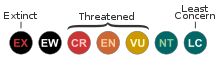
IUCN Red List of Threatened Plants Status :
Growth: S = slow M = medium F = fast. Soil: L = light (sandy) M = medium H = heavy (clay). pH: A = acid N = neutral B = basic (alkaline). Shade: F = full shade S = semi-shade N = no shade. Moisture: D = dry M = Moist We = wet Wa = water.
Now available:
Food Forest Plants for Mediterranean Conditions
350+ Perennial Plants For Mediterranean and Drier Food Forests and Permaculture Gardens.
[Paperback and eBook]
This is the third in Plants For A Future's series of plant guides for food forests tailored to
specific climate zones. Following volumes on temperate and tropical ecosystems, this book focuses
on species suited to Mediterranean conditions—regions with hot, dry summers and cool, wet winters,
often facing the added challenge of climate change.
Read More
Expert comment
Author
(L.)Urb.
Botanical References
58265266
Links / References
For a list of references used on this page please go here
Readers comment