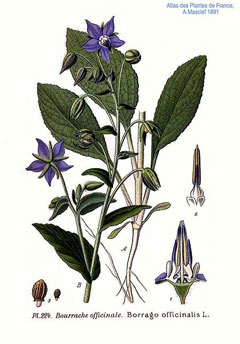
 |
|
http://commons.wikimedia.org/wiki/File:224_Borrago_officinalis_L.jpg |
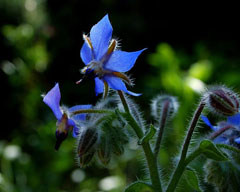 |
| http://commons.wikimedia.org/wiki/File:Borago_officinalis_Blue.JPG |
Translate this page:
Summary
Bloom Color: Blue.
Main Bloom Time: Early fall, Late summer, Mid summer. Form: Irregular or sprawling.
Physical Characteristics

 Borago officinalis is a ANNUAL growing to 0.6 m (2ft) by 0.3 m (1ft in) at a medium rate.
See above for USDA hardiness. It is hardy to UK zone 7 and is not frost tender. It is in flower from June to October, and the seeds ripen from July to October. The species is hermaphrodite (has both male and female organs) and is pollinated by Bees.
It is noted for attracting wildlife.
Suitable for: light (sandy), medium (loamy) and heavy (clay) soils, prefers well-drained soil and can grow in nutritionally poor soil. Suitable pH: mildly acid, neutral and basic (mildly alkaline) soils and can grow in very alkaline soils.
It can grow in semi-shade (light woodland) or no shade. It prefers dry or moist soil and can tolerate drought.
UK Hardiness Map
US Hardiness Map
Synonyms
Borago advena, Borago aspera, Borago hortensis
Plant Habitats
Hedgerow; Cultivated Beds; South Wall. In. West Wall. In.
Edible Uses
Edible Parts: Flowers Leaves Oil
Edible Uses: Colouring Oil Tea
Leaves - raw or cooked[2, 5, 7, 14, 115, 183]. They can be used as a pot-herb or be added to salads[4]. They are also added whole as a flavouring to various drinks such as Pimms and wine-based drinks[238]. The leaves are rich in potassium and calcium, they have a salty cucumber flavour[200]. Very hairy, the whole leaves have an unpleasant feeling in the mouth and so they are best chopped up finely and added to other leaves when eaten in a salad[K]. The leaves should always be used fresh, because they lose their flavour and colour if dried[244]. Flowers - raw. They are used as a decorative garnish on salads and summer fruit drinks[2, 5, 7, 14, 183]. The flowers are very nice, both to look at and to taste with a sweet slightly cucumber-like flavour[K]. A refreshing tea is made from the leaves and/or the flowers[21, 183]. The dried stems are used for flavouring beverages[183]. The seed yields 30% oil, 20% of which is gamma-linolenic acid[141]. Total yields are 0.35 - 0.65 tonnes per hectare[141]. Unfortunately, the seed ripens intermittently over a period of time and falls from the plant when it is ripe, this makes harvesting the seeds in quantity very difficult[K]. An edible blue dye can be obtained from the flowers. It is used to colour vinegar[183].
References More on Edible Uses
Medicinal Uses
Plants For A Future can not take any responsibility for any adverse effects from the use of plants. Always seek advice from a professional before using a plant medicinally.
Antirheumatic Demulcent Depurative Diaphoretic Diuretic Emollient Expectorant Febrifuge
Hypotensive Lenitive Poultice Sedative Skin Women's complaints
Borage is a fairly common domestic herbal remedy that has been used since ancient times[244]. It has a particularly good reputation for its beneficial affect on the mind, being used to dispel melancholy and induce euphoria[244]. It is a soothing saline, diuretic herb that soothes damaged or irritated tissues[238]. The leaves, and to a lesser extent the flowers, are demulcent, diaphoretic, depurative, mildly diuretic, emollient, expectorant, febrifuge, lenitive and mildly sedative[4, 7, 9, 14, 201, 238]. An infusion is taken internally in the treatment of a range of ailments including fevers, chest problems and kidney problems[4], though it should not be prescribed to people with liver problems. Externally it is used as a poultice for inflammatory swellings[4, 7]. The leaves are harvested in late spring and the summer as the plant comes into flower. They can be used fresh or dried but should not be stored for more than one year because they soon lose their medicinal properties[238]. The seeds are a rich source of gamma-linolenic acid, this oil helps to regulate the hormonal systems and lowers blood pressure[238]. It is used both internally and externally, helping to relieve skin complaints and pre-menstrual tension[238]. Used for the treatment of phlebitis (inflammation of the veins) [301].
References More on Medicinal Uses
The Bookshop: Edible Plant Books
Our Latest books on Perennial Plants For Food Forests and Permaculture Gardens in paperback or digital formats.
Edible Tropical Plants
Food Forest Plants for Hotter Conditions: 250+ Plants For Tropical Food Forests & Permaculture Gardens.
More
Edible Temperate Plants
Plants for Your Food Forest: 500 Plants for Temperate Food Forests & Permaculture Gardens.
More
More Books
PFAF have eight books available in paperback and digital formats. Browse the shop for more information.
Shop Now
Other Uses
References More on Other Uses
Cultivation details
Landscape Uses:Border, Foundation, Massing. A very easily grown plant, succeeding in ordinary garden soil[1], preferring a dry soil[37] and a sunny position[138]. It grows particularly well in loose, stony soils with some chalk and sand[244]. Plants are tolerant of poor dry soils, though much bigger specimens are produced when the plants are growing in better conditions[238]. Tolerates a pH in the range 4.8 to 8.3. Borage is often grown as a culinary plant in the herb garden[1, 7]. Although an annual, it usually maintains itself by self-sowing, sometimes in quite a prolific manner, as long as the soil is disturbed by hoeing etc[14, 188]. Plants often develop mildew when growing in dry conditions or towards the end of the growing season[238]. Flowers are a deeper blue when grown in poorer soils[138]. The flowers are rich in a sweet nectar and are very attractive to bees[7, 14, 20, 108, 244]. The growing plant is a good companion for strawberries, tomatoes, courgettes and most other plants[14, 201, 238]. It is said to deter Japanese beetle and tomato hornworms[238]. Special Features:Edible, Fragrant foliage, Not North American native, Invasive, Naturalizing, Suitable for dried flowers, Extended bloom season in Zones 9A and above. The plant is heat tolerant in zones 12 through 1. (Plant Hardiness Zones show how well plants withstand cold winter temperatures.
Plant Heat Zones show when plants would start suffering from the heat.
The Plant Heat Zone map is based on the number of "heat days" experienced in a given area where the temperature climbs to over 86 degrees F (30°C).
At this temperature, many plants begin to suffer physiological damage. Heat Zones range from 1 (no heat days) to 12 (210 or more heat days).
For example Heat Zone. 11-1 indicates that the plant is heat tolerant in zones 11 through 1.) For polyculture design as well as the above-ground architecture (form - tree, shrub etc. and size shown above) information on the habit and root pattern is also useful and given here if available. The plant growth habit is a clumper with limited spread [1-2]. A self-seeding annual [1-2].
References Carbon Farming Information and Carbon Sequestration Information
Temperature Converter
Type a value in the Celsius field to convert the value to Fahrenheit:
Fahrenheit:
The PFAF Bookshop
Plants For A Future have a number of books available in paperback and digital form. Book titles include Edible Plants, Edible Perennials, Edible Trees,Edible Shrubs, Woodland Gardening, and Temperate Food Forest Plants. Our new book is Food Forest Plants For Hotter Conditions (Tropical and Sub-Tropical).
Shop Now
Plant Propagation
Seed - sow April/May in situ. The plants quickly develop a stout tap-root and do not transplant successfully[238]. The seed can also be sown in situ in the autumn, this will produce larger plants and earlier flowering[4]. The plant usually self-sows prolifically.
Other Names
If available other names are mentioned here
Native Plant Search
Search over 900 plants ideal for food forests and permaculture gardens. Filter to search native plants to your area. The plants selected are the plants in our book 'Plants For Your Food Forest: 500 Plants for Temperate Food Forests and Permaculture Gardens, as well as plants chosen for our forthcoming related books for Tropical/Hot Wet Climates and Mediterranean/Hot Dry Climates. Native Plant Search
Found In
Countries where the plant has been found are listed here if the information is available
Weed Potential
Right plant wrong place. We are currently updating this section.
Please note that a plant may be invasive in one area but may not in your area so it’s worth checking.
Conservation Status
IUCN Red List of Threatened Plants Status :
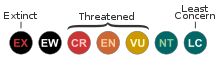
Growth: S = slow M = medium F = fast. Soil: L = light (sandy) M = medium H = heavy (clay). pH: A = acid N = neutral B = basic (alkaline). Shade: F = full shade S = semi-shade N = no shade. Moisture: D = dry M = Moist We = wet Wa = water.

Expert comment
Author
L.
Botanical References
200
Links / References
For a list of references used on this page please go here
Readers comment