 |
|
(c) 2010 Ken Fern, Plants For A Future |
 |
| (c) 2010 Ken Fern, Plants For A Future |
Translate this page:
Summary
Taxonomic Note: This genus was formerly classified in the family Alliaceae. Modern classifications include it within the Amaryllidaceae.
All members of this genus are, at least theoretically, edible. Their flavours range from mild onions and leeks to pungent onion and garlic. All parts of the plants are edible. The flowers have a more robust flavour than the leaves, and the young developing seed heads are even more potent. Eat the leaves and flowers in salads for a plentiful supply throughout the year. Use cooked leaves as a flavour with other vegetables in soups or use them as a cooked green. Some favourite species are listed below. Unless stated otherwise, all members of this genus require well-drained soil and a sunny position. They do not grow well with weed competition, though there are exceptions.
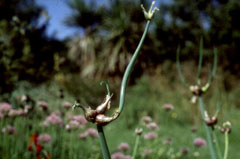
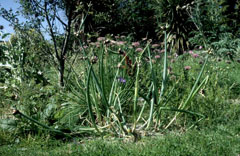
Allium cepa. This species includes the common onion and the charming and productive form called the Everlasting Onion. Everlasting Onions grow similarly to chives, quickly forming a large clump. The Potato Onion (A. cepa aggregatum) has strong floured leaves with a strong onion flavour. Use the flowers raw as a garnish on salads. The Egyptian Walking Onion (A. cepa proliferum) forms small edible bulbs at the top of the flowering stem. They have a strong onion flavour and are often used as pickled onions or added to salads. The Nodding Onion (A. cernuum) is an exceedingly beautiful plant, but both flowers and leaves have a delicious strong onion flavour – the flowers look lovely in a mixed salad.
The Welsh Onion (A. fistulosum) is similar to the Everlasting Onion in growth habit and flavour. Daffodil Garlic (A. neapolitanum) young leaves have a delicious sweetness followed by a moderately strong garlic flavour. Chives (A. schoenoprasum) are a very productive crop supplying mild, onion-flavoured leaves in full sun to semi-shade positions. Garlic Chives (A. tuberosum) form a slowly spreading clump; leaves have a delightful flavour, like a cross between garlic and chives. Garlic (A. sativum) leaves are edible raw or cooked, chopped and used in salads; they are relatively milder than the bulbs.
Physical Characteristics

 Allium cepa aggregatum is a BULB growing to 1.2 m (4ft) at a medium rate.
See above for USDA hardiness. It is hardy to UK zone 5 and is not frost tender. The species is hermaphrodite (has both male and female organs) and is pollinated by Bees, insects. The plant is self-fertile.
It is noted for attracting wildlife.
Suitable for: light (sandy) and medium (loamy) soils and prefers well-drained soil. Suitable pH: mildly acid, neutral and basic (mildly alkaline) soils and can grow in very alkaline soils.
It cannot grow in the shade. It prefers moist soil.
UK Hardiness Map
US Hardiness Map
Synonyms
Plant Habitats
Cultivated Beds;
Edible Uses
Edible Parts: Flowers Leaves Root
Edible Uses:
Bulb - raw or cooked[4, 33]. A nice onion flavour, when chopped up finely they make a nice addition to salads and can also be used as a cooked vegetable or as a flavouring in cooked foods[K]. Some of the cultivars are considered to be gourmet onions[183]. Leaves - raw or cooked. A strong onion flavour[K]. Flowers - raw. Used as a garnish on salads. The flowers are somewhat dry and are less pleasant than many other species[K].
References More on Edible Uses
Medicinal Uses
Plants For A Future can not take any responsibility for any adverse effects from the use of plants. Always seek advice from a professional before using a plant medicinally.
Anthelmintic Antiinflammatory Antiseptic Antispasmodic Carminative Diuretic Expectorant Febrifuge
Hypoglycaemic Hypotensive Lithontripic Skin Stomachic Tonic
Although rarely used specifically as a medicinal herb, the onion has a wide range of beneficial actions on the body and when eaten (especially raw) on a regular basis will promote the general health of the body. The bulb is anthelmintic, anti-inflammatory, antiseptic, antispasmodic, carminative, diuretic, expectorant, febrifuge, hypoglycaemic, hypotensive, lithontripic, stomachic and tonic[4, 7, 21]. When used regularly in the diet it offsets tendencies towards angina, arteriosclerosis and heart attack[254]. It is also useful in preventing oral infection and tooth decay[254]. Baked onions can be used as a poultice to remove pus from sores[254]. Fresh onion juice is a very useful first aid treatment for bee and wasp stings, bites, grazes or fungal skin complaints[7, 201]. When warmed the juice can be dropped into the ear to treat earache[254]. It also aids the formation of scar tissue on wounds, thus speeding up the healing process, and has been used as a cosmetic to remove freckles[7].
References More on Medicinal Uses
The Bookshop: Edible Plant Books
Our Latest books on Perennial Plants For Food Forests and Permaculture Gardens in paperback or digital formats.
Edible Tropical Plants
Food Forest Plants for Hotter Conditions: 250+ Plants For Tropical Food Forests & Permaculture Gardens.
More
Edible Temperate Plants
Plants for Your Food Forest: 500 Plants for Temperate Food Forests & Permaculture Gardens.
More
More Books
PFAF have eight books available in paperback and digital formats. Browse the shop for more information.
Shop Now
Other Uses
Cosmetic Dye Hair Polish Repellent Rust
The juice of the plant is used as a moth repellent and can also be rubbed onto the skin to repel insects[7]. The plant juice can be used as a rust preventative on metals and as a polish for copper and glass[7]. A yellow-brown dye is obtained from the skins of the bulbs[141, 168]. Onion juice rubbed into the skin is said to promote the growth of hair and to be a remedy for baldness[7]. It is also used as a cosmetic to get rid of freckles[7]. The growing plant is said to repel insects and moles[201]. A spray made by pouring enough boiling water to cover 1kg of chopped unpeeled onions is said to increase the resistance of other plants to diseases and parasites[201]. 1. Nectary - Flowers rich in nectar and pollen:
Yes – Allium species produce flowers rich in nectar and pollen, attracting pollinators like bees and butterflies.
2. Wildlife - Food (Fruit, Seeds, Leaf litter, Shelter, Nesting, Roosting):
Yes – Allium species' bulbs, leaves, and flowers are edible and provide food for humans and wildlife. The leaf litter can also provide some habitat, though they are not typically used for nesting.
3. Invertebrate Shelter (Overwintering sites, Leaf litter, Groundcover):
No – While Allium plants can provide some ground cover, they are not specifically known for providing significant shelter or overwintering sites for invertebrates.
4. Pest Confuser (Smell):
Yes – The strong aroma of Allium species can help deter pests, acting as a natural pest confuser due to their sulfur compounds.
Special Uses
Food Forest
References More on Other Uses
Cultivation details
Prefers a sunny sheltered position in a light well-drained fertile soil[1] but tolerates most soils. Tolerates a pH in the range 4.5 to 8.3. The potato onion was at one time fairly widely grown as a vegetable, but it has now fallen into virtual disuse[16]. There are still some named forms available[183]. This is a genuinely perennial form of A. cepa, the bulb grows deeper in the soil and divides to produce a number of underground bulbs each year in much the same way as shallots. Large bulbs divide to form 5 - 15 bulbs whilst smaller bulbs grow into one large bulb[160]. According to one report, the bulbs should be planted fairly deeply[1], whilst another report says that they should be planted just below soil level[4]. Onions grow well with most plants, especially roses, carrots, beet and chamomile, but they inhibit the growth of legumes[18, 20, 54]. This plant is a bad companion for alfalfa, each species negatively affecting the other[201]. Members of this genus are rarely if ever troubled by browsing deer[233]. The plant is heat tolerant in zones 12 through 2. (Plant Hardiness Zones show how well plants withstand cold winter temperatures.
Plant Heat Zones show when plants would start suffering from the heat.
The Plant Heat Zone map is based on the number of "heat days" experienced in a given area where the temperature climbs to over 86 degrees F (30°C).
At this temperature, many plants begin to suffer physiological damage. Heat Zones range from 1 (no heat days) to 12 (210 or more heat days).
For example Heat Zone. 11-1 indicates that the plant is heat tolerant in zones 11 through 1.) For polyculture design as well as the above-ground architecture (form - tree, shrub etc. and size shown above) information on the habit and root pattern is also useful and given here if available. The plant growth habit is a clumper with limited spread [1-2]. The root pattern is a bulb. Alliums are typically harvested in late spring to early summer, when the bulbs mature and the tops begin to yellow. Allium species typically flower in late spring to early summer, depending on the species and local climate conditions. Allium species generally have a moderate growth rate, with bulbs typically taking about 100 to 150 days from planting to harvest, depending on the variety and growing conditions.
References Carbon Farming Information and Carbon Sequestration Information
Temperature Converter
Type a value in the Celsius field to convert the value to Fahrenheit:
Fahrenheit:
The PFAF Bookshop
Plants For A Future have a number of books available in paperback and digital form. Book titles include Edible Plants, Edible Perennials, Edible Trees,Edible Shrubs, Woodland Gardening, and Temperate Food Forest Plants. Our new book is Food Forest Plants For Hotter Conditions (Tropical and Sub-Tropical).
Shop Now
Plant Propagation
Seed - sow spring in a cold frame. Seed is seldom produced by this plant[4]. Division in late summer. Harvest the bulbs as the foliage dies down and store them in a cool place. In areas with mild winters the bulbs are traditionally replanted on the shortest day of the year, but in colder areas it is best to wait until late winter or even early spring[4]. Plant the bulbs only just below the soil surface[4].
Other Names
If available other names are mentioned here
Native Range
TEMPERATE ASIA: Turkmenistan.
Weed Potential
Right plant wrong place. We are currently updating this section.
Please note that a plant may be invasive in one area but may not in your area so it's worth checking.
Conservation Status
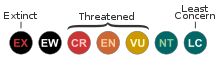
IUCN Red List of Threatened Plants Status :
| Related Plants
|
| Latin Name | Common Name | Habit | Height | Hardiness | Growth | Soil | Shade | Moisture | Edible | Medicinal | Other |
| Allium acuminatum | Hooker's Onion, Tapertip onion | Bulb | 0.3 |
5-9
| | LM | N | DM | 3 | 2 | 2 |
| Allium aflatunense | Persian Onion, Ornamental Onion | Bulb | 1.0 |
4-8
| M | LM | N | M | 2 | 2 | 1 |
| Allium akaka | | Bulb | 0.2 |
7-10
| | LM | N | DM | 3 | 2 | 1 |
| Allium altaicum | | Bulb | 0.3 |
-
| | LM | N | M | 3 | 2 | 1 |
| Allium ampeloprasum | Wild Leek, Broadleaf wild leek | Bulb | 1.8 |
5-9
| | LMH | N | DM | 5 | 3 | 2 |
| Allium ampeloprasum babingtonii | Babington's Leek | Bulb | 1.8 |
0-0
| | LMH | N | DM | 3 | 3 | 2 |
| Allium angulare | | Bulb | 0.0 |
-
| | LM | N | M | 3 | 2 | 1 |
| Allium angulosum | Mouse Garlic | Bulb | 0.5 |
4-8
| | LMH | SN | M | 3 | 2 | 1 |
| Allium atropurpureum | | Bulb | 1.0 |
7-10
| | LM | SN | M | 3 | 2 | 1 |
| Allium bisceptrum | Aspen Onion, Twincrest onion | Bulb | 0.3 |
7-10
| | LM | N | M | 3 | 2 | 1 |
| Allium bodeanum | | Bulb | 0.2 |
-
| | LM | N | DM | 3 | 2 | 1 |
| Allium bolanderi | Bolander's Onion | Bulb | 0.2 |
6-9
| | LM | N | M | 3 | 2 | 1 |
| Allium brevistylum | Shortstyle Onion | Bulb | 0.5 |
-
| | LM | N | MWe | 3 | 2 | 1 |
| Allium canadense | Canadian Garlic, Meadow garlic, Fraser meadow garlic, Hyacinth meadow garlic | Bulb | 0.5 |
4-8
| | LM | SN | MWe | 4 | 2 | 2 |
| Allium canadense mobilense | Canadian Garlic | Bulb | 0.5 |
4-8
| | LM | SN | MWe | 5 | 2 | 1 |
| Allium carinatum | Keeled Garlic | Bulb | 0.6 |
6-9
| | LMH | SN | M | 3 | 2 | 1 |
| Allium carolinianum | | Bulb | 0.4 |
-
| | LM | N | DM | 3 | 2 | 1 |
| Allium cepa | Onion, Garden onion | Bulb | 0.6 |
4-10
| M | LM | N | M | 5 | 3 | 3 |
| Allium cepa ascalonicum | Shallot | Bulb | 0.3 |
4-8
| | LM | N | M | 5 | 3 | 2 |
| Allium cepa proliferum | Tree Onion, Walking Onion | Bulb | 1.2 |
4-8
| M | LM | N | M | 5 | 3 | 3 |
| Allium cernuum | Nodding Onion, New Mexican nodding onion | Bulb | 0.5 |
5-9
| F | LMH | N | M | 5 | 2 | 2 |
| Allium chinense | Rakkyo | Bulb | 0.3 |
6-9
| | LM | N | M | 4 | 2 | 1 |
| Allium condensatum | | Bulb | 0.6 |
4-8
| | LM | N | M | 3 | 2 | 1 |
| Allium cupanii | | Bulb | 0.3 |
7-10
| | LM | N | DM | 3 | 2 | 1 |
| Allium douglasii | Douglas' Onion | Bulb | 0.3 |
0-0
| | LM | N | DM | 3 | 2 | 1 |
| Allium dregeanum | Wild Onion | Bulb | 0.6 |
-
| | LM | N | DM | 3 | 2 | 1 |
| Allium drummondii | Prairie Onion, Drummond's onion | Bulb | 0.3 |
6-9
| | LM | N | M | 3 | 2 | 1 |
| Allium fistulosum | Welsh Onion | Bulb | 0.6 |
5-9
| F | LMH | N | M | 5 | 2 | 2 |
| Allium flavum | Small Yellow Onion, Ornamental Onion | Bulb | 0.5 |
4-7
| M | LMH | SN | M | 2 | 2 | 1 |
|
|
Growth: S = slow M = medium F = fast. Soil: L = light (sandy) M = medium H = heavy (clay). pH: A = acid N = neutral B = basic (alkaline). Shade: F = full shade S = semi-shade N = no shade. Moisture: D = dry M = Moist We = wet Wa = water.
Now available:
Food Forest Plants for Mediterranean Conditions
350+ Perennial Plants For Mediterranean and Drier Food Forests and Permaculture Gardens.
[Paperback and eBook]
This is the third in Plants For A Future's series of plant guides for food forests tailored to
specific climate zones. Following volumes on temperate and tropical ecosystems, this book focuses
on species suited to Mediterranean conditions—regions with hot, dry summers and cool, wet winters,
often facing the added challenge of climate change.
Read More
Expert comment
Author
G.Don.
Botanical References
1
Links / References
For a list of references used on this page please go here
Readers comment