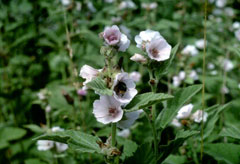
 |
|
(c) 2010 Ken Fern, Plants For A Future |
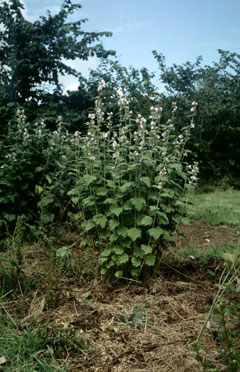 |
| (c) 2010 Ken Fern, Plants For A Future |
Translate this page:
Summary
Physical Characteristics

 Althaea officinalis is a PERENNIAL growing to 1.2 m (4ft) by 0.8 m (2ft 7in).
See above for USDA hardiness. It is hardy to UK zone 3 and is not frost tender. It is in flower from July to September, and the seeds ripen from August to October. The species is hermaphrodite (has both male and female organs) and is pollinated by Bees. The plant is self-fertile.
Suitable for: light (sandy), medium (loamy) and heavy (clay) soils. Suitable pH: mildly acid, neutral and basic (mildly alkaline) soils and can grow in saline soils.
It cannot grow in the shade. It prefers dry or moist soil.
UK Hardiness Map
US Hardiness Map
Synonyms
Althaea sublobata. Althaea taurinensis. Althaea vulgaris. Malva officinalis.
Plant Habitats
Cultivated Beds;
Edible Uses
Edible Parts: Leaves Oil Root
Edible Uses: Egg Oil Tea
Leaves - raw or cooked[2, 4, 100]. They are used as a potherb or to thicken soups[62, 183]. When used as a small proportion with other leaves, the taste and texture is acceptable, but if a lot of the leaves are cooked together their mucilaginous texture makes them unpalatable[K]. The leaves can be eaten raw but are rather fibrous and somewhat hairy, though the taste is mild and pleasant[K]. We have found them to be quite acceptable in salads when chopped up finely[K]. Root - raw or cooked[61]. When boiled and then fried with onions it is said to make a palatable dish that is often used in times of shortage[4]. The root is used as a vegetable[62, 141, 183], it is also dried then ground into a powder, made into a paste and roasted to make the sweet 'marshmallow'[4, 5, 7, 17, 61]. The root contains about 37% starch, 11% mucilage, 11% pectin[254]. The water left over from cooking any part of the plant can be used as an egg-white substitute in making meringues etc[62]. The water from the root is the most effective[183], it is concentrated by boiling until it has a similar consistency to egg white. A tea is made from the flowers[183]. A tea can also be made from the root[183].
References More on Edible Uses
Medicinal Uses
Plants For A Future can not take any responsibility for any adverse effects from the use of plants. Always seek advice from a professional before using a plant medicinally.
Antidiarrhoeal Antitussive Demulcent Diuretic Emollient Laxative Odontalgic Urinary
Marsh mallow is a very useful household medicinal herb. Its soothing demulcent properties make it very effective in treating inflammations and irritations of the mucous membranes such as the alimentary canal, the urinary and the respiratory organs[4, 254]. The root counters excess stomach acid, peptic ulceration and gastritis[254]. It is also applied externally to bruises, sprains, aching muscles, insect bites, skin inflammations, splinters etc[4, 238]. The whole plant, but especially the root, is antitussive, demulcent, diuretic, highly emollient, slightly laxative and odontalgic[4, 17, 21, 46, 165]. An infusion of the leaves is used to treat cystitis and frequent urination[254]. The leaves are harvested in August when the plant is just coming into flower and can be dried for later use[4]. The root can be used in an ointment for treating boils and abscesses[254]. The root is best harvested in the autumn, preferably from 2 year old plants, and is dried for later use[238]. The German Commission E Monographs, a therapeutic guide to herbal medicine, approve Althaea officinalis Marsh Mallow for irritation of mouth and throat and associated dry cough/bronchitis (Root and leaf), mild stomach lining inflammation (root) (see [302] for critics of commission E).
References More on Medicinal Uses
The Bookshop: Edible Plant Books
Our Latest books on Perennial Plants For Food Forests and Permaculture Gardens in paperback or digital formats.
Edible Tropical Plants
Food Forest Plants for Hotter Conditions: 250+ Plants For Tropical Food Forests & Permaculture Gardens.
More
Edible Temperate Plants
Plants for Your Food Forest: 500 Plants for Temperate Food Forests & Permaculture Gardens.
More
More Books
PFAF have eight books available in paperback and digital formats. Browse the shop for more information.
Shop Now
Other Uses
Adhesive Fibre Oil Teeth
The dried root is used as a toothbrush or is chewed by teething children[6, 7]. It has a mechanical affect on the gums whilst also helping to ease the pain. The root is also used as a cosmetic, helping to soften the skin[7]. A fibre from the stem and roots is used in paper-making[46, 61, 74, 115]. The dried and powdered root has been used to bind the active ingredients when making pills for medicinal use[268]. A glue can be made from the root[74]. The root is boiled in water until a thick syrup is left in the pan, this syrup is used as a glue. An oil from the seed is used in making paints and varnishes[74].
Special Uses
Food Forest
References More on Other Uses
Cultivation details
Succeeds in almost any soil and situation[1, 4, 200], though it prefers a rich moist soil in a sunny position[4, 200]. It also tolerates fairly dry soil conditions[1]. Plants are hardy to about -25°c[187]. Marsh mallow is often cultivated in the herb garden, as a culinary and medicinal herb as well as for ornament[61]. Its roots were at one time the source of the sweet 'marsh mallow', but this sweet is now made without using the plant[4]. The plant is heat tolerant in zones 9 through 1. (Plant Hardiness Zones show how well plants withstand cold winter temperatures.
Plant Heat Zones show when plants would start suffering from the heat.
The Plant Heat Zone map is based on the number of "heat days" experienced in a given area where the temperature climbs to over 86 degrees F (30°C).
At this temperature, many plants begin to suffer physiological damage. Heat Zones range from 1 (no heat days) to 12 (210 or more heat days).
For example Heat Zone. 11-1 indicates that the plant is heat tolerant in zones 11 through 1.) For polyculture design as well as the above-ground architecture (form - tree, shrub etc. and size shown above) information on the habit and root pattern is also useful and given here if available. The plant growth habit is a clumper with limited spread [1-2]. The root pattern is a tap root similar to a carrot going directly down [1-2].
References Carbon Farming Information and Carbon Sequestration Information
Temperature Converter
Type a value in the Celsius field to convert the value to Fahrenheit:
Fahrenheit:
The PFAF Bookshop
Plants For A Future have a number of books available in paperback and digital form. Book titles include Edible Plants, Edible Perennials, Edible Trees,Edible Shrubs, Woodland Gardening, and Temperate Food Forest Plants. Our new book is Food Forest Plants For Hotter Conditions (Tropical and Sub-Tropical).
Shop Now
Plant Propagation
Seed - sow spring or autumn in a cold frame. The seed is best sown as soon as it is ripe in late summer, the germination is often erratic[238]. Stratification can improve germination rates and time. Prick out the seedlings into individual pots when they are large enough to handle and plant them out in the summer[K]. Division in spring or autumn. Fairly easy, it is best to pot up the divisions in a lightly shaded position in a cold frame or greenhouse until they are growing away well and then plant them out into their permanent positions. Root cuttings in December.
Other Names
If available other names are mentioned here
Native Plant Search
Search over 900 plants ideal for food forests and permaculture gardens. Filter to search native plants to your area. The plants selected are the plants in our book 'Plants For Your Food Forest: 500 Plants for Temperate Food Forests and Permaculture Gardens, as well as plants chosen for our forthcoming related books for Tropical/Hot Wet Climates and Mediterranean/Hot Dry Climates. Native Plant Search
Found In
Countries where the plant has been found are listed here if the information is available
Weed Potential
Right plant wrong place. We are currently updating this section.
Please note that a plant may be invasive in one area but may not in your area so it’s worth checking.
Conservation Status
IUCN Red List of Threatened Plants Status :

Growth: S = slow M = medium F = fast. Soil: L = light (sandy) M = medium H = heavy (clay). pH: A = acid N = neutral B = basic (alkaline). Shade: F = full shade S = semi-shade N = no shade. Moisture: D = dry M = Moist We = wet Wa = water.

Expert comment
Author
L.
Botanical References
17200
Links / References
For a list of references used on this page please go here
Readers comment